EYES BENEATH
THE SHIPPING LANES
A founder’s Fieldbook · 3 November 2026 · Seah Ying Cong
Imagine an engineer opening yesterday’s seabed survey beside the previous one. A cable has become exposed. A patch of sediment has moved. She can see where the evidence is strong, where it is missing, and which change deserves a closer look. A small robot has made a hidden piece of infrastructure easier to maintain.
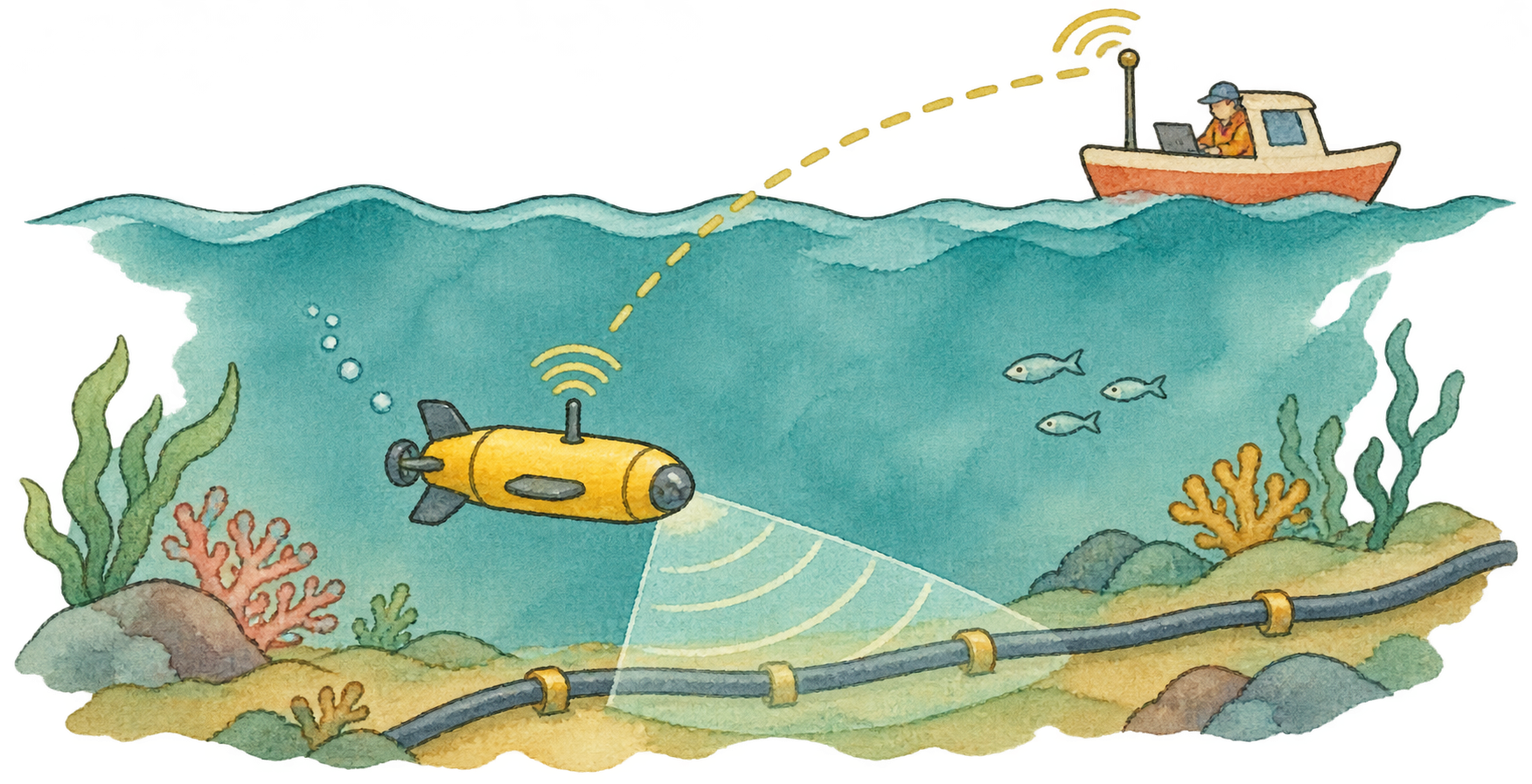
I want that capability to become ordinary. My starting hypothesis is a Singapore-based inspection service selling repeat, permissioned cable-corridor comparisons through an established survey contractor. Begin with equipment we can buy or partner for. Build proprietary autonomy only when accepted work exposes a bottleneck worth owning.
01 · Protection begins with the actual failure
A broken cable does not tell us why it broke
For people relying on an island’s connection, the distinction between an accident and an attack does not restore service. Chunghwa Telecom’s account of the two Matsu cable breaks in February 2023 describes microwave fallback preserving some services while other traffic became congested. It supports a tangible resilience problem, rather than total communications loss or an established state-directed attack. Operator statement
The global baseline should discipline the security story. ICPC estimates 150–200 telecom cable faults annually, with 70–80% caused by accidental human activity, chiefly fishing and anchors. It holds no state-sabotage data and says, anecdotally, it knows of no verified state-sponsored case since World War II. It puts deliberate damage and incidents of unverifiable intent at less than 1% of global damage annually. These are attributed industry estimates, not findings about every incident. ICPC FAQ
NATO’s 14 January 2025 Baltic Sentry announcement expresses a different institutional concern: protection through frigates, patrol aircraft, surveillance integration and naval drones. It does not identify an underwater inspection purchase for a new company. Both perspectives matter; neither turns a damaged cable into a ready customer. NATO announcement
My inference is that a founder should start with an owner’s consequential maintenance decision. Protection, attribution, repair and condition inspection are different products.
02 · Singapore is a starting place, not a market calculation
Infrastructure stock must become permissioned, paid work
IMDA’s 2023 Digital Connectivity Blueprint seeks to enable a doubling of cable landings over ten years. That is a capacity ambition, not a count of completed installations or a survey revenue forecast. IMDA blueprint, original report
I would use Singapore as the proposed learning base: find an owner, its survey engineer and a contractor willing to compare complete jobs. I have not established a recurring local survey budget, purchasable data access or an underserved corridor.
The commercial denominator narrows at every step: infrastructure exists; a particular sensor can observe useful features; the owner permits access; a suitable operating window exists; the evidence is accepted; the owner pays enough to cover the whole job. Only the last step funds the company.
Cable-deployment guidelines describe multiple approvals and designated landing sites. They do not automatically define every inspection operator’s obligations. MPA’s hydrographic-survey form also establishes a permission route, rather than blanket autonomous-vehicle clearance. The owner, marine authorities and insurer must agree the actual operation. Deployment guide, survey application
Regional expansion repeats that work. A Singapore base does not confer access to Taiwan’s waters, customers or naval programmes.
03 · Why autonomy matters underwater
The robot must make useful decisions between messages
A remotely operated vehicle can carry a tether for power and data. An autonomous underwater vehicle carries a mission and makes local decisions. Neither architecture is universally superior; the tether changes communications and recovery constraints, while untethered operation changes what must work onboard.
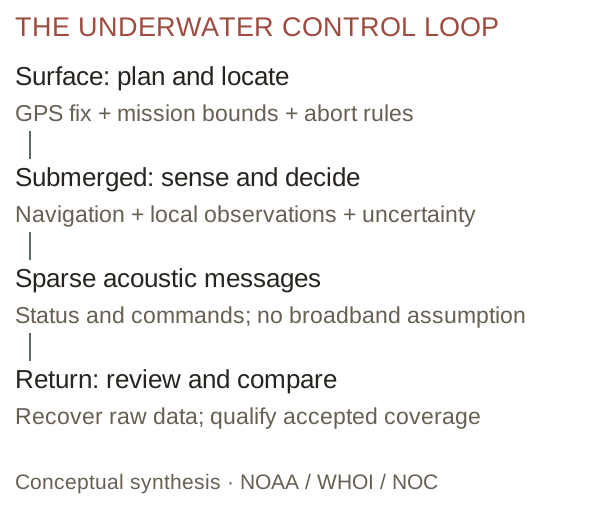
Sound travels through seawater at roughly 1,500 metres per second. A hypothetical 1,500-metre acoustic path therefore takes about one second one way, before transmission and processing delays. This is propagation arithmetic, not a universal end-to-end link measurement. NOAA sound-speed explanation
WHOI’s Micromodem documentation lists 80–5,400 bits per second packet rates and distinguishes them from useful system throughput. That is a specific modem example, not an industry-wide ceiling. It is enough to show why an ordinary broadband video-control assumption is unsafe. WHOI documentation
The promising AI job is bounded: interpret local observations, maintain a useful route, recognise uncertainty, and execute a safe return or abort policy when the link disappears. A larger model earns its place only if it improves those measured outcomes.
04 · Where am I, and what did I actually inspect?
Navigation uncertainty becomes evidence uncertainty
A robot needs a position estimate before it can tell an owner that a particular feature changed. Surface GPS can initialise or correct a mission; submerged navigation combines other instruments and references. NOAA describes surface fixes and inertial navigation, while NOC describes acoustic positioning and seafloor mapping where GPS cannot penetrate. NOAA REMUS account, NOC vehicle overview
An inertial system estimates motion from measured acceleration and rotation. Acoustic references or observations of the seabed can help constrain where that motion has taken the vehicle. The resulting position still has uncertainty. A comparison report should carry that uncertainty into its claim about change.
My proposed product would distinguish a newly observed object from an apparent displacement caused by inconsistent registration between surveys. It would retain source observations, calibration context, missing segments and review decisions. These are design requirements, not capabilities demonstrated here.
Distance travelled is a poor success metric. The useful denominator is route distance accepted under a specified sensing, coverage and positional-uncertainty agreement. Unobserved sections remain unobserved even when the robot’s track passes through them.
05 · Choose what the instruments can see
A cable corridor is not the cable’s complete health record
My proposed first scope is repeat change detection on permissioned shallow-water corridors: newly exposed cable where observable, seabed disturbance and visible free spans. A free span is a section unsupported by the seabed. The owner’s engineer must define which changes matter and how confidently they must be located.
Sonar can observe seabed geometry; optical evidence depends on visibility. A buried cable needs appropriate additional sensing before we promise burial-depth information. Internal electrical condition and cable repair are outside this first offer. The sensor package must follow the question, rather than the founder’s favourite robot. This envelope is a proposed application of the documented survey architectures. Kongsberg HUGIN
A 2026 cable-following preprint reports visual inspection of up to 59% of a 120-metre test cable, with tracking loss and reacquisition. That is a small, specific field result; the percentage is neither detection accuracy nor the industry’s capability ceiling. It makes a valuable point: robot motion and completed inspection have different denominators. Authors’ preprint
Before selecting equipment, I would agree depth, current, visibility, standoff, positional uncertainty, change classes, missing-data treatment and recovery limits. No universal “inspection-grade accuracy” replaces that contract.
06 · The expensive machine may be above the water
Saving computation is useful only when it changes the job
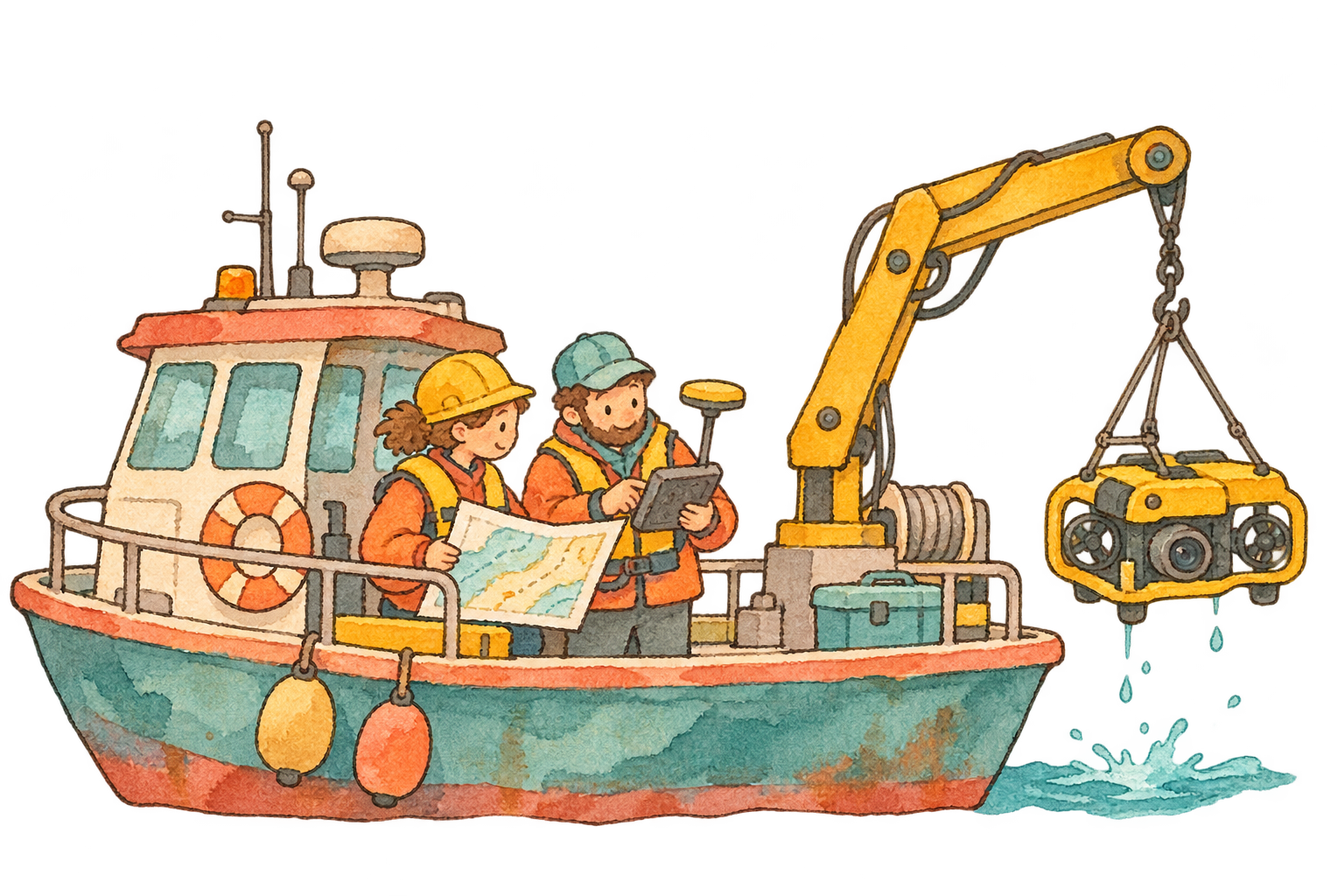
A capable robot still needs to reach the site, enter the water, recover safely and produce a reviewed deliverable. Weather, standby, mobilisation, crew time, permissions and repeat attempts belong in the cost of the inspection. The model below treats these as explicit assumptions rather than absorbing them into a robot price.
A resident vehicle that docks underwater could change the logistics. Saab Seaeye’s Sabertooth describes docking, charging and data transfer. The dock also becomes infrastructure to install and maintain; its existence does not establish a cheaper campaign in the corridor we want. Saab resident architecture
I would ask a narrow operational question after every proposed improvement: which charged day, revisit or review task disappears, and who confirms that it disappeared? Faster onboard inference may be valuable, but an unchanged charter and unchanged acceptance process produce unchanged costs in this model.
Safe recovery after communications loss is part of the proposed experiment. It is not a claim that local autonomy already permits unattended operation.
07 · Sell a comparison an engineer can act on
Begin with the service boundary we can test
The candidate customer is the cable owner or consortium’s marine-maintenance budget holder. The accepting party is its competent survey or asset engineer. The first channel is an established marine survey contractor with operating competence, vessel access and a customer relationship. These are buyer hypotheses; no interviews or paid scopes have validated them.
The deliverable would combine a georeferenced comparison with raw sonar or imagery, coverage, uncertainty and change adjudication. It should help the owner decide whether to investigate, intervene or accept that a segment remains unresolved. It should never silently translate “no observation” into “no change.”
The contractor route can reduce the founder’s entry burden, while leaving the contractor with pricing power and possibly the customer and data relationship. The company needs repeat revenue and rights to reuse relevant learning. Neither follows automatically from processing the survey.
I would pay for an incumbent comparison before commissioning a new vehicle. If the owner can buy the result acceptably today, partnership may be the right company. If no differentiated outcome survives that comparison, I would stop this wedge. The opportunity is conditional synthesis of the existing offers, not an observed gap. BeeX workflow, EIVA inspection precedent
08 · The incumbents already know the sea
“Nobody is doing this” fails in Singapore itself
BeeX advertises autonomous capture through georeferenced reporting. DSTA’s 6 October 2025 announcement confirms a MINDEF acquisition contract and co-development involving its hover-capable autonomous underwater vehicles. That establishes a local supplier and a buyer relationship, without disclosing its margins or proving performance on our proposed job. BeeX, DSTA announcement
| Alternative | Capability already offered | The entrant’s test |
|---|---|---|
| Kongsberg HUGIN | Integrated multi-sensor autonomous survey | Can purchased capability deliver the same scope? |
| Saab Seaeye Sabertooth | Hybrid autonomous/remotely operated and resident architecture | Does the dock-inclusive job actually cost less? |
| EIVA and survey partners | Onboard inspection and survey workflow | Is repeat comparison already adequately solved? |
| Oceaneering | Established subsea service delivery | Can a small operator match acceptance and recovery? |
| Exail | Navigation and integrated maritime robotics | Is there a specific unresolved integration problem? |
These are offer comparisons, not a performance ranking. HUGIN, Sabertooth, Exail results
EIVA reports a commercial unmanned inspection of 175 kilometres of Equinor pipeline using a HUGIN AUV and SEA-KIT surface vehicle. That participating-supplier account is meaningful precedent, not a disclosed invoice or proof of transferable telecom performance. Project account
09 · A profitable campaign can hide a losing company
The model is a question generator, not a price list
All values on this card are invented USD planning inputs or their arithmetic, as of the research date. None is a quote, forecast or market benchmark. The model describes a possible future owned operating cell; initial validation uses a bought service or partner stack. Reproducible model
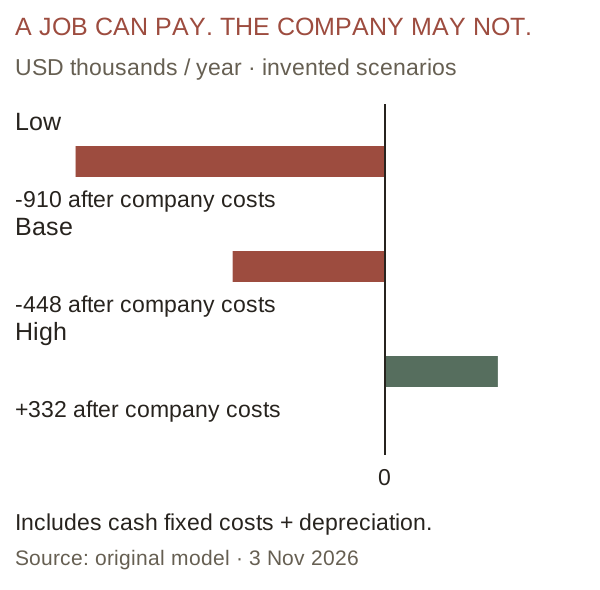
For an assumed 20 accepted kilometres, the base captures 8 kilometres per survey day at 90% acceptance yield: round up to 3 survey days, then add 1 standby and 1 mobilisation day. At $4,000 vessel plus $2,000 survey/robot crew per day, and $9,000 other campaign charges, variable cost is $39,000. Revenue at $3,000 per accepted kilometre is $60,000, leaving $21,000 before annual fixed costs. Scenario arithmetic
Assume 12 campaigns annually, $600,000 cash fixed costs and $100,000 depreciation: annual economic contribution is −$448,000. Base economic break-even needs 34 campaigns, versus an assumed scheduling ceiling of 44. Capacity is not customer demand. Model
10 · The charter assumption can overturn the thesis
Stress the least grounded cost before optimising the robot
The model’s $4,000 vessel day is uncalibrated and potentially optimistic. Holding other base inputs constant, doubling it to $8,000 raises campaign cost to $59,000 and leaves $1,000 contribution. Annual economic contribution falls to −$688,000. Break-even would require 700 campaigns, far beyond the assumed 44-campaign capacity. Original stress model
At $12,000 per vessel day, campaign cost becomes $79,000, contribution is −$19,000, and annual economic contribution is −$928,000. More identical work deepens the loss. These multipliers are stresses, not claims about prevailing charter rates. Model
The less dramatic sensitivities also matter. An extra standby day lowers base annual economic contribution to −$520,000; halving capture throughput lowers it to −$664,000; doubling annual demand still leaves −$196,000. Each changes only the named input. Model sensitivities
The research priority follows directly: obtain comparable charter terms, including standby, mobilisation, cancellation and recovery obligations. Then measure the full time to accepted output. A compelling robot demonstration cannot calibrate any of those costs.
11 · Mature margins are evidence of a business, not our margin
Keep segment accounting, job contribution and cash separate
Oceaneering reported Subsea Robotics revenue of about US$233 million, 32% operating margin, 65% ROV utilisation and US$11,781 ROV revenue per utilised day for the quarter ended 30 September 2026. The segment includes more than the ROV rate metric, and corporate unallocated expenses sit separately. This is evidence of mature value capture; it is not a vessel-inclusive Asian AUV price or a startup margin. Q3 filing
The founder must finance the gap between buying work and collecting payment. In the original base scenario, 90-day receivables imply about $177,534 tied up in invoices. Adding $300,000 equipment capex and $300,000 for half a year of fixed cash expenses gives about $777,534. That is an incomplete cash inventory, not a sufficient financing plan: ramp losses, tax, financing, deposits and extreme events are excluded. USD scenario model
An uninsured replacement of the assumed $300,000 vehicle plus a lost $21,000 campaign contribution makes the base economic result −$769,000. That is an incremental cash-at-risk stress beside an economic metric, not actuarial loss or accounting guidance. The small model reserve does not establish adequate insurance. Loss stress
12 · Defence is a different company-building path
A programme sponsor matters more than a contract headline
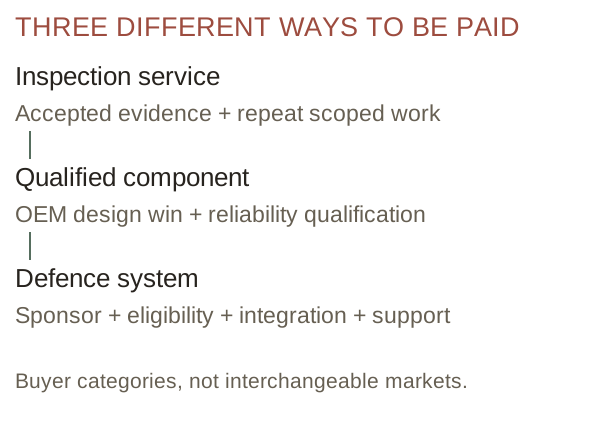
Australia’s September 2025 Ghost Shark announcement committed A$1.7 billion to delivery, maintenance and continued development over five years, after about A$140 million invested since 2022. It does not disclose a usable unit price or establish cheap attritable economics. I would not divide the headline by an assumed fleet count, or substitute a Dive-XL price. Australian Defence announcement
DIU’s small-UUV account gives a real prototype-to-production precedent with HII: a US$10.7 million prototype award and US$347.8 million transition ceiling dated 28 September 2023. A ceiling is not collected revenue or evidence of an open solicitation today. DIU programme account
Defence is possible; BeeX is a local counterexample to blanket pessimism. It also demands eligibility, testing, integration and support. GAO records roughly five years of delay on the much larger Orca prototype programme, associated with materials and pressure-vessel construction. That does not forecast a small inspection service, but it makes naval-first capital risk concrete. GAO audit, programme pages 159–160
13 · Adjacent demand is real, but not interchangeable
Wind, components and civil inspection have different acceptance tests
Offshore-wind cable losses can be severe without dominating claim frequency. The JNRC bulletin’s AXIS cohort, with loss dates January 2021–September 2025, assigns 57% of claims by count to turbines, 14% to inter-array cables and 6% to export cables; average export-cable claim size is US$18.8 million. Those figures do not establish fleet-wide failure rates or preventability by external imaging. 2026 claims bulletin
ORE Catapult’s page describes cables as the bulk of claims without that same cohort definition. I would preserve the difference rather than average incompatible headlines. ORE subsea cable work
A component company is another credible route. Kraken’s FY2025 results report C$102.2 million revenue, 62.1% gross margin, and C$30.3 million of capex and intangible purchases. Batteries, sonar and services contribute to a mixed business; these are not a new thruster or battery company’s unit economics. Kraken results
I would switch to a subsystem wedge only when an OEM identifies a missing capability, funds qualification and offers a credible design win. I would switch to wind only with an owner-defined external observation that changes an operational decision. Neither adjacent sector rescues unvalidated telecom demand.
14 · The strongest bear case
We build a survey subcontractor with an expensive research department
Owners may prefer burial, diverse routes, surface monitoring and repair readiness to another periodic survey. That is an unresolved substitution hypothesis. The cable sections we can observe may be too few; incumbent reports may already be good enough; the owner may buy too infrequently to fund a company.
The contractor may own the relationship and the data. Weather and traffic may fragment the available work. A vehicle loss may consume the contribution from many successful jobs. The founder then carries marine operating risk and robotics development cost while earning neither a service advantage nor reusable intellectual property. The negative base scenario makes that failure possible without any spectacular accident. Original model
Export and technical-access constraints also belong in company design. USML Category XX specifies controlled military submersible categories; Singapore’s guidance addresses controlled software and technology made available electronically or through foreign access. Civil intent alone does not classify a particular component. Actual origin, configuration, destination, end user and supplier terms require review. USML text, Singapore ITT guidance
Singapore’s announced control-list change takes effect 1 December 2026, after this research cutoff. Trials after that date need a refreshed classification review. Singapore Customs
15 · A conditional path of attack
Spend on the proof that unlocks the next commitment
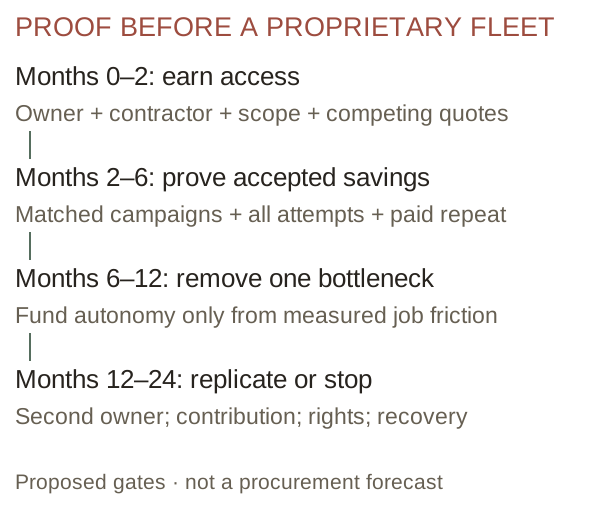
Months 0–2: the founder obtains historical job packs and competing proposals; a retained survey lead defines the observation and acceptance envelope; counsel checks access and classification. Buy the best available baseline before specifying new hardware.
Months 2–6: the survey lead compares matched campaigns, records every attempt and charges every relevant day. A customer engineer reviews changes and unresolved coverage. The commercial lead seeks paid repeat scopes and verifies collections. No free demonstration substitutes for a purchase.
Months 6–12: use logs to choose one repeated, removable cost. It might be reacquisition, review or recovery. Fund proprietary autonomy only when it can improve full cost per accepted kilometre at the same contracted quality. Retain the incumbent as a live comparator.
Months 12–24: replicate with another owner or site type only after renewal, contribution, data rights and recovery hold. Reassess permissions and export controls for the actual expansion. These are proposed time ranges and milestones, not demonstrated progress. Scenario assumptions and commercial limits
The defensible asset might become accumulated same-route learning and a dependable operating system for repeat surveys. That remains a hypothesis until contracts permit reuse and the learning demonstrably improves delivery.
16 · Let the first experiment stop the company
Define failure while conviction is still cheap
These are original screening thresholds, not regulatory standards or statistically sufficient safety certification. The founder and retained survey lead own them; no outreach or field experiment has occurred.
By day 45, I would require eight relevant owner/contractor interviews, three permissioned historical job packs and two independently priced alternatives. Continue only with an owner and contractor agreeing a paid comparison and data access. By day 60, agree coverage, uncertainty, critical changes, permissions, insurance and abort/recovery rules. Stop if useful eligible segments cannot be observed within an affordable existing stack. These counts and deadlines are founder-designed targets.
For the proposed days 60–120 comparison, seek six matched campaigns across at least two condition bands, subject to access. The hurdle is at least 20% lower full cost per accepted kilometre at equivalent agreed quality versus the best bought alternative, with no observed critical misses relative to the reference and explicit uncertainty and abstention. These are proposed decision rules; such a small screen cannot prove rare-event reliability.
By month 6, require two paid repeat scopes, collected payments under agreed terms and quote-backed break-even at feasible demand and capacity. These are proposed commercial gates. Stop hardware spending if they fail. The economic reason for requiring repeat work is visible in the original model.
The next action is concrete: assemble the historical scopes, full time logs, raw observations, accepted reports, invoices and competing quotes. The founder owns access; the survey lead owns comparability. A disconfirming result saves capital for a better company.
17 · What the headline omits
A hidden world deserves visible evidence
A naval drone announcement does not identify the paid inspection job. A long-range specification does not establish accepted coverage. A large insurance claim does not show that a robot could have prevented the failure. A positive campaign contribution does not fund the whole company.
The Baltic legal story also needs dates. In the Eagle S matter, the 27 August 2026 appellate decision reversed the earlier jurisdiction dismissal and remitted the case. That is a jurisdiction ruling, not a guilt verdict; later finality was not established in this research. I would not infer either state direction or current legal impunity from it. Finlex appellate summary
Evidence boundary: public primary materials and attributed supplier accounts, checked for a research cutoff of 3 November 2026. No buyer interviews, private fault records, quotes, local field measurements or paywalled contents support this thesis. Some optional pages remained blocked; they supply no numerical headline. Vendor descriptions establish offered capability, not independently verified performance. The scenario model labels every commercial input as invented.
My decision is to fund a bounded test of repeat corridor inspection, using existing systems through a competent partner. I would not yet fund a general AUV platform, an anti-sabotage patrol fleet or a naval vehicle programme.
What excites me is a future in which engineers can repeatedly see consequential changes in infrastructure that is presently hard to observe. Earn that future one accepted comparison at a time. If the buyer, instruments and full-job economics agree, the logs will tell us which robot capability deserves to exist next.