WIRING AGENTS
TO CREATORS
A founder's Fieldbook · 2 September 2026 · Seah Ying Cong
Picture a growth agent that has found a long list of creators worth talking to (an illustration, not a figure from the research). It can read their posts and draft something that sounds like a person. Then it hits a wall, because the place those creators actually answer, Instagram, will not let a business message a stranger through its official door.
My decision: should Switchboard, my multi-channel message layer, grow from WhatsApp into Instagram, and later LinkedIn, so that customers' agents can operate real messaging identities? My answer from the notes is a conditional yes for one narrow thing, a capped Instagram creator-outreach pilot, and a no for a broad platform or a LinkedIn connector. The evidence behind that is thin in places, and this book says where.
01 · A buyer wrote the spec
One named person offered money for exactly this job
On 30 May 2026 Cody Schneider, who builds agent infrastructure, publicly offered a $5,000 bounty and said he would be the first recurring customer for a reliable Instagram creator-outreach product. His linked brief reads like a purchase order: submit vetted profiles and a message, send paced first-touch DMs, track sent, failed, skipped and replied, and return events by API, webhook or export. His post, the brief
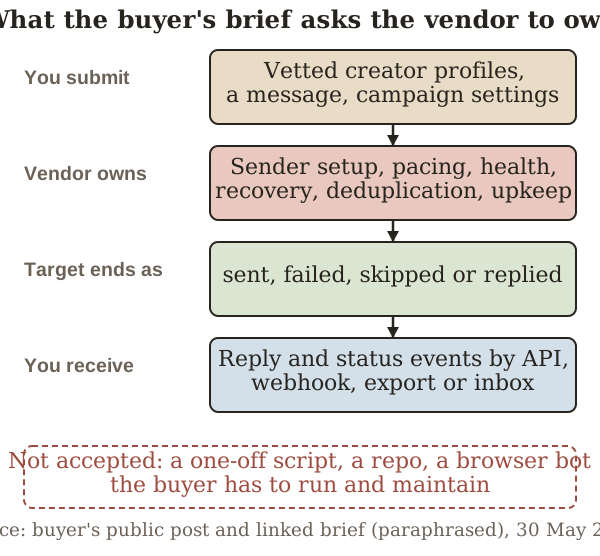
What he does not want matters most. He rejects a one-off script, a repo, or a browser bot he has to babysit. He wants a vendor to own sender setup, throttling, recovery and platform changes. His shorthand was “HeyReach for Instagram DMs.”
What this proves: one buyer, with money attached, specified the job. What it does not prove: that a second buyer exists. The post reached about 48.8K views, 88 replies and 602 bookmarks when my notes captured it, so the signal was public, yet the notes record no second buyer coming out of it. I could not re-open the post or the brief when I rebuilt this book (the X page returned a payment wall, the Notion page rendered empty), so these details rest on my dated notes, not a fresh read.
02 · The official door opens inward
Meta’s API will not start a conversation for you
Instagram’s own messaging API is built around the user speaking first. Meta’s developer documentation says conversations begin when an Instagram user messages the business, and a business can reply inside a window that is usually 24 hours, stretching to 7 days in a few cases. A professional account cannot use it for arbitrary cold first-touch DMs. Meta Instagram messaging docs

LinkedIn is similar in spirit. Its developer page says most permissions and partner programs need explicit approval, and only a few open permissions (sign-in, profile, email, posting) are self-service. LinkedIn API access
My inference, not a quoted fact: the job Cody wants therefore needs an authenticated account session, private web behaviour or browser automation. That likely sits uneasily with platform terms. I have not done a legal read of those terms.
03 · The plumbing is mostly built
Switchboard already does the hard single-user part
From my inspection of the repository, recorded in the notes, Switchboard can already start an Instagram conversation by handle, read and send messages, pull profile and feed context, log every event append-only, search it, expose MCP tools, and resolve one person across WhatsApp, Instagram and other channels. It also fails closed on the residential proxy used for private-web Instagram access.
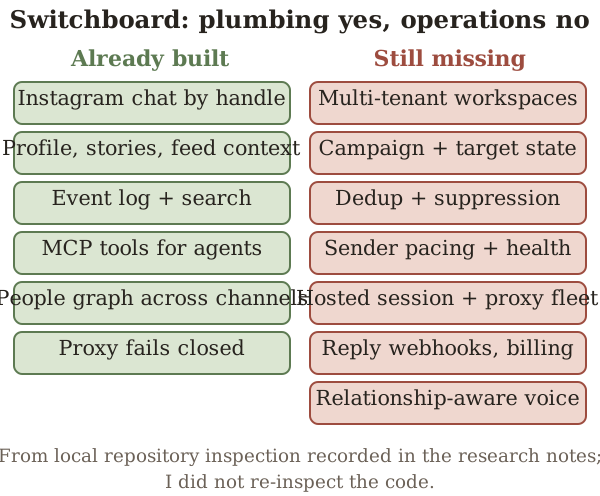
What is missing is not a transport. It is a product that holds state across days: workspaces, a campaign and target model, deduplication, suppression, pacing, sender health, a hosted session fleet, reply webhooks, billing, and someone on call. That is why a pilot, not a platform, is the right size.
04 · The product is the liability
Anyone can send a DM. Few want to own what happens next
If the official API cannot do it, every vendor in this space is operating an unofficial layer, and that layer breaks. One operator of a LinkedIn automation tool said that browser-cloud disconnects stopped campaigns and caused flags, bans, angry support and churn, and that moving to Unipile shifted support from broken accounts to setup questions. Operator’s post
This is one operator’s account, on LinkedIn, in a different architecture. It supports a narrow reading: session reliability drives support load and retention for tools like this. It does not tell me the failure rate for Instagram, or for Switchboard.
The gap I think is real: the market is less missing an endpoint than missing a vendor willing to carry the account-risk liability and answer the pager. That is an inference from the structure above.
05 · Everyone sells a slice
Prices tell you who is solving which part
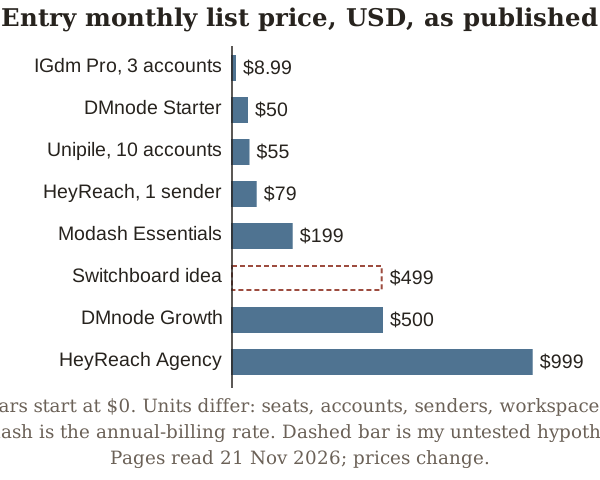
I re-read each pricing page on 21 November 2026. Unipile sells one API across LinkedIn, WhatsApp, Instagram and Telegram (it says LinkedIn, WhatsApp and Instagram work through reverse engineering), from about $55 a month for 10 accounts, then $5.50 an account up to 50. HeyReach sells managed LinkedIn sending from $79 a sender. IGdm Pro is an $8.99 desktop app. DMnode sells API-first Instagram campaigns at $50 and $500. Modash sells creator discovery and email workflow at $199 and up on annual billing. Unipile, HeyReach, IGdm, DMnode, Modash
| Product | What it sells | Why it does not fully answer the job |
|---|---|---|
| Unipile | Horizontal transport, four channels | Customer still owns campaign logic, pacing, voice |
| DMnode | Instagram campaigns shaped like the brief | Brand new; no public proof of reliable production use; its terms say availability and delivery are not guaranteed |
| IGdm Pro | Local bulk-DM app | Customer runs the machine and carries recovery |
| HeyReach | Managed LinkedIn outreach, API and MCP | LinkedIn only |
| Modash | Creator CRM, email outreach | Different transport; shows buyers already spend |
06 · A copyable surface needs a deeper moat
DMnode appeared three days after the bounty
Cody posted on 30 May. DMnode announced itself on 2 June as API-first Instagram outreach for agents, with dry runs, suppressions, sender capacity, approval gates, reply routing, MCP and webhooks. DMnode launch post That launch post drew very little attention (74 views when my notes observed it), so I read it as proof the feature list is easy to copy, not as proof of a competing business.

So the POST /campaigns shape is not a moat. The only durable edge I can imagine is slower to build: a log of how sessions break and get repaired, sender-health history, per-channel safety rules, and a relationship graph that spans channels. That is a hypothesis. Nothing in the notes shows Switchboard has accumulated any of it at campaign scale.
07 · Two markets hide in the listings
Software buyers and relationship-labour buyers want different things
On 3 September 2026 my notes scanned live Upwork, Freelancer and PeoplePerHour listings. They split cleanly. One group buys software: an Instagram DM qualification system with resumable conversations and deterministic actions, an automation agency seeking a white-label partner, a brand paying $30 to $50 an hour for a managed UGC outreach campaign. The other group pays humans, as little as $5 to $6 an hour for an outreach assistant, and some explicitly reject bots or AI-heavy messaging.
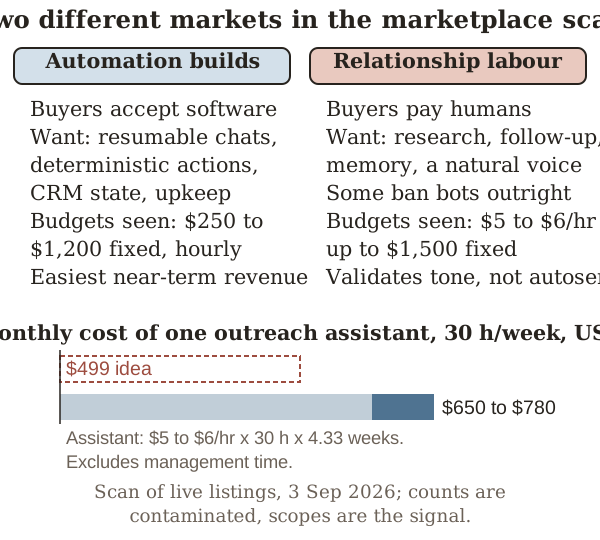
Two things follow. First, creator outreach is already bought as recurring labour, which is useful evidence that the pain is funded. Second, the human-approved framing is forced by the market: a pitch of “a bot replaces your relationship manager” meets a stated ban. These are snapshots of a few listings, perishable, and I did not re-open them.
08 · Voice is the bet that might not pay
Relationship-aware tone is the differentiator I cannot yet prove
Transport can be copied, so my notes make tone the experience differentiator. The idea is that a message is built from the relationship with this person, the sender’s persona, channel norms, the campaign goal and recent profile evidence, instead of a template with a name merged in.
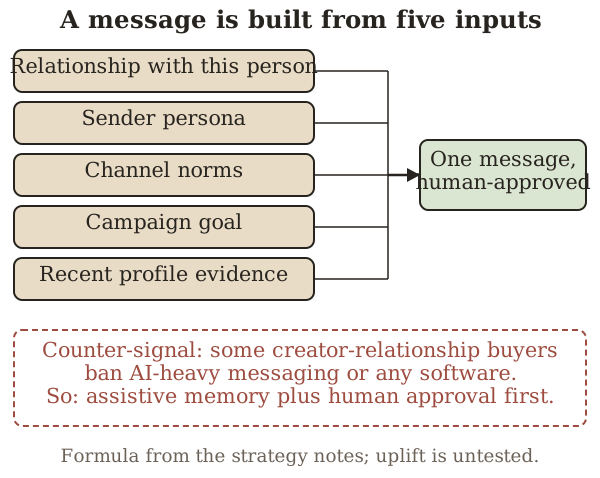
The risks are plain. More research and approval steps can erase the speed advantage. High-value creator-relationship buyers explicitly distrust AI-heavy writing. So the first version keeps a human approving each campaign, and I claim no reply-rate uplift until a blind comparison on a real campaign shows one. If it adds review burden without better replies, I demote voice to an optional layer.
09 · What the headline omits
A bounty is not a market
The headline is “a buyer offered $5,000.” The unflattering version is below.

| Risk, highest first | Why it matters |
|---|---|
| Fulfilment | Sender continuity, checkpoints, safe pacing, platform change |
| Trust | Will a customer connect a valuable real account? |
| Willingness to pay | One bounty is not a repeatable market |
| Differentiation | Does relationship-aware voice beat templates? |
| Retention | Do campaigns recur enough for a subscription? |
| Acquisition | Does open-source reach economic buyers, not only builders? |
Add that Cody explicitly rejects self-hosting while I personally prefer open tools, so the product has to separate customer-owned data from paid operations. And broadening to more channels adds a separate unofficial stack and a separate policy risk for each. Nothing here shows a customer, a payment or a retained user for Switchboard itself.
10 · The first ninety days
Package, probe, build the thin layer, run one live pilot
This card and the next four are my proposal, not findings. Only the scope limits come from the notes: one build cycle, one or two customer-controlled sender accounts, no full dashboard, a 14-day pilot window, up to 50 creators, human approval, and no promises about ban prevention, deliverability or reply rate.
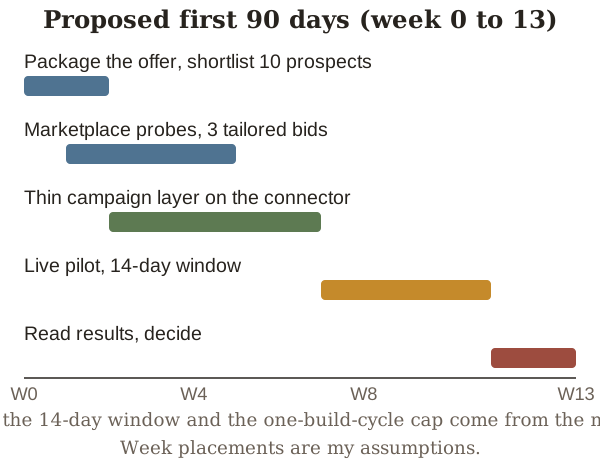
What I would build: a campaign endpoint or CLI, profile-aware first messages, deduplication and suppression, conservative pacing with a visible account-health state, a reply callback plus CSV export, and a minimal campaign table. Reuse the existing Instagram connector. Do not build LinkedIn, a general dashboard or a sender marketplace. In parallel, the notes propose three tailored marketplace bids as a cheap acquisition test: an Instagram qualification build, a managed UGC campaign and an agency partnership, each with one working demo clip and a disclosed-automation proposal. Owner for all of it is me; budget is not specified in the sources.
11 · Who I would ask, and for what
A named buyer type, a real account, a recurring fee
The best-fit customers in the notes are growth-agent builders, agency owners and UGC-heavy B2C teams that already have a vetted creator list, run recurring outreach and already use agents. Excluded: teams wanting creator discovery or a CRM, solo creators wanting cheap bulk DMs, and anyone who needs native LinkedIn before they can try Instagram.
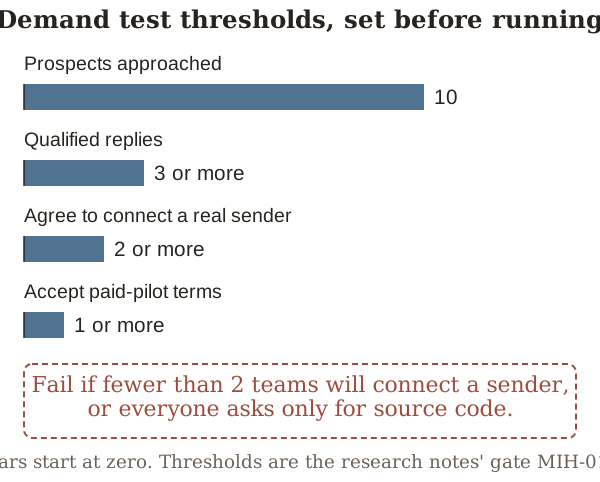
The ask is concrete: a real creator list and a connected sender, for a $500 paid pilot credited toward a first managed month. Reach is a short founder demo of an agent creating a campaign and receiving a live reply, plus individually qualified outreach to 10 prospects, with no paid traffic. Cody is the obvious first conversation, but his bounty only stands in for the price test if its terms are still current, and one buyer cannot validate the rest. I have not contacted anyone.
12 · Price, open core and the thin capital story
Charge for operations; keep the data plane open
The notes propose open-sourcing the data plane (event model, message store, MCP surface, people graph, connector interface and an export-and-revoke path) and charging for what customers do not want to own: hosted sessions and proxies, sender health and recovery, campaign execution, callbacks and support. The price hypothesis is $500 for the pilot, then $499 a month per managed workspace with one active sender and a capped volume.
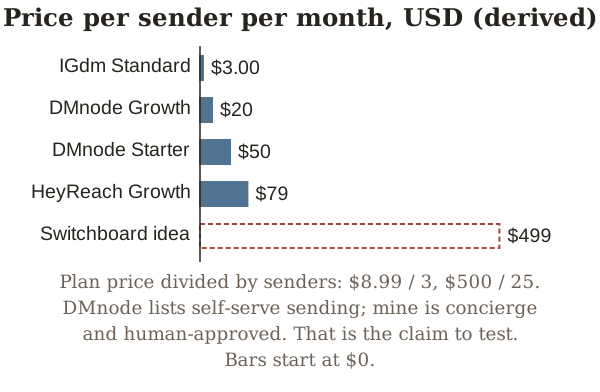
Read the chart as a warning. On a per-sender basis $499 sits far above every listed alternative, including DMnode’s $500 plan that lists 25 sender accounts. The justification, a concierge, human-approved, relationship-aware service, is exactly what the pilot must prove; the notes’ own alternative test is $200 to $500 a month.
Capital: not researched. The sources contain no cost model, no hosting or proxy cost, no support cost and no funding plan. The only revenue figures are the one-off $5,000 bounty, the $500 pilot and the $499 monthly price. I will not invent a cost base. The first job of the pilot is to measure the real cost of running one sender safely.
13 · Credibility, team and the legal gap
What a newcomer must learn, and what I did not research

Credibility would come from a working demonstration rather than a claim: a real campaign with a real reply, a public incident log, honest limits (no “ban-proof”, no “unlimited DMs”, no “official Meta integration”), and an export-and-revoke path customers can test. The open data plane is itself a trust device, although I have not tested whether customers care.
What I must learn: how Instagram checkpoints and session loss actually behave at campaign scale, safe pacing, proxy and session operations, and how creators react to automated outreach. Team: the notes name no hire or co-founder. A person who has run social-account infrastructure on call would be the gap, but that is my reading.
Legal and regulatory: not researched. The notes flag platform-policy and account risk, and the book assumes cold outreach through unofficial access likely breaches platform terms. I have not checked anti-spam, data-protection or marketing-consent rules in any country, so I make no claim about what is allowed. Personal payout: not modelled; the sources contain no founder-compensation or exit analysis.
14 · Gates and kill criteria
Four gates with numbers set before running, and one way to stop
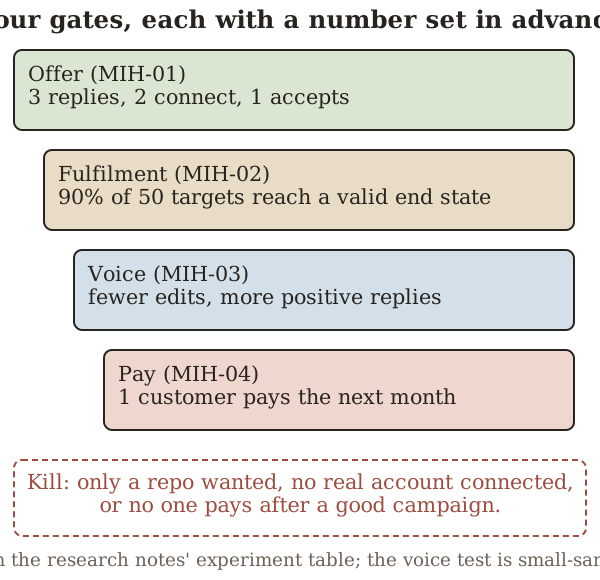

The numbers are staged. The offer gate asks that, of 10 prospects, at least 3 reply with a real campaign, at least 2 agree in principle to connect a sender, and at least 1 accepts paid terms. My overall bar for building further is stricter: two qualified teams connect real senders and submit real lists, and at least one commits to a recurring fee after a live campaign. At least 90% of eligible targets should reach sent or an explained safe skip, with no unplanned customer interventions and every reply delivered. Stop if teams only want a repo, refuse to connect real accounts, or will not pay a managed fee after a good campaign: then Switchboard stays personal and open-source infrastructure and I do not build the hosted outreach company. If every qualified buyer demands native LinkedIn, I would first consider a provider adapter, not native development. Cap the whole test at one build cycle, one sender and about 50 targets.
15 · Appendix: evidence, reconciliation and gaps
How the notes were reconciled, and what I re-checked
Dating: the book carries the research date, 2 September 2026. The marketplace scan is from 3 September, and the price and documentation re-checks were done on 21 November 2026, so the page mixes three dates.
The source folder held numbered files (00 to 05) and un-numbered duplicates. 04-decisions.md is a superset of decisions.md (it adds the 3 September marketplace decision), and 03-experiments.csv (four gate experiments) supersedes experiments.csv (four earlier tests with looser thresholds, such as a $200 to $500 price range). Where they differ I used the numbered files and say so above. Full reconciliation, the claim ledger and the execution path are in the internal dossier.
| Claim | Re-checked 21 Nov 2026? | Result |
|---|---|---|
| Meta: user must message first, window usually 24h | Yes, Meta developer docs | Confirmed (7 days in some cases) |
| LinkedIn: most permissions need approval | Yes | Confirmed |
| Unipile: four channels; reverse engineering; about $55 min, $5.50 per account | Yes | Confirmed (page lists EUR 49 / USD 55; it says Telegram uses an official API, which my notes had lumped in) |
| A developer’s “$275 for 50 accounts” | Arithmetic | $55 + 40 x $5.50 = $275, consistent |
| HeyReach $79 per sender, $999 for 25 senders | Yes | Confirmed |
| IGdm $8.99 for 3 accounts, $19.99 unlimited | Yes | Confirmed (a $29.99 tier also exists) |
| Modash $299 to $599 monthly | Partly | Page states annual-billing $199 and $499; monthly figures implied, not stated |
| DMnode $50 and $500, terms disclaim delivery | Yes | Confirmed |
| Cody’s $5K bounty and brief; Notion spec | No | X returned a payment wall, Notion rendered empty |
| DMnode launch date, Salesrobot and Anuj posts | No | Not re-opened |
| Upwork, Freelancer, PeoplePerHour listings | No | Perishable; not re-opened |
| Switchboard capabilities | No | First-party repo claims, not re-run |
Thin or absent in the sources: any second buyer; any Switchboard campaign, payment, activation or retention data; costs and funding; legal review; hiring plan; founder payout. What would disprove the thesis: the gate failures on the previous card.