THE TRUCKING FINANCE OS OPPORTUNITY
Own the receivable before you own the bank
A fieldbook on freight invoicing, AI collections, factoring, and the vertical-fintech wedge
Research edition · 28 August 2026
Seed: Eric’s X post · Independent operator investigation
Working thesis The insight is directionally right: trucking’s cash-flow pain begins in the load-to-invoice-to-payment workflow, not at the card. But this is not a greenfield neobank opportunity. Factoring, fuel cards, wallets, instant payouts, and back-office automation already exist. The viable wedge is a workflow-native receivables control plane that generates better underwriting evidence—and initially partners with a factor or bank rather than becoming one.
01 · The actual problem
A load is complete long before the cash arrives
The seed post proposes a neobank for logistics and trucking. Its operating sequence is concrete:
completed load → proof of delivery → invoice → broker / shipper submission
→ payment status and follow-up → reconciliation → cash available for fuel, payroll, insurance, maintenance, next load
The proposed software layer would generate invoices, collect and verify proof of delivery, submit to brokers and shippers, track outstanding receivables, automate AI payment follow-ups, and reconcile payment. Banking and credit follow underneath.
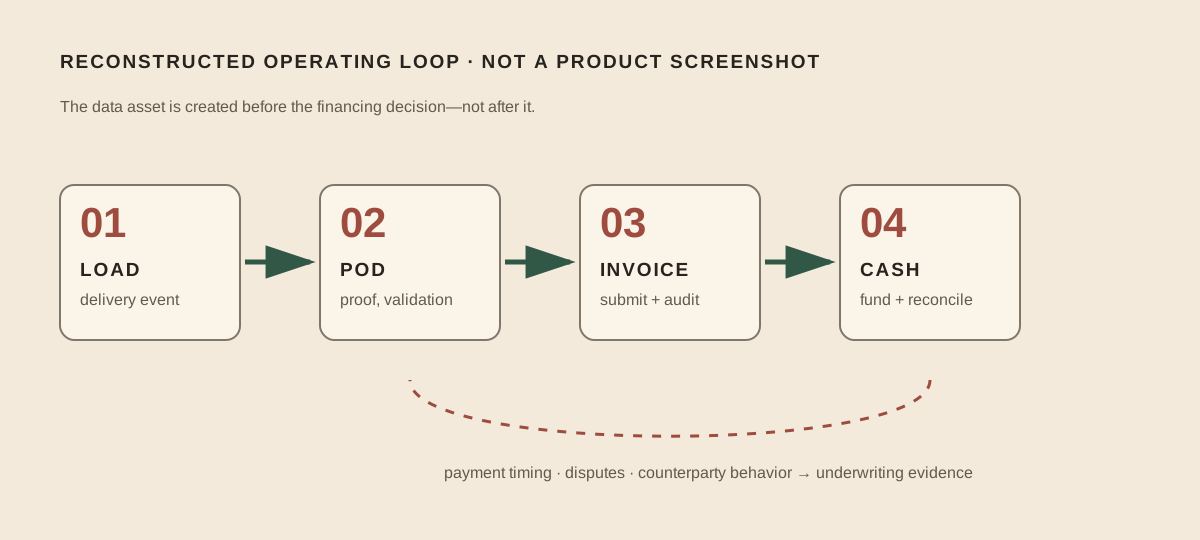
Evidence reconstruction. It translates the operations named in the seed post into a system boundary; it is not a claim that a single product currently performs every step.
That is a materially better starting point than a generic business card. It begins where the user feels pain every day: a completed job that has not yet turned into usable cash.
The product thesis is not “truckers need another bank.” It is “the company that sees a freight receivable become real can finance it more intelligently.”
02 · What is already built
The bundle exists. The missing layer must be narrower.
The market has already moved beyond fuel-only fintech. OTR Solutions publicly offers business banking, factoring, fuel credit, working-capital products, carrier payments, and back-office automation. It says it has processed more than 22M invoices and paid out more than $30B in invoices—company-reported figures, not an independent market census.
AtoB offers factors a digital wallet, instant payouts, fuel and expense cards, driver-pay features, telematics/GPS invoice validation, and a factoring-partner integration. Its own materials explicitly pitch instant funding plus payments and card monetization around the invoice.
| Incumbent capability | Evidence | Implication |
|---|---|---|
| Factoring + instant cash | OTR and AtoB both market invoice-linked, rapid payouts | “Get paid faster” alone is not a wedge |
| Fuel / expense card | AtoB and Coast sell transport-focused cards and controls | Generic card economics are competed away |
| Banking / wallet | OTR Clutch and AtoB Wallet | Deposits and payouts are an attach product, not unique differentiation |
| Back-office / invoice operations | OTR markets connected audit, AP, and AR; AtoB plugs into funding workflows | The hard fight is workflow adoption and data quality |
Sources: OTR Solutions · AtoB for Factors · Coast transportation.
03 · The scale of the incumbent problem
Triumph proves both the opportunity and the barrier
Triumph Financial’s 2025 10-K is the cleanest public counterweight to the seed post. It operates banking, factoring, payments, and intelligence products for brokers, shippers, factors, and carriers. Its Payments segment processed 33.6M invoices and paid carriers $40.517B in 2025. Its Factoring segment purchased $11.699B of invoices, with a $1,717 transportation average invoice; it says invoices are typically paid 30–60 days after delivery while carriers need immediate operating cash.
| Observed 2025 figure | What it establishes | What it does not establish |
|---|---|---|
| 33.6M invoices / $40.517B payments | Invoice workflow can create high-volume payment-network value | A new entrant can acquire the network |
| $11.699B invoices purchased | Factoring is already a major capital deployment business | Gross margin for a startup |
| $1,717 transportation average invoice | Tiny-ticket, repeatable operations are the real scaling challenge | Unit cost of automated versus manual review |
| 30–60 day carrier-payment gap | A real working-capital mismatch exists | A card alone solves it |
Triumph’s investor presentation further reported a roughly 1.29% average discount rate, around 10 annual portfolio turns, and a 14.3% yield on net funds employed as of 3Q25. Those are incumbent-reported metrics—not portable startup forecasts—but they make the gate clear: a new platform must either reduce cost-to-serve, improve loss/fraud outcomes, or acquire proprietary workflow distribution.
Sources: Triumph Financial 2025 10-K · Triumph investor presentation.
04 · Where the value could still accrue
The underwriting loop is the prize—not the card interchange
The proposed product has a defensible flywheel only if it makes the underlying receivable more observable and more collectible.
workflow adoption
      ↓
clean POD + invoice + broker/shipper + dispute + payment-time data
      ↓
better fraud checks, collection prioritization, and expected-payment model
      ↓
lower loss / faster funding / better credit terms
      ↓
more operating cash flows through the platform
      ↓
more workflow data
The economic claim must be tested, not asserted. A freight receivable is not automatically safe because an invoice exists: duplicate invoices, false proof of delivery, broker credit, disputes, payment routing, and concentration can all break the model.
Public evidence points in the same direction. AtoB describes telematics and GPS validation for invoice payouts. OTR’s FAQs describe invoice submission, broker follow-up, disputes, and payment status as part of the carrier problem. The question is whether a new entrant can capture more complete or better-timed data than the established factor already sees.
05 · The demand and supply map
Do not call every trucker the customer
| Segment | Cash-flow pain | Data accessibility | Initial fit |
|---|---|---|---|
| Owner-operator, spot market | High; limited admin bandwidth | Low to medium; fragmented documents and brokers | Medium |
| Small fleet with recurring brokers | High; repeat AR and payroll/fuel pressure | Medium to high | Strong |
| Mid-market fleet | Complex AP/AR and controls | High, but incumbent systems and sales cycle | Medium |
| Freight broker | Carrier-pay and working-capital pain | High | Strong, but a different buyer and risk model |
| Enterprise shipper | Long implementation cycle | High | Weak first wedge |
The first useful customer is likely a small fleet with repeat counterparties and an existing but painful invoice process. It has enough recurring volume for an automation loop, but not enough finance operations to build its own.
The buyer is not necessarily the driver. It may be the owner, dispatcher, or back-office operator who currently chases documents, submits invoices, fields broker questions, and waits for cash.
06 · Unit economics: the question behind the headline
“Software becomes distribution” only works if the financed receivable performs better
For one funded invoice, the simplified contribution stack is:
factor / credit revenue + payments / interchange revenue + software revenue
− cost of capital
− expected credit loss and fraud loss
− payment rails and card rewards
− collections and support
− acquisition, integrations, compliance, and servicing
= contribution
The card can improve retention and add revenue, but it does not cure credit losses. The underwriting advantage must show up in one or more measurable outcomes:
| Metric | Base measurement | Go signal |
|---|---|---|
| Time from POD to fundable invoice | Actual median / p90 | Material reduction without higher exception rate |
| Invoice acceptance and dispute rate | By broker/shipper cohort | Better prediction than factor’s existing rules |
| Days-to-pay forecast error | Absolute error by counterparty | Accurate enough to price and prioritize collections |
| Fraud / duplicate-loss rate | Loss per funded dollar | Lower than partner baseline after all review costs |
| Gross contribution per funded invoice | Revenue less capital, loss, rails, ops | Positive after human exception handling |
The public narrative omits cost of capital, recourse terms, loss reserves, fraud operations, licensing, and collection labor. Those are the business.
Sensitivity: a thin invoice fee can disappear quickly
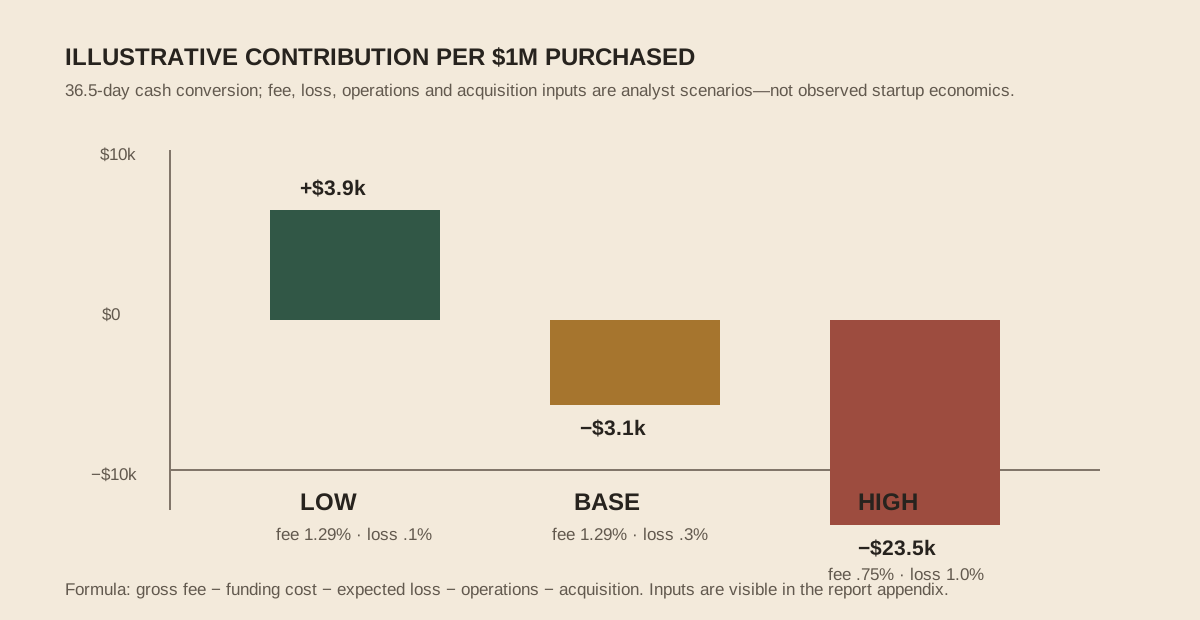
Using Triumph’s $1,717 average transportation invoice and its 1.29% disclosed discount-rate reference, the gross fee reference is $22.15 per invoice. The following is not Triumph’s economics and not a startup forecast. It is a deliberately transparent sensitivity for $1M purchased, assuming a 36.5-day cash-conversion period (10 turns/year) and using analyst assumptions for funding, loss, operations, and acquisition.
| Scenario | Gross fee | Funding cost | Expected loss | Ops + acquisition | Contribution |
|---|---|---|---|---|---|
| Low | $12.9k (1.29%) | $5.0k (5% annualized) | $1.0k (.1%) | $3.0k | +$3.9k |
| Base | $12.9k (1.29%) | $8.0k (8% annualized) | $3.0k (.3%) | $5.0k | −$3.1k |
| High | $7.5k (.75%) | $12.0k (12% annualized) | $10.0k (1.0%) | $9.0k | −$23.5k |
The chart intentionally treats the purchase discount as the entire gross revenue pool. Card interchange, payment fees, software fees, reserves, and recourse mechanics may improve or worsen the actual result; none may be silently assumed. The binding variable is not “AI collections.” It is whether the system produces enough verified signal to price capital and reduce exception-handling cost better than the incumbent network.
07 · What the headline omits
Cards are cheap distribution; verified receivables are the hard asset
Coast currently lists $4 per active user per month for its fleet-card platform, with 3–9¢/gallon partner-station rebates and 1% non-gas cashback. That is evidence of pricing pressure around the card/control layer. AtoB and OTR both market instant funding and wallet/payment products. The founder must not confuse an attractive financial-product bundle with a durable economic moat.
The hidden questions a serious lender, operator, or investor should ask are:
- Which document and counterparty fields are unavailable to Triumph, OTR, AtoB, broker TMSs, or the factor already?
- Does AI reduce human touch time on real invoices—including exceptions—or merely draft emails?
- Who bears fraud, dilution, credit, and recourse risk when a broker disputes a proof of delivery?
- How are the first 100 fleets acquired without buying them through uneconomic card rewards or financing subsidy?
- Can the workflow remain useful even if the financing partner changes?
Source for fleet-card pricing: Coast pricing. This is a product-page snapshot, not a full competitor price survey.
08 · The recommended wedge
Start as the receivables control plane, not a new bank
Product 1: invoice-to-cash operating system for one carrier cohort.
- Ingest load details, rate confirmation, proof of delivery, and invoice.
- Validate document completeness and detect duplicate or inconsistent fields.
- Submit to a defined set of brokers/shippers and track acknowledgement.
- Forecast payment date, prioritize follow-up, and preserve the communication trail.
- Reconcile the payout against the invoice and surface exceptions.
- Offer funding through a licensed factoring or banking partner only after the data loop works.
This sequencing avoids the highest-capital, highest-regulatory version of the idea while proving whether workflow data improves the economics. It also creates a credible integration wedge for existing factors—AtoB itself markets such a partner model—rather than assuming a new entrant must displace them immediately.
First sell: “we remove the admin work between delivery and cash.” Later sell: “our verified receivable lets you access faster, better-priced capital.”
09 · Falsification and 30-day test
The smallest credible experiment is operational, not financial
| Test | Owner | Time | Go / stop rule |
|---|---|---|---|
| Interview 15 small-fleet operators and 5 factoring operations staff | Founder | Week 1 | Go only if the same document / collection pain repeats across both sides |
| Process 100 invoices in a human-in-the-loop workflow | Ops + product | Weeks 2–3 | Go if ≥80% can be made submission-ready without manual rework beyond a defined threshold |
| Build broker/shipper payment-time and dispute baseline | Data | Weeks 2–3 | Go if counterparty-level variance is large enough to make forecasting valuable |
| Pilot follow-up and reconciliation with 3–5 fleets | Product | Week 4 | Go if time-to-submit or days-sales-outstanding improves without increasing exceptions |
Stop condition: if carriers will not switch or integrate before a financing promise, or if most invoice value depends on bespoke exception handling, the product is an operations-heavy service—not a scalable finance OS.
Confidence: medium. The workflow pain and competitive bundle are strongly evidenced; the claimed underwriting advantage, willingness to switch, and unit economics are hypotheses until real invoices are instrumented.
Appendix · Evidence ledger, provider boundary, and visual provenance
| Claim | Type | Source | Confidence | What would disprove it? |
|---|---|---|---|---|
| Seed post proposes freight-invoicing workflow before banking, then factoring/credit based on operating data | Fact | Canonical X post | High | Canonical post changes or is removed |
| OTR offers factoring, business banking, fuel, carrier payments, and back-office automation | Fact / company offering | OTR Solutions | High | Official site changes |
| OTR’s 22M-invoice and $30B-payout figures | Company claim | OTR Solutions | Medium | Independent reporting or revised disclosure contradicts |
| AtoB supports instant factor-funded wallet payouts, cards, and telematics/GPS invoice validation | Fact / company offering | AtoB for Factors | High | Official site changes |
| Workflow data can improve underwriting and loss outcomes | Hypothesis | Operator inference | Medium | Pilot fails to beat partner baseline after review cost |
| A workflow-first partner model is superior to forming a new bank initially | Recommendation | Economics and execution inference | Medium | Evidence that licensing/capital is not the binding constraint and incumbents cannot integrate |
Extended evidence ledger
| Claim | Type | Source | Confidence | What would disprove it? |
|---|---|---|---|---|
| Triumph processed 33.6M carrier invoices and paid $40.517B in 2025 | Fact | Triumph 2025 10-K | High | Amended filing or source error |
| Triumph purchased $11.699B of invoices at $1,752 average; transportation average was $1,717 | Fact | Triumph 2025 10-K | High | Amended filing or source error |
| 1.29% discount rate and ~10 turns are relevant reference points | Company-reported estimate | Triumph investor presentation | Medium | Updated company disclosure or non-comparable cohort definition |
Provider disagreement log
Gemini Deep Research was not connected in this workspace, so no Gemini brief exists and no Gemini-derived claim appears in this report. X, primary company pages, SEC filings, and web search were used as separate evidence routes. Company marketing claims were retained only where labelled; the conclusion relies on the SEC filing and visible product offers.
Visual evidence plan and provenance
| Visual | Role | Provenance / constraint |
|---|---|---|
| Cover watercolor | Editorial metaphor: delivery becomes cash | Original generated illustration; no third-party reuse |
| Invoice-to-cash loop | Explains the operator workflow in the seed post | Original SVG reconstruction; no measured performance claim |
| Contribution sensitivity | Shows which economics assumptions are binding | Original SVG model; all analyst inputs stated in nearby table |
Public/paywalled boundary
No paywalled source was accessed. The public record cannot tell us an entrant’s true acquisition cost, factor-partner take rate, fraud-loss distribution, counterparty concentration, or exception-handling labor. Those are exactly the measurements required before committing capital.
No paywalled source was used. Company claims are labelled as such. The fieldbook does not provide lending, legal, or investment advice.