PEPTIDE PROOF
A pharmacist should be able to follow the evidence all the way back.
A founder’s Fieldbook · 3 November 2026 · Seah Ying Cong
Imagine a pharmacist opening a quality record and finding something unusually useful: the original manufacturer, the received lot, who selected the sample, the methods and raw results, and the questions still unresolved. Every claim has a boundary. Every discrepancy has an owner.
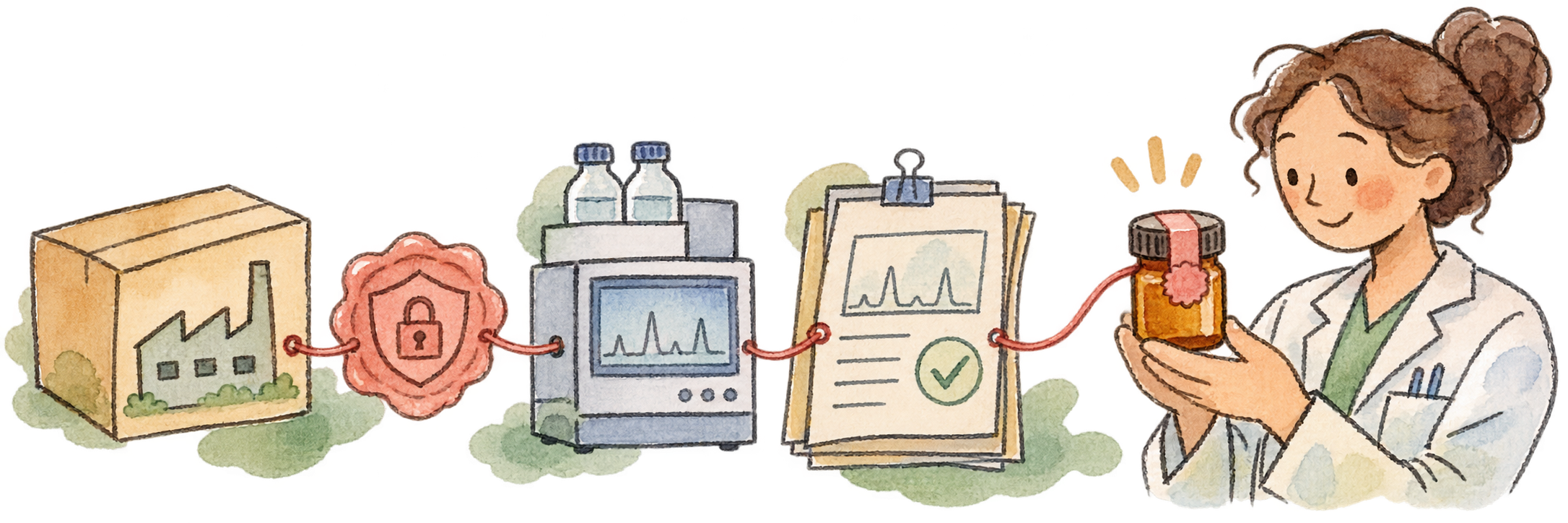
I would explore a company that makes this ordinary for a narrowly lawful peptide workflow. Start with buyer-controlled sampling, qualified laboratory partners and independent technical review. Earn accreditation for an owned laboratory only if repeat demand justifies it. Keep product sales outside the initial business.
The founder decision: can a pharmacy-paid evidence service become a trusted, profitable institution? That is a testable opportunity. A report cannot establish that an experimental treatment works, is appropriate for a patient, or is legally eligible.
01 · Attention is arriving before certainty
Search interest is a signal to investigate
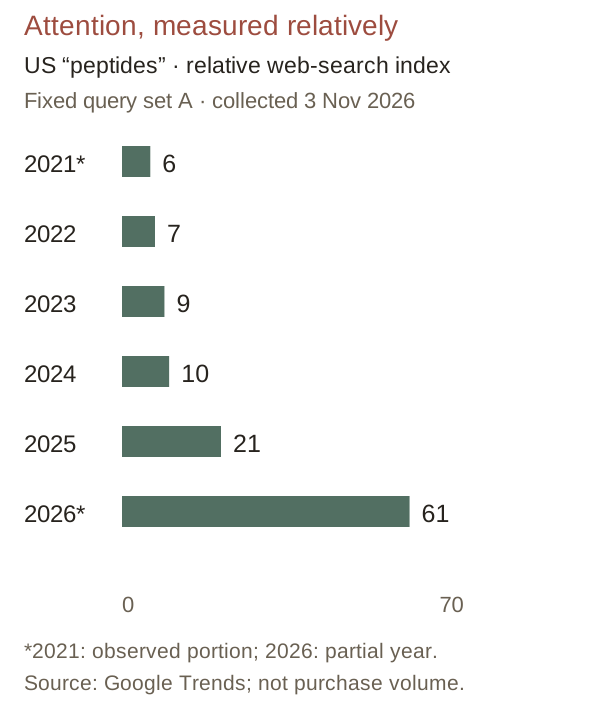
A dated Google Trends capture for this Fieldbook recorded average relative interest in “peptides” rising from approximately 6 in the observed 2021 window to 61 in partial 2026, with 21 in 2025. The comparison set was Ozempic, testosterone, peptides, loneliness and couples therapy. Skincare and nutrition searches belong to this broad term too. I read this as attention, not purchases or therapeutic demand. Google Trends, fixed query set
Finnrick reports more than 21,000 test requests from more than 8,000 people, in its stated February 2025–May 2026 dataset. Those are vendor-reported requests for free testing, not completed tests or paying pharmacy customers. Finnrick’s account
The exciting possibility is an institution that turns uncertainty into usable evidence. The missing commercial fact is whether a serious buyer will pay enough for that work.
02 · Begin with a molecule
“Pure” is a narrower word than it sounds
A peptide is a chain of amino acids. Its sequence, chemical form and condition matter to what it is. An analytical laboratory asks specific questions about a specific sample; the instrument does not pronounce on the whole product story.
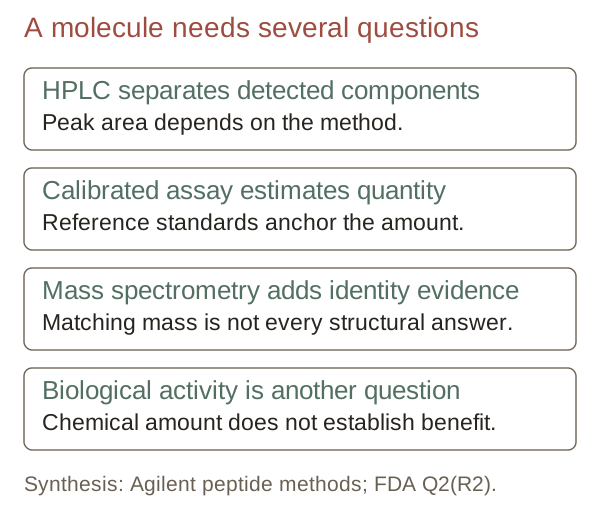
High-performance liquid chromatography, or HPLC, separates components detected under a chosen method. A dominant peak can support a purity measurement under that method. Its share of detected peak area is not automatically the amount of peptide in the container. Quantification requires an appropriate calibrated comparison. Mass spectrometry adds mass information; a mass match cannot resolve every structural ambiguity. Agilent peptide-analysis methods
I would ask for the method, reference standard, matrix, raw data and evidence that the procedure suits the intended decision. FDA’s analytical-validation guidance is a framework for that discipline. A chemical assay does not itself establish biological activity or patient benefit. FDA Q2(R2)
03 · There are several kinds of proof
A passing result cannot answer a question nobody tested
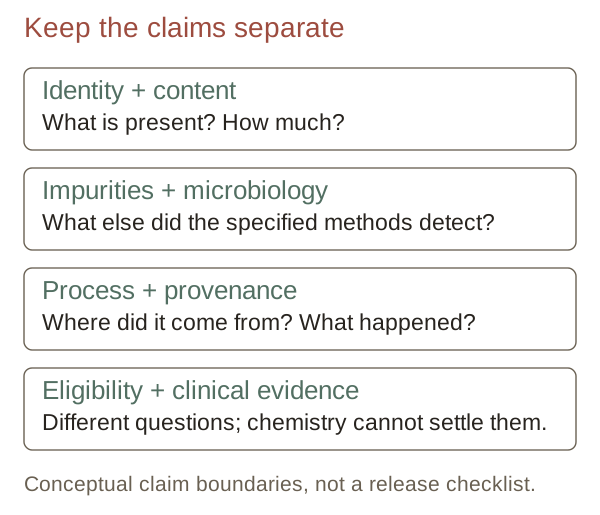
Microbial enumeration counts organisms under specified conditions. Growth-based sterility testing asks a different question. Endotoxin testing addresses bacterial material that is not equivalent to living microbial growth. The acceptance limit and method suitability depend on the product and intended exposure; a consumer rating threshold cannot simply become a pharmacy release limit. FDA endotoxin guidance
A clean ingredient sample also cannot establish the condition of a subsequently formulated, filled, transported or opened product. USP’s sterile-compounding standard concerns preparation practices as well as risks; it is not one purchasable assay. USP <797>
The ordinary growth-based sterility procedure carries an incubation constraint of at least fourteen days. A quick chemistry result does not remove that clock or the need to establish test suitability. USP public preview
The commercial product must state which question each result answers, and leave the rest visibly open.
04 · The sample is the first vulnerability
The evidence chain begins before the instrument
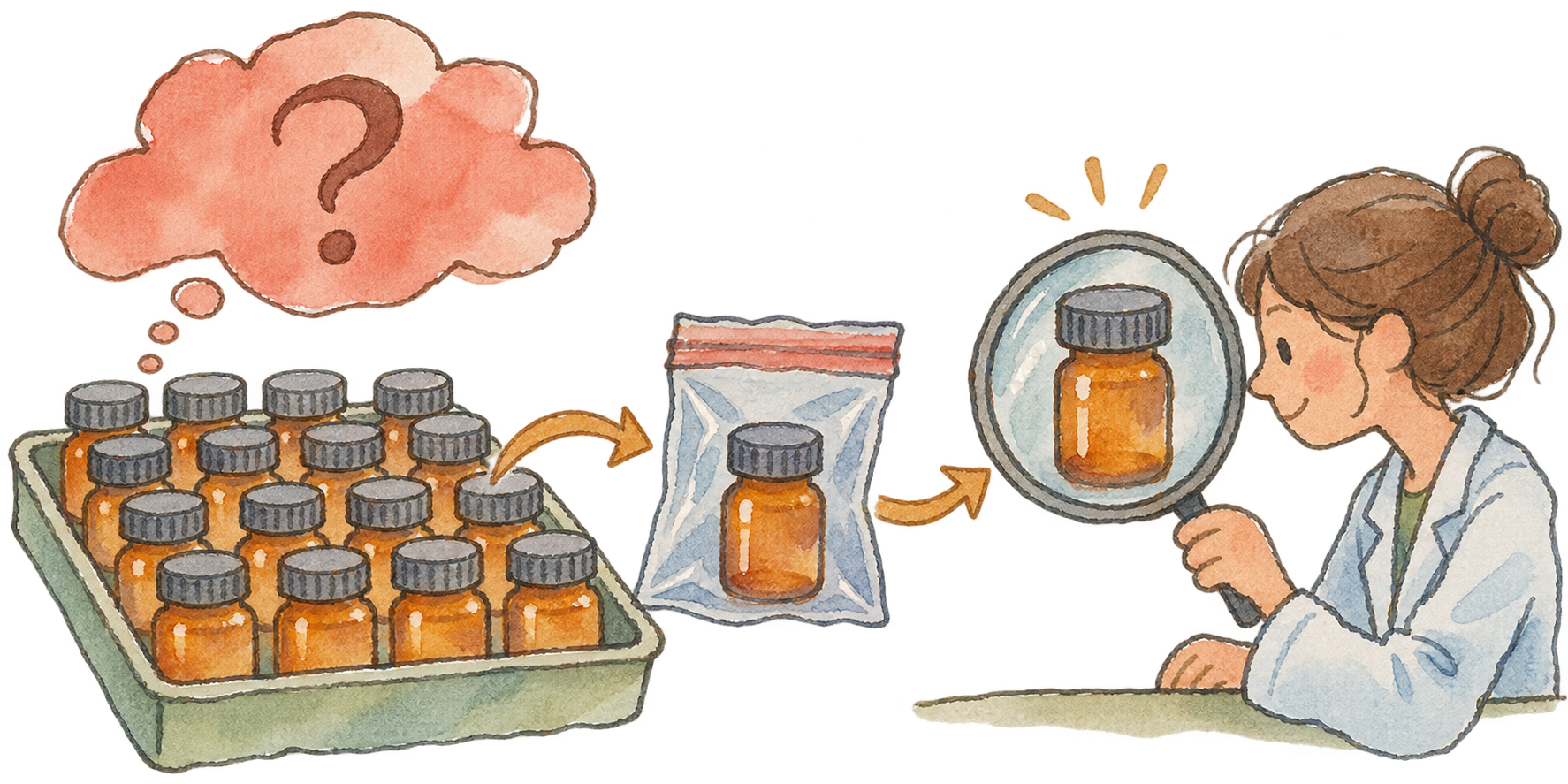
If a seller chooses the best-looking sample, even excellent chemistry may answer the wrong purchasing question. If a report is later attached to another lot, the analytical result may remain accurate while the commercial claim becomes false. These are foreseeable failure modes, not measured prevalence estimates.
My proposed workflow gives the buyer and quality lead control over sample selection. Record the sampling plan, original manufacturer, received lot, seals, custody transfers and method versions. Preserve original laboratory reports and technical review. Agree discrepancy and split-sample rules before seeing results; never keep repeating an investigation until a preferred answer appears.
USP explicitly distinguishes a sampled sterility result from assurance that a whole batch is sterile. Representative sampling and process evidence remain essential. USP sterile-compounding FAQ
This is where a verification company might earn its fee: connecting an honest observation to the exact decision it can support.
05 · The policy headline moved again
An opening is possible; an orderly transition is unproven
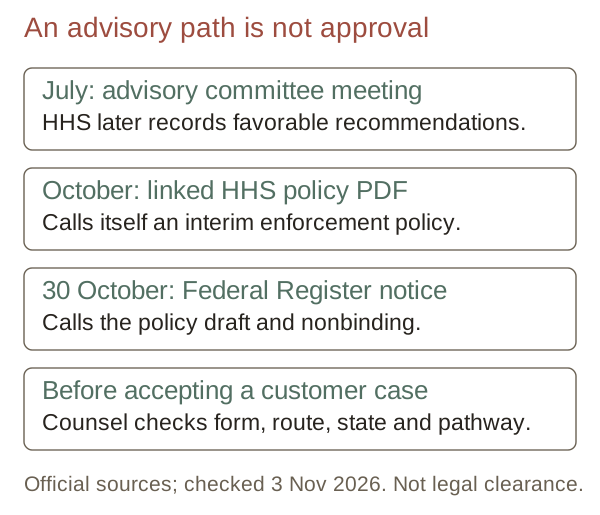
The HHS PDF records favorable committee recommendations for BPC-157, epitalon, KPV, MOTS-c, semax and TB-500, despite contrary CDER recommendations. It describes an interim enforcement policy with form, route, characterization and supplier conditions. This research has not verified exact vote tallies or DSIP’s disposition. HHS policy PDF · FDA committee page
The 30 October 2026 Federal Register notice calls the policy draft and nonbinding. It refers to Appendix A; the linked filename ends “appendix-b.pdf”. I would preserve that documentary mismatch and have counsel resolve present reliance. Neither document establishes drug approval. Federal Register notice
The federal pathways also differ: 503A generally centers individual-patient prescriptions and conditional exemptions; 503B outsourcing facilities remain subject to current good manufacturing practice. Bulk eligibility is a separate question. Clinics cannot purchase their way around those distinctions. FDA pathway comparison · Bulk-substance rules
06 · Accreditation must attach to real work
A laboratory logo cannot travel beyond its scope
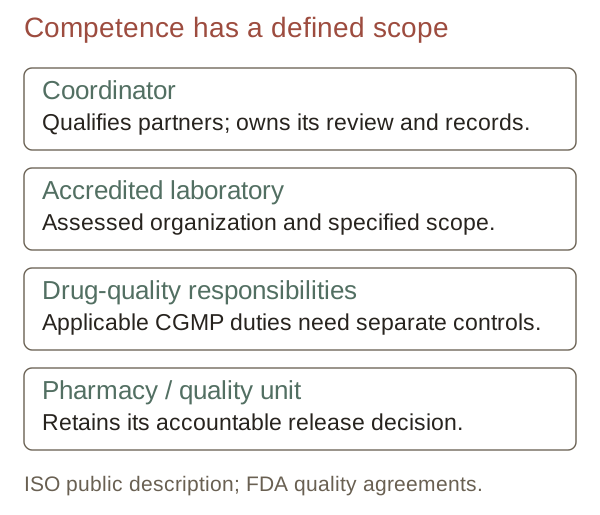
ISO/IEC 17025 concerns laboratory competence, impartiality and consistent operation. The practical question is which organization, analytes, methods and matrices have actually been assessed. Full standard text was not licensed for this research. ISO public description
PharmLabs’ posted scope names ten peptide analytes under HPLC. That supports a specific documented scope, not every advertised assay. Its live issuer status and any controlled flexible-scope additions still need checking before qualification. Posted accreditation schedule
For applicable drug-quality work, quality agreements and current good manufacturing practice responsibilities remain relevant when work is outsourced. Accreditation alone cannot replace them. FDA contract-manufacturing guidance
I would begin as an honestly described evidence service. An owned laboratory would follow a gap assessment, application, assessment and corrective work for the actual intended scope. No accreditation badge before the grant. A2LA’s route
07 · Independence is a system of incentives
Buyer-paid does not mean conflict-free by magic

Finnrick offers paid vendor programs and states that results and ratings cannot be bought. Vendor payment alone does not establish biased measurement. Its published methodology also makes endotoxin coverage optional, so the reader must inspect what was actually tested. Vendor programs · Methodology
The proposed company would take fixed fees from the buyer, reject supplier commissions and supplier equity incentives, and separate sales from technical sign-off. The contract would preserve raw-data access, adverse findings and a dated correction history. Confidential quality investigations could remain confidential; selectively published successes could not masquerade as a representative ranking.
I would refuse a blanket “safe” or “compliant peptide” badge. The report should name the sample, method, date, acceptance basis and limitations. The strongest version of this company is willing to hold a case and disappoint its paying customer.
That discipline is part of the product. Whether buyers value it enough to fund it is still unknown.
08 · The laboratory market already exists
The hardest competitor may be a direct contract
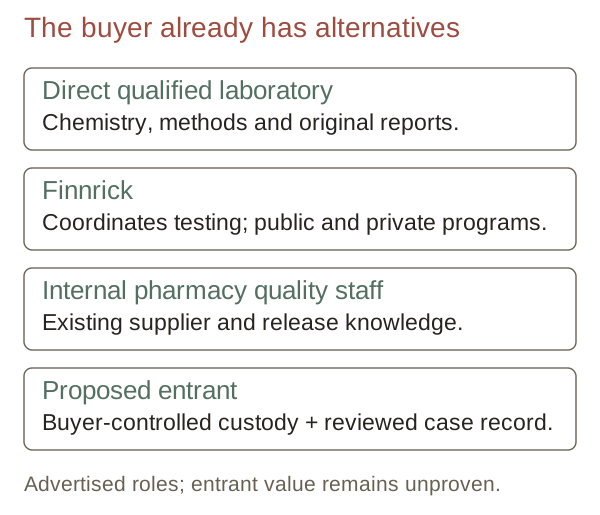
Janoshik lists BPC-157 analysis at $215, with optional endotoxin $180, “sterility” $290, and metals $105. Together that is $790, before shipping and further work. The checkout label does not establish a USP <71> procedure or suitability for a US pharmacy decision. Janoshik menu
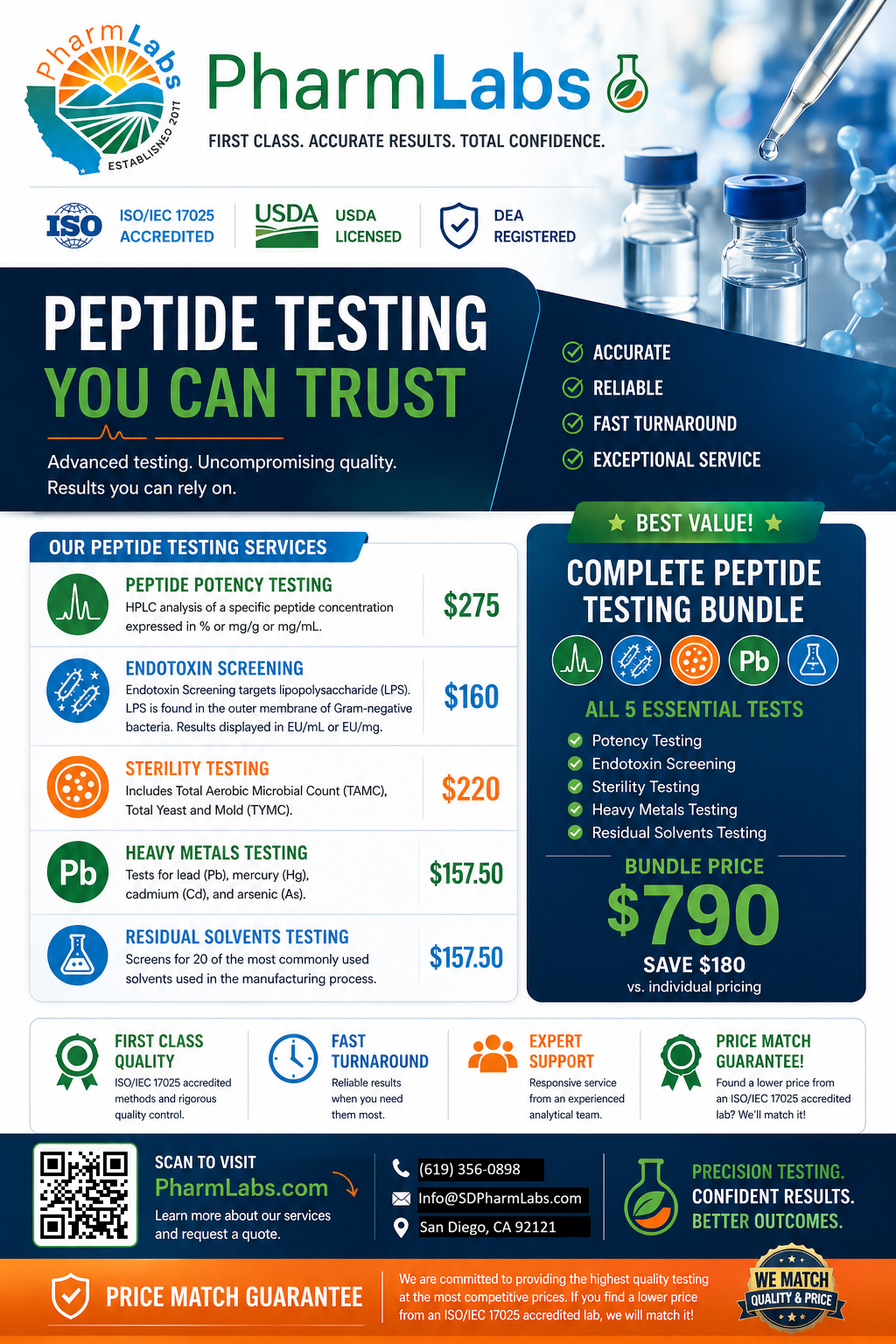
PharmLabs advertises a $790 bundle, whose microbiology is count-based TAMC/TYMC. Equal prices do not make the scopes equivalent. Krause advertises HPLC-UV/MS and USP <71>/<85> add-ons; actual methods, validation and procurement fit need qualification. PharmLabs price sheet · Krause menu
Finnrick’s terms say it coordinates outside laboratories and does not operate a lab or interpret private results. A portal is therefore already a business model. Partner terms
The entrant’s hypothesis is narrower: buyer-controlled custody, technical interpretation and supplier evidence reduce a real pharmacy burden. If direct qualified-lab buying already solves that job, I would partner or stop.
09 · Price the record, not the optimism
A small service margin can disappear quickly
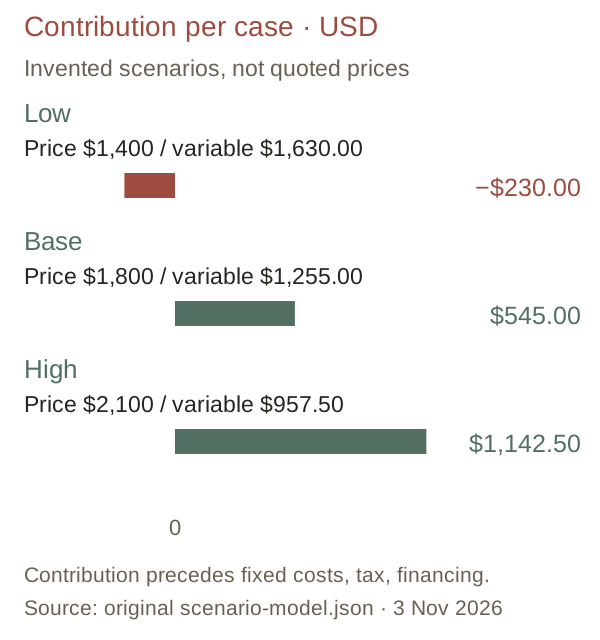
The base case assumes a $1,800 fee: $800 initial lab panel with 10% repeat allowance, $65 logistics, two review hours at $100/hour, $50 support and $60 risk allowance. Variable cost is $1,255; contribution is $545, approximately 30.3%. At 45 cases/month and $22,000 fixed expense, operating residual is $2,525/month, before tax and financing. Break-even is 41 cases/month. Every commercial input is invented. Model and arithmetic
A case means one stipulated, qualified evidence workflow. It does not promise that a cheap panel establishes a whole lot’s quality. The HHS characterization program is broader, and finished-product, stability, audits and new-method development need separate scopes.
The proposed service succeeds only if a buyer accepts the full price after sampling, review, repeat investigations and inventory-hold burdens become visible.
10 · What the headline omits
More interest can create more liability than margin
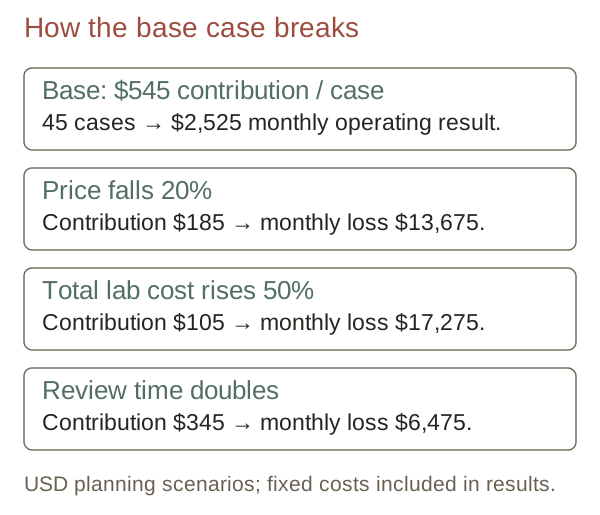
A 20% price cut produces a $13,675 monthly loss. A 50% increase in total laboratory cost produces a $17,275 loss. Doubling reviewer time produces a $6,475 loss. None is a prediction. These sensitivities tell me to obtain matched laboratory bids and time real investigations before expanding. Reproducible scenario arithmetic
The bear case is severe: a competent laboratory service becomes a legitimacy layer for unsafe commerce; insurers exclude the relevant claims; pharmacies already have better suppliers; consumers choose free testing; labs bundle away the margin; policy changes remove the fashionable work.
FDA’s NuScience warning letter illustrates that research-use labeling does not neutralize evidence of human intended use. This is FDA’s stated enforcement position, not an adjudication or a verified current remediation finding. FDA warning letter
The GLP-1 precedent also shows that shortage-dependent latitude can end. A startup should not require a temporary exception to persist indefinitely. FDA GLP-1 policy
11 · Build the service before the laboratory
Each stage should buy evidence for the next

My proposed sequence starts with paid feasibility and record review, then outsourced qualified analysis, then a decision about whether an owned lab improves the business. Finnrick establishes that coordination can be offered without operating a laboratory; it does not establish this entrant’s demand or margins. Coordination precedent
During the opening month, choose one analyte, chemical form, matrix and state/customer workflow that counsel can clear today. Experimental peptides under unsettled policy are not the default inventory. A lawful adjacent workflow is acceptable only if buyers actually need it.
During the following service stage, own sample custody, partner qualification, technical review and the discrepancy record. The pharmacy’s accountable professional retains release decisions. A stable verification link should preserve original reports and corrections, with confidential information protected.
This resembles my drone thesis in The Part That Comes With Proof: find the person who can accept the evidence, then earn repeat orders. The limit to the analogy matters. An engineering acceptance package cannot stand in for medical efficacy or lawful drug eligibility.
12 · Spend the first ninety days on a decision
A budget should name owners and evidence
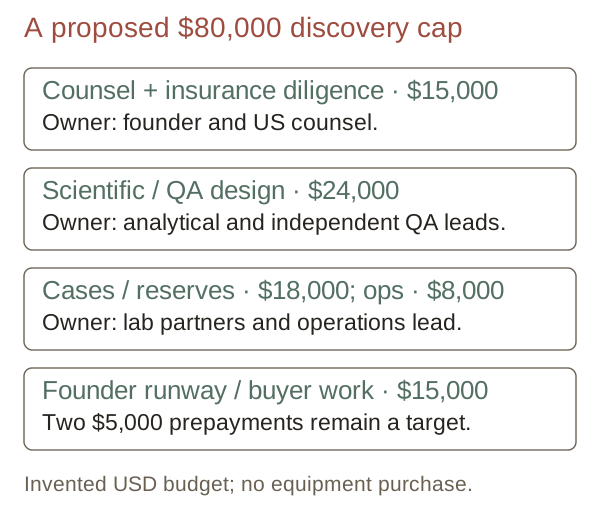
The founder and US counsel first produce a written scope, claims boundary and insurance assessment. The analytical and QA leads obtain three comparable lab bids, design sample selection and blinded splits, and secure raw-data and quality agreements. Operations builds a minimal custody record. The founder interviews fifteen buyers and reviews consented records from five pharmacies. These are proposed actions, not completed work. Execution plan
My first commercial gate is two unrelated pharmacies each prepaying $5,000 for defined pilots. By day ninety, require ten completed cases, complete traceability, no unresolved critical discrepancy, two paid follow-on orders, and at least 30% collected contribution after all direct costs. These are founder-selected screening rules, not industry benchmarks. Proposed gates
Ten cases cannot establish safety or a market failure rate. They can reveal whether the workflow, price and buyer relationship are worth continuing. A properly held adverse case is useful work.
13 · Find the person who can act on the report
Sell through a real quality decision
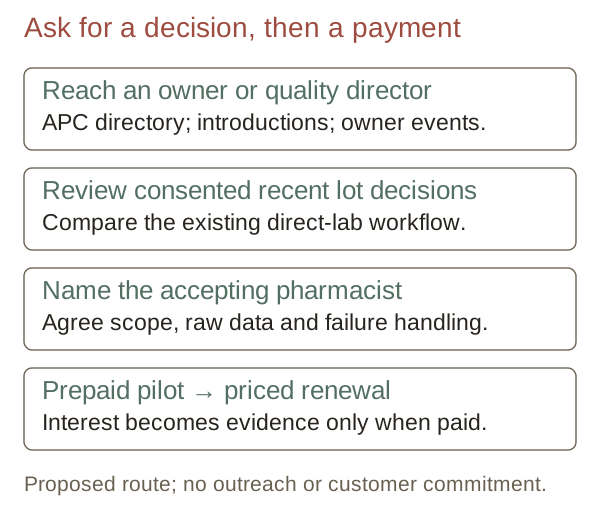
Start with pharmacy owners, quality directors and pharmacists responsible for ingredient qualification. APC’s dated directory supplies a lead pool, including Belmar, Empower, Hallandale and Harbor. Membership is neither endorsement nor evidence of interest in this service. Recheck entity, authority and scope. APC directory
I would seek industry-adviser introductions and attend relevant owner or quality sessions; APC lists Owner Summit and EduCon channels. Begin with a recent procurement problem and an incumbent comparison, rather than a broad consumer pitch. APC events
The commitment should include an accepting pharmacist, access to relevant records, sampling authority, agreed methods, failure handling, data rights and a priced renewal. Ask buyers who decline what already solves the job.
A telehealth clinic might later buy pharmacy diligence. It does not replace the pharmacy’s quality authority. Consumer testing needs a separate payer experiment. Free requests are not evidence that either segment will fund an institutional evidence service.
14 · The founding team must know when to refuse
Scientific credibility begins with correct limits

I would pair a commercial and technical operator with a peptide analytical scientist and an empowered QA professional. Retain US pharmacy regulatory counsel and a pharmacist adviser. Contract microbiology expertise; an LC-MS specialist does not automatically understand sterile-process assurance. This is a proposed team, not secured talent.
Recruit through analytical chemistry, pharmaceutical quality and pharmacy networks and experienced contract labs. The founder must learn molecular form, standards, method suitability, sampling uncertainty, data integrity and the difference between chemical quantity and biological action. A useful founder can recognize an unsupported conclusion without personally operating every instrument.
Credibility work should produce a narrowly worded methods-and-limitations page, a permissioned redacted worked case, disclosed advisers, blinded split checks and a corrections policy. Publish who paid, who selected the sample and who performed each method. Accreditation has its own assessed route; content marketing cannot substitute for it. ISO competence and impartiality framework
The institutional asset would be a consistent history of defensible decisions, including the uncomfortable ones. It is a hypothesis about earned reputation, not a moat already built.
15 · Finance the cash gap before scaling
The founder gets paid from a functioning service
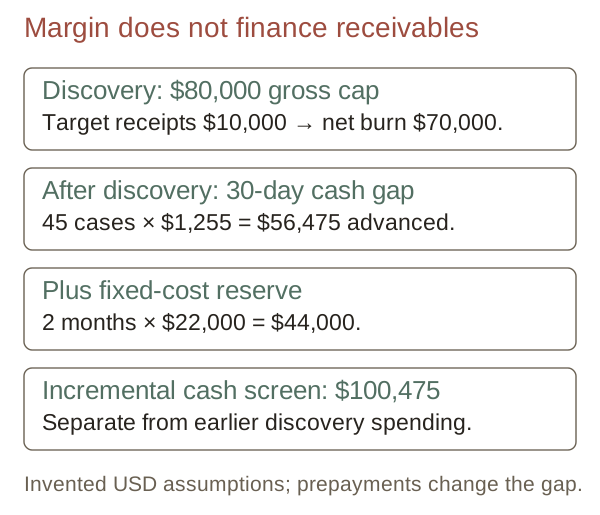
The $80,000 discovery envelope is founder or angel risk capital. Target pilot prepayments of $10,000 would leave $70,000 net discovery burn if the full budget were spent. Later, assuming thirty-day collections, advancing variable cash for 45 cases requires $56,475; adding $44,000 fixed reserve gives $100,475 incremental cash after discovery. This simplified screen excludes growth and exact payment timing. Capital model
Use customer prepayments and receipts before equipment debt. Retained profit or specialist angel funding could later finance a bid-based laboratory plan. Venture funding needs evidence of reusable value beyond bespoke consulting. No grant, investor appetite or founder eligibility is assumed. A Singapore-based founder would need separate US entity, employment and immigration advice.
The discovery founder allowance is runway funded by risk capital. The base operating scenario includes a hypothetical $6,000 monthly founder salary inside fixed expense; its $2,525 monthly residual is before tax and financing and should build reserves before dividends. Compensation assumptions
A profitable independent service is a legitimate destination. No valuation, acquisition or secondary proceeds are needed to make the plan coherent.
16 · Earn the right to own more
A laboratory, a consumer service and supply are separate bets
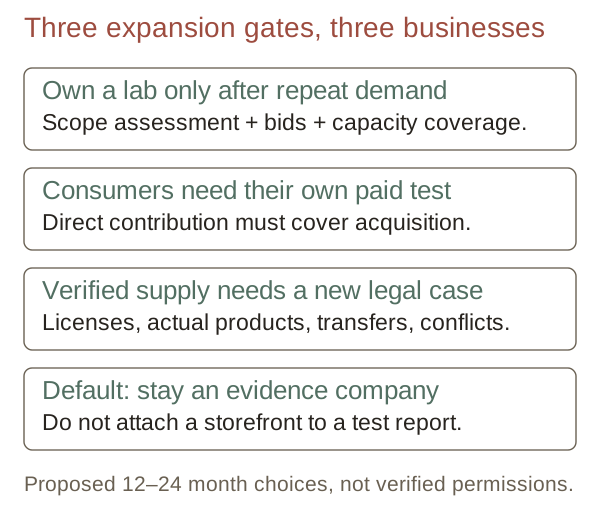
During proposed months six to eighteen, standardize the same buyer job. An owned-lab gate would require six months of repeat paid work, three unrelated renewing buyers, commitments for sixty cases/month, external backup and a bid-based downside model covering fixed costs at no more than 60% of practical capacity. These hurdles do not establish actual capacity or capex feasibility. Stage gates
Price premises, instruments, service, references, staff, waste, validation, proficiency testing and insurance. Commission a scope-specific accreditor gap assessment. If outsourcing remains better, keep it. Consumer expansion would need a prepaid cohort whose direct contribution covers acquisition before scaling.
During proposed months twelve to twenty-four, verified supply would require a new legal, licensing, import, storage, dispensing and liability analysis, plus credible separation of assessment from sales. In particular, 503B transfer restrictions make a simple reseller assumption unsafe. Execution sequence · FDA transfer framework
My default remains an evidence company with no peptide sales. Expansion should improve the buyer’s decision without turning the verifier into an interested promoter.
17 · The result that would change my mind
Proof is useful only when it can stop the sale

I would fund bounded discovery, conditional on a lawful, insurable scope. Stop immediately for falsified custody, suppressed adverse findings, unauthorized therapeutic claims or an insurance exclusion that defeats the job. Hold unresolved critical cases. Stop the company thesis if buyers will not renew, fully costed contribution stays below the proposed hurdle, or direct laboratory procurement already solves the problem. Decision rules and owners
Evidence boundary. Research is US-focused and dated 3 November 2026. The Trends observation comes from a dated browser capture with its recorded method. Vendor menus establish offers, not qualified equivalence. The widely repeated contamination percentage lacks a defined cohort and is omitted. Exact July vote tallies, current issuer accreditation status, licensed standards, matched bids, insurance and paid customer demand remain open. No clinical efficacy review, customer outreach, laboratory experiment or purchase has been performed. Evidence ledger
I am interested because chaotic supply makes credible evidence valuable. I would test whether the scarce product is an accountable purchasing decision, and build the institution capable of saying “this claim is supported,” “this remains unknown,” and “this case must stop.”