PIPELINE
IN A PERSON
One founder. A network of laboratories. A definite plan to build a medicine.
A Fieldbook for founders and investors · 30 October 2026
A child born with a devastating genetic disease should not have to wait for a large company to make that disease a priority. I think a new kind of founder can help change that: one who combines AI, specialist scientists and rented laboratory capacity into a focused drug-development company.
The founder would own the question, the experiments, the evidence and the rights. Most of the physical infrastructure would belong to somebody else.
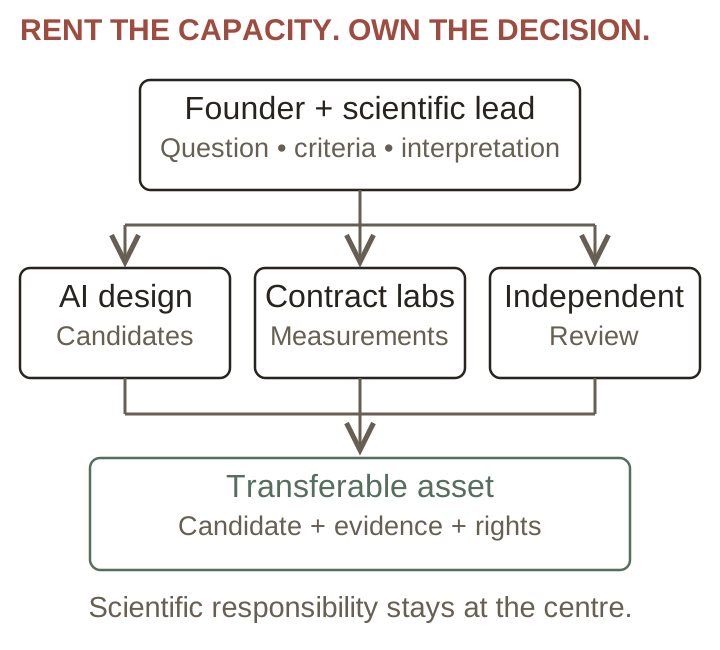
Definite optimism is the founding premise: a better future can be deliberately built. Choose a disease worth changing, develop a specific insight into how to change it, and organise the company around making that treatment possible. Mithril Medicine gives this ambition a concrete organisational precedent.
01 · What is becoming possible
Mithril has already crossed the organisational frontier
On 27 October 2026, Anthropic announced its acquisition of Mithril Medicine, a one-person company led by Cody Tranbarger. It described a founder using Claude to coordinate 11 external laboratories, taking a muscular-dystrophy programme from idea to encouraging mouse results in under 18 months. The research continues inside Anthropic. Anthropic announcement
That is the precedent I want to replicate: one founder assembling capabilities that used to require a much larger organisation. The acquisition is a demonstrated organisational outcome; it is not yet a demonstrated human treatment. The checked announcement does not disclose the price or the programme’s budget. Tranbarger brought biology education and biotech experience; the model to replicate combines founder agency with acquired scientific judgment. Founder biography
The opportunity is to build a company around a specific therapeutic insight, with AI carrying much of the reading, analysis and coordination and specialist partners doing the physical work. The founder owns the product hypothesis, the decisions, the evidence and the rights.
A therapeutic asset is that whole package: a candidate, an intended medical use, supporting data and transferable ownership. Creating one is a substantial achievement even before human trials.
I would start with the question that makes the company worth existing: what useful biological function can we restore, and why can this small team now do it unusually well?
02 · The seductive version breaks
A better future, designed and built
Peter Thiel’s definite optimism, developed in Zero to One and his earlier talks, combines belief in a better future with a specific view of how to create it. In his 2013 SXSW talk, he contrasts focused conviction and engineering with treating the future as a random walk. Thiel’s talk, transcript with original audio
Here is how I would apply that mindset to this company.
Describe the future in concrete terms. A defined group of patients gains a treatment that restores a named biological function. Specify what changes in their lives and the evidence that would establish the change.
Have an insight that makes the company necessary. Identify an overlooked mechanism, molecular architecture or way of organising the work. Explain why this particular team can turn it into a meaningful advance. “AI makes biotech cheaper” is too broad to guide a company.
Concentrate on one important problem. Select a narrow disease–function pair where an exceptional result matters. Build the design, experimental and scientific capabilities required to solve it; work backwards from that result to today’s decisions.
Let experiments improve the plan. Conviction belongs in the mission and the reasoned thesis. Each proposed molecule must earn confidence through evidence. When a result contradicts the mechanism, revise the intervention or choose a stronger thesis.
My founder question is: what useful future can we now build that would otherwise remain unrealised? The company is the plan, people and capabilities assembled to make the answer real.
03 · Match the molecule to the job
Restore the function that matters
Mithril’s reported approach is a bispecific bridge: an antibody joining laminin-α4 to β-dystroglycan to restore muscle anchorage in LAMA2-related disease. Its tetravalent construct was associated with roughly doubled force and grip strength in a mouse pilot. The report is not peer reviewed; nonrandomised, unblinded study limitations make controlled replication an important next step. Technical report, abstract and discussion
The lesson I take is to search for a tractable restoration of function, then choose the molecular architecture that can perform it.
Proteins perform different jobs: they cut other molecules, carry signals, build structures, or hold other proteins together. A binder is a molecule that attaches to a target. Attachment matters only if it changes the right job in the right direction.
Consider hereditary angioedema associated with deficient or dysfunctional C1 inhibitor. Loss of normal regulation permits excess activity in a blood-borne pathway. Lanadelumab, an approved antibody, inhibits plasma kallikrein and reduces excess bradykinin generation. It acts elsewhere in the pathway rather than simply binding the missing inhibitor. FDA mechanism description, historical label
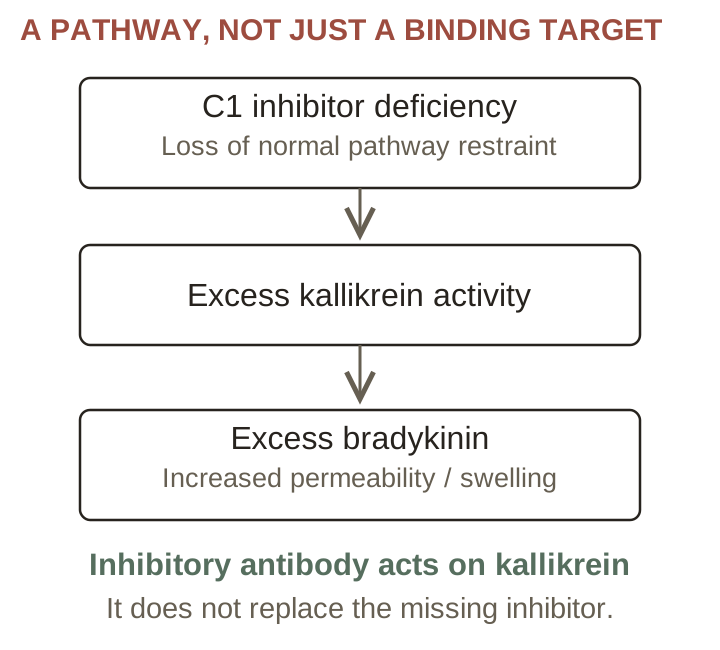
This example validates a mechanism, not an available startup niche: an approved incumbent already occupies it.
There are also sophisticated ways to restore missing function. Emicizumab bridges activated factor IX and factor X to substitute for a role of missing activated factor VIII in haemophilia A. That engineered two-target action is much more specific than “make a binder.” FDA mechanism description, historical label
04 · What AI has actually proved
The design frontier has moved; the finish line has not
I would not dismiss computational protein design as a beautiful-screen-image business. There is physical evidence.
The BindCraft study tested designs across 12 targets, reporting experimental binding success ranging from 10% to 100%, with a mean of 46.3%. Affinities were predominantly nanomolar. The researchers also demonstrated selected functional effects, including reduced allergen interaction with patient-derived antibodies. Original study
That is an encouraging result for the studied targets and workflows. It does not establish that twenty designs against an arbitrary disease target will produce two or three sub-nanomolar therapeutic leads. Target accessibility, molecular format and the definition of a successful experiment matter.
A nanobody is a compact antibody binding domain. A designed miniprotein is another kind of small protein. Neither label supplies adequate exposure, low immune response or a manufacturable product.
My interpretation is that AI has made candidate generation a more credible starting point. A founder still has to build the evidence that connects a candidate to a useful treatment. I would measure progress in reproducible functional leads per dollar and month, rather than sequences generated.
05 · The tool stack has an ownership stack
Commercial rights start before the first design
The model’s name is not a licence. Code, weights, outputs, hosted access and dependencies can carry different terms. As checked on 30 October 2026:
| Tool or artifact | What the owning source says | Founder implication |
|---|---|---|
| RFdiffusion | BSD licence explicitly covers code and referenced downloadable weights | Permissive terms are useful; still audit dependencies and patent rights |
| AlphaFold 3 | Official README identifies a commercial cloud route; public/local output terms restrict commercial use | Choose the authorised access route before using outputs commercially |
biohub/esm3-sm-open-v1 | Current model card identifies MIT licensing | Record this exact artifact/version; do not extrapolate to every ESM service |
Sources: RFdiffusion licence, AF3 README, AF3 output terms, named ESM3 model card, linked ESM licence.
I would retain an audit trail of model version, input provenance, access terms and human design decisions. Open model access is not freedom to operate: another party may still hold relevant patents, and outsourced work needs clear ownership terms.
A language model can help organise this work. Scientific and legal accountability remain with the people running the programme.
06 · The evidence ladder
Every rung answers a different question
The early funnel should be designed backwards from the uncertainty a buyer would need resolved.
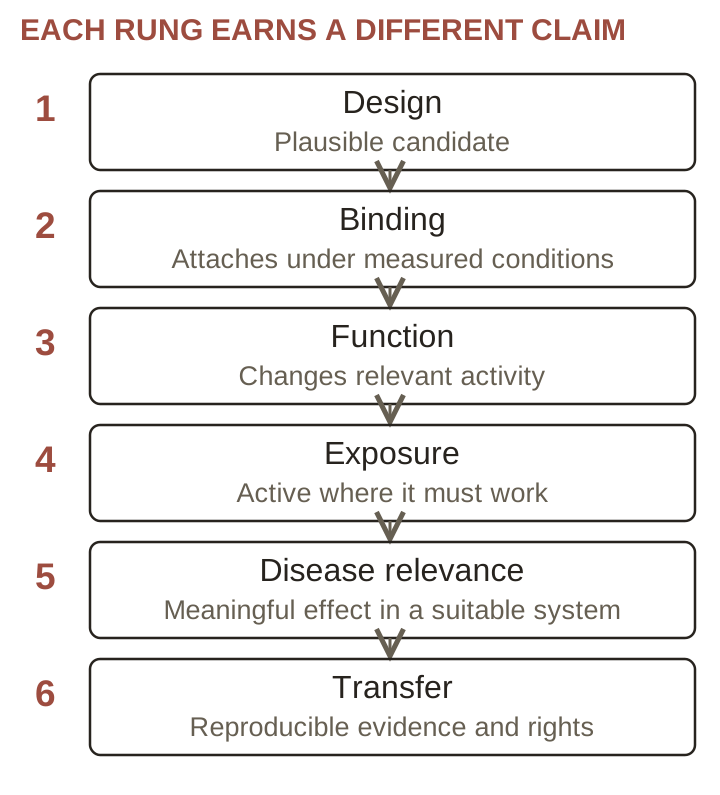
Binding assays ask whether and how molecules attach. Functional experiments ask whether they change a relevant biological activity. Exposure work asks whether enough active molecule reaches and remains at the place it must work. Disease evidence asks whether that produces an outcome that matters.
A final transfer test asks whether someone else can reproduce the result from the materials, methods and raw data supplied. These questions can overlap and send the programme back to an earlier stage.
A sub-nanomolar dissociation constant, written KD < 1 nM, indicates tight binding under the measurement conditions. It is not a universal threshold for therapeutic value. The relevant potency, selectivity and exposure requirements depend on the mechanism.
I would select the next experiment by its ability to change the decision. Repeating an attractive binding result is poor use of capital if function is the unresolved question.
07 · Biology as a service, with state
Build a scientific operating system
Mithril’s technical report includes a revealing operational example: Claude helped turn a 341-page package on 113 constructs into a coordinated plan across five CROs. A human decision changed the set progressing to 89 constructs. People reviewed and sent the emails; the report also records AI errors. Technical report, pp. 19–20
My replication plan is to make that loop explicit. Every result should connect to a versioned material, a question, an acceptance criterion and a next decision. Every decision should update the affected experiments, orders and partner instructions.
The founder’s technical advantage is building this operating system: document retrieval, structured experiment records, result ingestion, analysis notebooks, dependency tracking and reviewable drafts. Start with a dependable workflow that one scientist can inspect. Automate more as its reliability earns trust.
Expertise remains a capability to acquire deliberately. Assign owners for disease biology, molecular engineering, translational pharmacology, statistics and IP. They can be collaborators, advisers, consultants and CRO specialists rather than a large permanent payroll.
“One person” describes the company’s organisational core. It is not a requirement to learn every specialty alone. The winning founder recruits judgment as deliberately as laboratory capacity.
08 · A mouse is evidence, not an exit certificate
Ask what the model can establish about a human medicine
A disease model is useful only for the question it represents. A result can depend on the species, the engineered disease, the measured endpoint, or exposure that would be impractical in people.
I would ask an independent reviewer whether the model, comparator and analysis could distinguish a meaningful biological effect from a misleading one. Randomisation, blinding, justified sample size and uncertainty reporting are basic design issues, not optional decoration around a positive graph. NC3Rs design guidance
The regulatory direction creates room to choose better evidence. FDA is advancing human-relevant alternatives; its checked monoclonal-antibody safety guidance remains draft, not for implementation, and concerns particular nonclinical safety questions. That is not a blanket waiver or a claim that any cell assay replaces disease evidence. FDA draft status and scope, April 2026 progress report
Choose the evidence package that advances the programme towards a development candidate. Early efficacy and a clinical-entry application are different milestones, so plan the handover explicitly rather than treating one experiment as the whole journey.
09 · Budget for learning, including failure
Make the first programme financeable
The first financing advantage is structural: buy specialist capacity for a defined programme instead of owning every capability at the outset. To turn that advantage into a plan, price the work from the bottom up. The pasted assay and mouse-study estimates remain unverified; the checked Mithril materials do not establish a transferable programme budget.
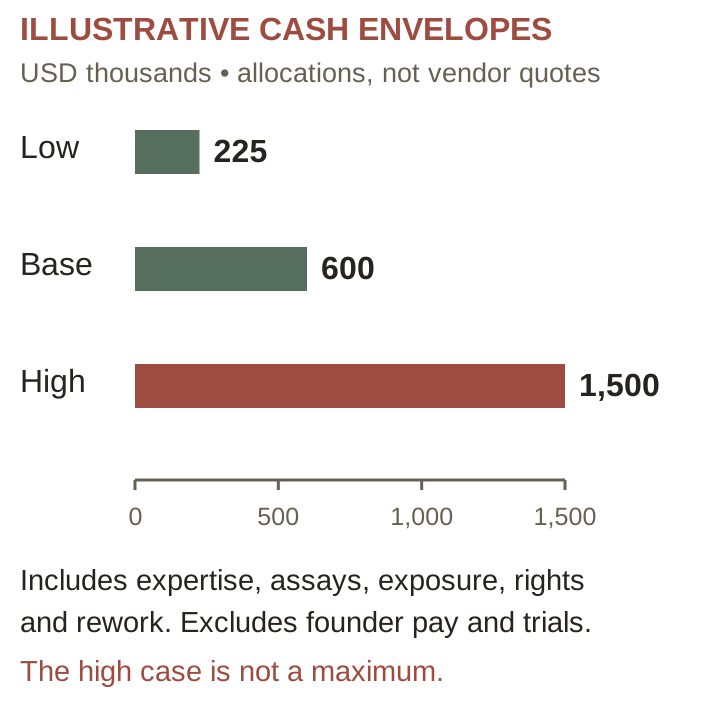
Here is an original allocation model for a capped early research programme. The columns are illustrative low/base/high planning envelopes, not cost estimates for a selected target. All amounts are USD thousands.
| Allocation, $000 | Low | Base | High |
|---|---|---|---|
| Scientific leadership and programme management | 40 | 100 | 220 |
| Design, synthesis, expression and quality checks | 30 | 70 | 180 |
| Functional assays and independent repeats | 40 | 110 | 260 |
| Exposure and fit-for-purpose disease evidence | 50 | 150 | 400 |
| IP, contracts and diligence preparation | 20 | 50 | 100 |
| Failure, rework and contingency reserve | 45 | 120 | 340 |
| Total | 225 | 600 | 1,500 |
These envelopes exclude founder salary, taxes, financing costs, full clinical-entry manufacturing/toxicology work and trials. Early stopping spends less. None guarantees a usable lead. Replace every row with scoped bids before committing capital.
10 · What the cheap headline omits
A component price is not the price of an answer
Twist advertises gene fragments from $0.07 per base pair and clonal genes from $0.09, with scope and minimum-price conditions. Those are DNA products. They do not include the chain of expressed protein, reliable functional experiments, exposure and disease evidence. Twist menu
ProteoGenix illustrates a subtler trap: the checked page body advertises antibody production from $100, while the footnote ties that price to 7,000 antibodies produced in parallel. Its page title still says $296. Neither headline prices a twenty-candidate therapeutic campaign. Service page and footnote
Before comparing quotes, normalise the scope: quantities and quality; failed-expression policy; assay development versus routine measurement; controls and repeat runs; raw data; sample shipping; timelines; transfer rights; and what remains excluded.
The sensitivity is straightforward. More design rounds increase production and assay spend. A method that does not transfer consumes both cash and calendar time. A lead with inadequate exposure can require molecular redesign and renewed validation.
I would seek two comparable written bids for the next decision, plus a funded repeat. A low starting price matters only if the resulting work answers the programme’s question.
11 · The strongest bear case
Turn the bear case into a work programme
The strongest objection is that a founder can coordinate every task efficiently and still pursue an ineffective treatment. A beautiful binder may not restore function. A functional lead may not reach the tissue. A positive model result may not predict a patient benefit. A technically good molecule may offer too little improvement over an incumbent.
These are concrete failure modes. I would give each one a corresponding design requirement.
| Challenge | Work that can resolve it |
|---|---|
| The intervention changes the wrong biology | Write a mechanism-to-function argument reviewed by a disease specialist |
| Binding does not produce the intended effect | Make the functional readout an early milestone |
| The molecule cannot work at relevant exposure | Bring translational pharmacology into candidate selection |
| A positive result is fragile | Plan independent reproduction and appropriate controls |
| The product is undifferentiated | Define the patient benefit and comparator before optimisation |
This is where founder conviction becomes useful. It keeps the programme focused long enough to solve hard problems, while demanding evidence about the chosen approach.
A result that disproves one design can still improve the programme. The question is whether it changes a tractable design variable or overturns the therapeutic premise. I would redesign the former and revisit the latter.
12 · Choose a wedge, not an orphan label
The first product is a testable improvement
I would screen for an extracellular function that a protein therapeutic could restore or control: bridge a broken connection, replace a missing activity, or restrain a harmful one. Prioritise strong human support, a quantitative functional readout, accessible exposure and a specific patient benefit. This is a proposed selection framework; it has not yet validated a new target.
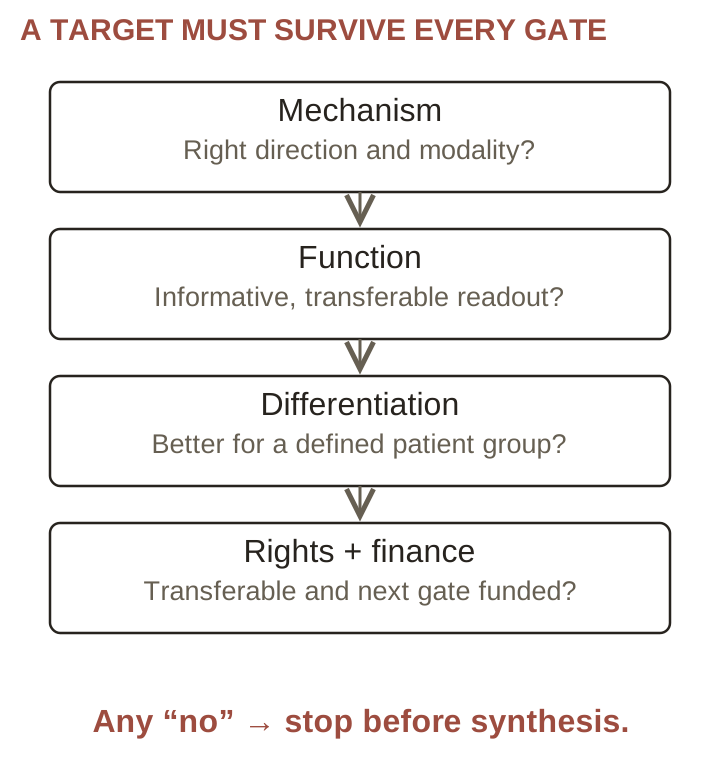
“Rare” is not enough. US orphan designation generally concerns conditions affecting fewer than 200,000 people, with an alternative cost-recovery route; it is separate from approval. The original twenty-thousand-patient rule is a founder’s arbitrary filter, not a regulatory definition. FDA designation framework
Hereditary angioedema offers an example of downstream inhibition, but also an approved competitor. Haemophilia A shows functional substitution can work, but requires sophisticated molecular action. A missing enzyme may call for replacement rather than another inhibitor. These are mechanism lessons, not a disease shortlist.
Disproof: if an expert cannot connect the proposed modality to a measurable, clinically relevant improvement over a named comparator, I would stop before ordering candidates. No target has passed that test in this research.
13 · Where the company can earn its place
Models and laboratories are suppliers; differentiation is the business
A founder competes with more than other virtual biotechs.
| Alternative | What it already brings | What an entrant must add |
|---|---|---|
| Approved therapy and its developer | Human evidence and an established product | A meaningful advantage for a defined patient group |
| Academic programme or spinout | Mechanistic depth, assays and sometimes exclusive IP | A better development path or partnership |
| Protein-design company | Design capability and experimental learning | Target-specific insight or access it lacks |
| CRO-led discovery service | Execution capacity and established workflows | Ownership of the product decision and resulting asset |
| Better-funded biotech | Specialists, runway and parallel programmes | A narrower question it can answer unusually well |
I would write the founding insight in one sentence: “Others overlook this opportunity because ___; we believe ___; our decisive evidence will be ___.” This is a proposed tool for sharpening the thesis, not a claim that an overlooked opportunity has already been found.
The goal is to build a capability that becomes difficult to reproduce: deep disease knowledge, an informative assay, a record of productive design–test decisions, and rights to a differentiated candidate. Each experiment should strengthen that capability as well as advance the molecule. A narrow starting point can support an ambitious company when it produces something uniquely valuable.
If the founder has no disease advantage but discovers a repeatable bottleneck in experiment traceability or procurement, that may suggest a different software business. It would need its own customer validation. Building an asset company is not automatically the best way to monetise engineering skill.
14 · What buyers actually buy
Mithril establishes a second kind of strategic value
Mithril belongs in the buyer map. Anthropic explicitly says it acquired the company and is continuing its research. My previous edition missed this direct AI-lab precedent. Acquirer’s announcement
For a biopharma partner, the asset thesis is a differentiated route to a useful medicine. For an AI research organisation, an active programme can also be an environment for improving scientific capabilities. That second rationale is my inference from the acquirer’s stated research strategy, not a disclosed valuation formula.
| Potential partner | Package to build | Question to answer early |
|---|---|---|
| Biopharma developer | Therapeutic differentiation, reproducible data and transferable rights | Does this address a priority in its development portfolio? |
| Specialist biotech investor | Credible scientific insight and a financeable next milestone | Can the next tranche create a material advance? |
| AI research organisation | A serious therapeutic programme and a working AI–laboratory loop | Does it reveal important capabilities the organisation wants to build? |
| Disease-focused collaborator | A clear connection between the programme and patient benefit | Can its knowledge or infrastructure improve the programme? |
Earlier transactions also show substantial buyer interest in early science: AbbVie’s discovery-stage Mitokinin acquisition included $110m at closing, and Novartis acquired preclinical DTx Pharma with its delivery platform. AbbVie, Novartis filing
I would build a programme worth continuing independently, then use partner feedback to improve it. An acquisition can accelerate the mission; it need not be the premise that makes the company sensible.
15 · The economics of an option
Capital should buy a named advance

I would not begin by multiplying an invented chance of success by an imagined acquisition price. That can make almost any thesis look attractive or hopeless. The useful starting point is a designed sequence of scientific advances.
| Tranche | What the company buys | Asset created |
|---|---|---|
| Thesis | Disease expertise, product definition, assay feasibility and initial rights review | A defensible intervention hypothesis and executable plan |
| Function | Candidate production, quality checks and comparative functional testing | A lead with measured biological action |
| Translation | Exposure work and fit-for-purpose disease evidence | A candidate with a stronger connection to a future treatment |
| Transfer | Independent reproduction, documentation and ownership work | A package another team can assess and develop |
For each tranche, ask for an itemised bid, expected delivery date, scientific owner and a repeat reserve. Define the next financing conversation before the cash is committed.
The cost of this programme is the sum of those scoped commitments, the founder’s runway and a reserve for iteration. The budget envelopes on card 09 are planning scenarios until real bids replace them; they are not Mithril’s reported expenditure.
The commercial objective is to create more therapeutic value with each unit of capital by reducing fixed organisational overhead and improving the quality and speed of decisions. Whether our particular programme achieves that is measurable.
16 · The sensitivity that should change your mind
Build the financing around the strongest version of the plan
The right funding route follows the programme’s next milestone. Capped founder capital may establish the thesis; a disease foundation, specialist investor or development partner may support the next advance. These are proposed routes, with eligibility and terms still to verify.
I would present a funder with a specific object to finance: a functional lead, a decisive translational result, or independent reproduction. The pitch should explain what becomes possible after that result and what resources are needed to reach it.
Run three sensitivities before accepting a budget: one more iteration, twice the assay-development effort, and a three-month delay. Use actual bids to calculate the cash consequences. These tests tell the founder where to negotiate scope, recruit expertise or change the sequence.
Measure operating performance as well: time from incoming data to a reviewed decision; time waiting on a partner; the number of results requiring rework; and the cost of obtaining a reproducible functional lead. These are proposed management metrics, not published Mithril benchmarks.
The ambition is to build an increasingly capable company, not to remain permanently tiny. Add a person when they remove a binding constraint. Add a programme when the first operating loop can support it. Let the mission determine the organisation’s size.
17 · Protect the evidence you create
A clean data room begins with the first contract
A useful virtual data room lets a reviewer trace each claim back to a material, method and result. I would include candidate provenance; batch and quality records; methods and raw data; analysis decisions; failed experiments; comparator evidence; exposure findings; and the remaining development plan.
The rights folder is equally important: consultant and CRO assignments, material-transfer restrictions, model/access terms, patent work and the ability to transfer the programme. These are proposed diligence requirements, not a universal buyer checklist.
A US provisional application is not examined and does not itself become a granted patent. Preserving its priority benefit requires sufficient disclosure and timely follow-on filing, generally within twelve months. USPTO filing explanation
Patentability and freedom to operate ask different questions. Owning a potentially patentable improvement does not automatically clear other parties’ rights. AI use also does not remove inventorship analysis; the USPTO’s current resource page points to November 2025 guidance applying the same legal standard to AI-assisted inventions. USPTO current guidance
I would resolve these issues with qualified counsel before assuming the package is transferable or publishing enabling details.
18 · A 12–24 month path of attack
Work backwards from a convincing therapeutic programme
The intended destination is a differentiated programme with reproducible functional and translational evidence, ready for serious development discussions. Here is the proposed sequence to build it. Calendar ranges are planning targets rather than promises.
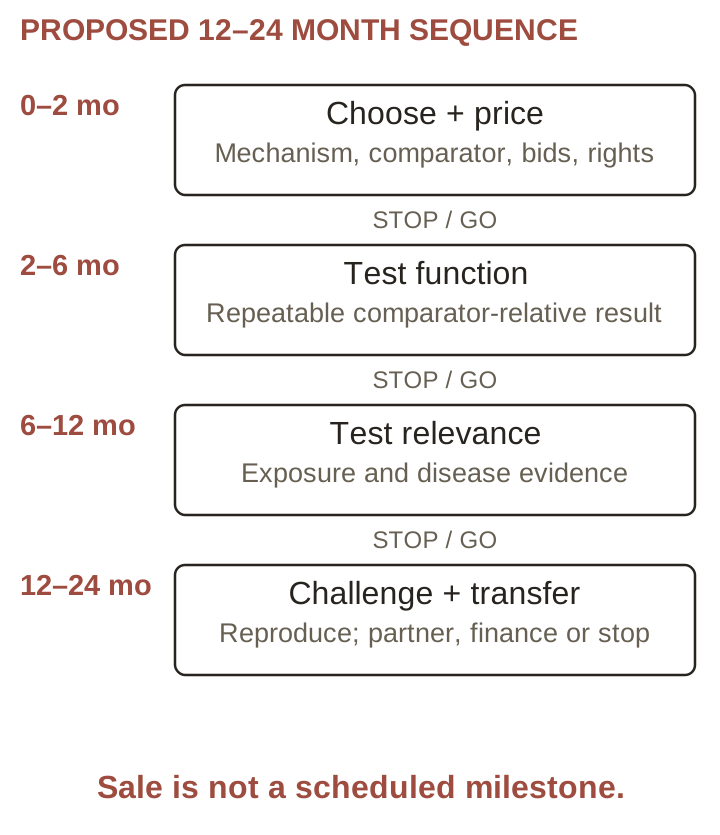
Months 0–2: choose and price the question. Founder and retained scientific lead compare three target-product profiles, review incumbents and rights, and obtain comparable bids. Continue only with a measurable differentiation claim and a funded next gate.
Months 2–6: establish function. The scientific lead owns a benchmarked design–test loop. Continue only when a technically valid result changes the relevant function and survives a predefined repeat criterion. Binding alone does not release the next tranche.
Months 6–12: establish relevance. A translational specialist selects fit-for-purpose exposure and disease-evidence work. Continue only if the intended product remains plausible at relevant exposure and against the chosen comparator.
Months 12–24: test transferability. Independent reproduction, rights review and diligence challenge the package. Use the resulting package to secure the right next resources: financing, a development partnership or acquisition. The destination is continued progress towards a treatment; the transaction structure should serve it.
19 · The first thirty days
Leave the month with a programme you can start
The first thirty days should produce a founding plan clear enough for an exceptional scientist, investor or partner to commit to it.
Write a one-page definite-future memo: the patient outcome we intend to create; the insight others have missed; why the opportunity is actionable now; the capability we will build; the first decisive proof; and the resources and owner for achieving it. Every statement should connect to the work below.
Week 1: choose the problem. Compare three disease–mechanism opportunities. For each, name the missing or harmful function, the proposed modality, the best comparator and the patient benefit sought. Recruit a disease specialist to challenge the argument.
Week 2: design the proof. Choose one opportunity. With the relevant scientists, specify the functional question, required controls, data deliverables and the result that would justify the next stage. Document how this programme differs from existing work.
Week 3: assemble the network. Obtain comparable scoped proposals from two suitable partners for the first major work package. Establish rights, material handling and data-access expectations. Assign an accountable scientific owner.
Week 4: commit to the first milestone. Finalise the budget, reserve, calendar, analysis plan and financing path. Build the shared programme workspace so new evidence can become a reviewed decision promptly.
These are proposed actions; this research has not ordered work or validated a target. If a key premise fails, choose a better intervention rather than manufacturing confidence around it.
My decision is to pursue a specific future: make a useful treatment possible for a carefully chosen disease through a distinctive restorative mechanism, an AI-assisted operating loop and an exceptional specialist network. The first thirty days turn that conviction into a company plan. Each subsequent tranche builds the evidence and capability needed to fulfil it.
20 · Evidence, assumptions and open work
A compact research appendix
Evidence boundary. Research checked 30 October 2026, with a US-oriented regulatory lens. No specific target, vendor quote, patent landscape, grant eligibility, buyer appetite or clinical-entry plan was validated. Selected public deals cannot establish sale probability. No outreach, purchase, grant application, filing or experiment was performed.
| Material claim | Status | Direct evidence or model |
|---|---|---|
| AI can generate experimental binders | Demonstrated for studied workflows; not therapeutic yield | BindCraft |
| Human genetics helps target selection | Retrospective relative association; not certainty | Minikel et al. |
| Outsourced binding measurements exist | Vendor offering, not proof of project success | GenScript |
| Rare disease remains a development programme | Regulatory guidance, not a universal study list | FDA rare-disease guidance |
| Early-stage acquisition is possible | Selected transactions; missing failure denominator | AbbVie, Novartis filing |
| Small expert-led wedge can work | Founder hypothesis | Mechanism, function, differentiation and rights gates on card 12 |
| Cash envelopes and staged financing | Original planning scenarios; bids still needed | Allocations on card 09; tranche plan on cards 15–16 |
| Mithril acquired by Anthropic | Confirmed acquirer announcement; terms not stated | Anthropic |
Disagreement log. This edition corrects the prior omission of Mithril and replaces invented acquisition-return arithmetic with a concrete financing plan. The supplied zero-risk claim and unsourced all-in prices remain unsupported. Vendor starting prices differ by scope; the ProteoGenix title/body mismatch is disclosed. Model licences are artifact- and access-specific. Historical drug labels support mechanism only; current dosing and indications are not asserted.
Public/private boundary. This investigation uses public original research, regulators, owning licences, service menus, buyer announcements and a filing. It does not infer private CRO quotes, paid database contents or unpublished buyer requirements. Open research copies were checked through EuropePMC when publisher/PMC browser access was restricted. No access controls were bypassed.
Falsification and next collection. The scientific lead must reject an incoherent intervention; assay review must reject an uninformative endpoint; competing-product review must reject an undifferentiated candidate; counsel must challenge rights; comparable bids must replace cost allocations. The thirty-day feasibility memo owns these checks.
The opportunity is to make the creation of a serious therapeutic programme possible for a new class of founder. Mithril supplies a precedent. The work now is to design the next one.