POWER
FOR AI
A founder’s Fieldbook · 3 November 2026 · Seah Ying Cong
Imagine choosing where to build useful computing because that is where the people, land and work belong—and knowing dependable electricity can follow. A hospital could expand its computing. A research team could run a larger experiment. A developer could turn a warehouse full of machines into a working service.
I find the nuclear version of this future especially compelling: manufacture small reactors repeatedly, learn from real hardware, and make dependable energy more abundant. But the first founder decision is where in the chain we can produce a real improvement.
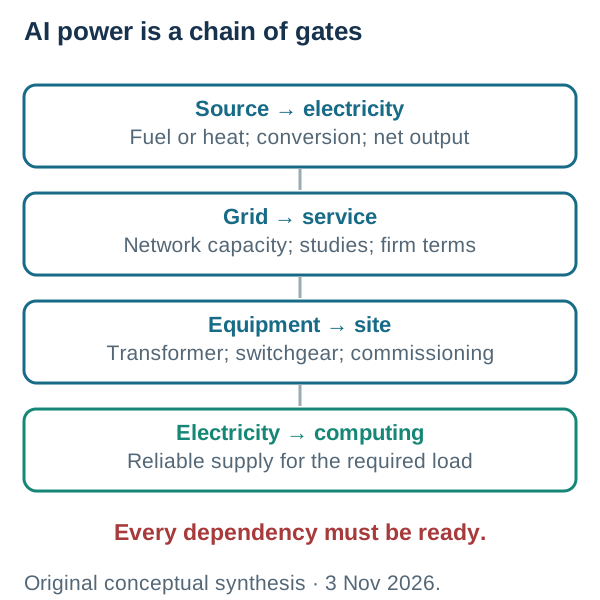
My provisional bet: for a team without a nuclear operating mandate, begin with an engineer-reviewed equipment and energisation package for a developer’s actual site. For a specialist nuclear team, Valar’s test-first approach deserves serious attention. Both paths must earn their next commitment through evidence.
01 · The opportunity is local
A global energy forecast cannot energise a building
The electricity question becomes tangible when a developer has a site, a customer and a date—but no accepted route to power. Buying computing equipment does not create a utility connection. Securing a generator does not secure its fuel. A signed electricity agreement does not necessarily build a new plant nearby.
The demand signal is substantial. The IEA estimated global data-centre electricity consumption at 415 TWh in 2024, with a 945 TWh Base Case for 2030 in its April 2025 report. These figures cover all data centres, including non-AI uses; the latter is a forecast. Its newer update reports 17% growth in 2025, alongside tighter equipment supply. IEA 2025 report · IEA April 2026 update
A terawatt-hour measures energy over time. A megawatt measures the rate of delivery. A site also needs acceptable voltage, outage behaviour and response to changing loads. Annual energy abundance somewhere in a region cannot establish those conditions at a particular substation.
My inference: the most useful initial market map follows blocked projects and their actual critical paths. The largest forecast is a poor substitute for knowing which buyer can authorise a purchase that moves a project forward.
02 · Four companies hiding in one bottleneck
Choose the capability the founding team can own
There are several worthwhile businesses here, with very different requirements.
| Entry point | What the customer receives | What the founder must be good at |
|---|---|---|
| Equipment manufacturing | Qualified transformers or switchgear | Factory execution, testing, warranty and working capital |
| Interconnection software | Better intake, studies and milestone handling | Power-system models, operator trust and data integration |
| Onsite power integration | A dependable source at a named site | Fuel, permits, engineering, commissioning and operations |
| Reactor development | A repeatable nuclear energy system | Reactor engineering, fuel, authorisation, construction and long-duration capital |
These are company-boundary choices, rather than a ranking of technologies. A transformer manufacturer can be valuable even if AI demand disappoints. A reactor team can pursue a much larger energy ambition than serving data centres. A software team needs a repeated information problem that someone will pay it to solve.
I would start with independent developers that already control a site and have entered a utility process, but lack a hyperscaler’s procurement organisation. That customer definition is a hypothesis, not an observed underserved segment.
The proposed product reconciles engineering requirements, utility milestones and manufacturer-confirmed equipment availability into one decision-grade package. Its first competitor is the developer’s existing engineer and EPC contractor. If they already perform the job well, another platform adds little.
03 · The transformer is a physical promise
Voltage conversion comes with specifications and acceptance
A transformer transfers electrical energy between circuits at different voltages. Switchgear controls and isolates circuits, including during faults. The customer needs equipment compatible with its actual system, backed by testing, transport and an accepted commissioning plan.
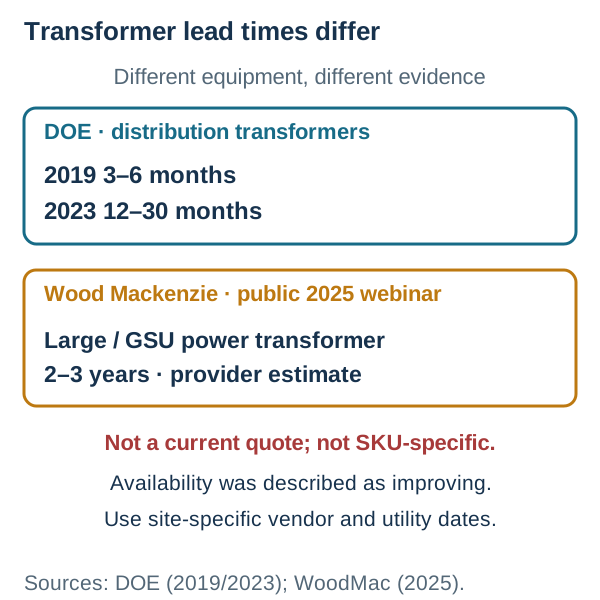
DOE reports distribution-transformer lead times rising from 3–6 months in 2019 to 12–30 months in 2023, the latest data stated on that page. It also identifies more than 80,000 varieties and specification inconsistency as a production issue. Those are distribution figures, not current large-power-transformer or switchgear quotes. DOE supply-chain analysis
For large and generator-step-up transformers, Wood Mackenzie’s public 2025 webinar describes availability as improving slightly while averaging 2–3 years. The underlying survey methods are not available here. Wood Mackenzie public description
A founder should see a question worth testing: can better reconciliation find an acceptable alternative before a costly commitment? DOE’s recent discussion of refurbishment highlights testing and documentation barriers. Finding nominal stock is only the beginning; a qualified engineer and accepting utility must establish suitability. DOE, October 2026
04 · Onsite power moves the boundary
The fuel pipe becomes part of the computing system
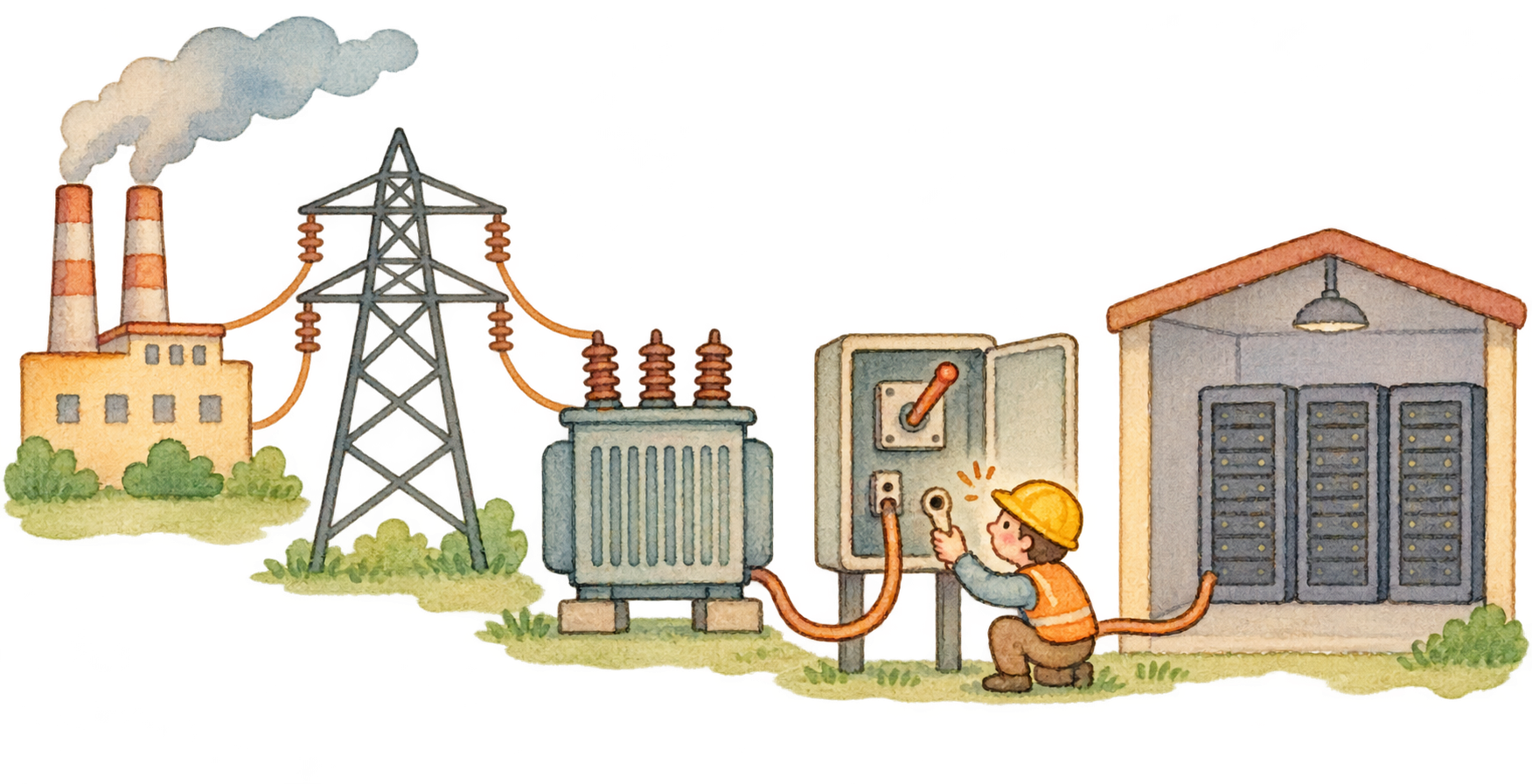
Onsite generation is attractive because it can reduce dependence on a particular grid construction schedule. A turbine converts fuel heat into mechanical work and electricity. A fuel cell converts fuel electrochemically. Both still need a complete site system, dependable fuel and permission to operate.
The turbine supply chain has its own queue. GE Vernova disclosed 122 GW of gas equipment backlog plus slot reservations in its October 2026 results. That combined book is neither delivered generating capacity nor a firm order total with identical commitment levels. GE Vernova Q3 release
Fuel cells offer a useful operating precedent. Bloom and Equinix described approximately 75 MW operational and 30 MW under construction, supplementing the grid at 19 US data centres, in February 2025. This is a dated supplier/customer announcement, not an independently metered current fleet assessment or proof of standalone reliability. Bloom–Equinix announcement
I would compare qualified partners before inventing new generation hardware. The decision needs firm fuel terms, emissions permissions, net output under site conditions, maintenance coverage and the consequences of an outage. Natural-gas fuel cells remain fuel-dependent; their name does not make their electricity carbon-free.
05 · A queue is a request
Software can improve evidence; it cannot construct transmission
A new generator must be studied because connecting it changes power flows and may require network upgrades. A large new load also needs a credible delivery path. These are related system problems with different applications and datasets.
LBNL’s 2026 Queued Up edition describes about 8,200 active generation and storage projects at the end of 2025. For capacity requested during 2000–2020, it reports 13% operating and 75% withdrawn by end-2025. This is a historical generation-capacity cohort, not an AI-load queue or the probability that a particular developer will succeed. LBNL Queued Up
PJM describes vetting data-centre construction timelines and financial commitments when preparing its load forecast. A request needs evidence of maturity before it becomes credible demand. PJM load forecasting
The software field is already occupied. GridUnity markets large-load workflows from discovery to energisation. Pearl Street offers study automation and scenario analysis. Their public descriptions establish competition, not independently verified speedups. GridUnity · Pearl Street
My proposed wedge therefore starts with a narrow comparison: reconstruct the customer’s actual critical path using its existing tools, then identify an avoidable error the incumbent process missed. If the limiting step is transmission construction, our best deliverable may be an honest no-go decision. That can prevent a bad investment, but it is not proof of a scalable software company.
06 · Nuclear deserves a serious hearing
A controlled chain reaction is an important beginning
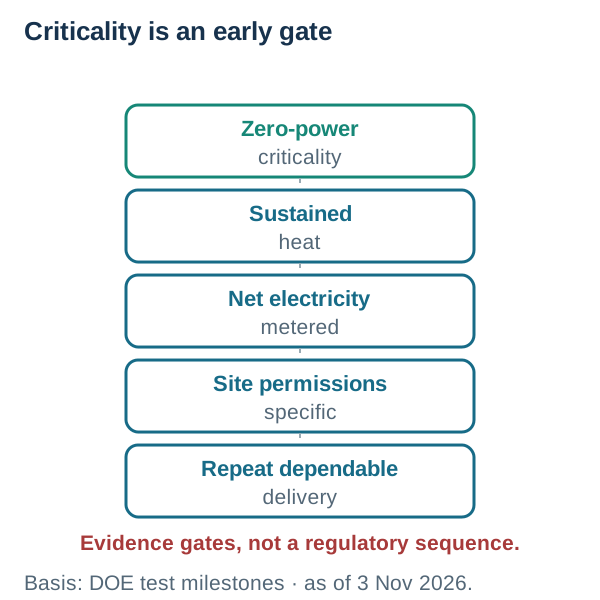
A reactor uses a controlled chain reaction to release heat. A heat-removal system carries that energy away. A conversion system turns some of it into electricity, while pumps, controls and other auxiliaries consume part of the output. The customer ultimately needs dependable net electrical delivery.
The appeal of small reactors is a learning loop: build manageable hardware, test it, discover the difficult interfaces and repeat. My hypothesis: if repeated manufacturing and operating experience lower delivered cost and schedule risk, they could make dependable low-carbon energy available to more sites. Smaller size alone does not establish that result.
DOE reports four advanced test reactors reaching criticality by 4 July 2026 and calls the goal exceeded. But the original overview specified at least three concepts outside national laboratories, while the later tally includes tests at Idaho National Laboratory. I retain that unresolved scope mismatch rather than declaring every original condition met. DOE July fact sheet · DOE program overview
The reported test achievements are real progress on a narrower question. They do not establish commercial power delivery. A DOE test pathway and a future commercial site’s permissions must be assessed separately.
07 · Valar Atomics and the hardware loop
The promise is repeatable execution
The name is Valar Atomics, rather than “Valor.” DOE confirms that its Ward 250 reactor completed zero-power fueled criticality on 18 June 2026 at the Utah San Rafael Energy Lab. That establishes a controlled nuclear chain reaction in a test reactor. It does not establish useful electricity supplied to a data centre. DOE milestone release

Valar describes Ward 250 as a high-temperature, helium-cooled reactor using TRISO fuel. Its engineering argument is to learn through extensive hardware testing and iteration. I find that interesting because operational competence has to be built through actual systems. The company’s public update also contains incomplete text and a “July XX” placeholder; I use its design description cautiously and exclude its raw performance/date arithmetic. Valar engineering update
The strongest version of the thesis is an integrated capability: design, manufacture, test and operate a repeatable energy system. The decisive next evidence is sustained useful output, then a permitted customer deployment, then a repeat build with measured cost and schedule. These are my diligence gates, not claims about Valar’s present achievements.
A founder with reactor, fuel and operating expertise could rationally choose this path. The public evidence cannot yet rank Valar’s delivered electricity cost against its peers. I would finance a named engineering advance rather than capitalise a promised future cost curve.
08 · Compare projects, not company headlines
Some of the apparent race is between different milestones
| Company | Public evidence at the cutoff | What it leaves unproven |
|---|---|---|
| Valar | DOE-confirmed Ward 250 zero-power criticality | Sustained commercial electrical output (DOE) |
| Oklo | Company reports low-power criticality for Groves, an isotope test reactor | Aurora commercial plant operation (Oklo) |
| Aalo | DOE confirms Aalo-X zero-power criticality; follow-on power is a separate project | Data-centre electricity from that follow-on (DOE, Aalo) |
| Radiant | October update describes safety-analysis approval and a readiness review before nuclear operations | Criticality or full-power operation from that announcement (Radiant) |
The differences matter. An isotope test reactor is not an operating commercial power product from the same company. An approval whose next step is a readiness review is not evidence that the plant has run at full power, even when a headline sounds close.
I would keep a project-level record with separate fields for test authorisation, fueled operation, sustained heat, net electricity, site permissions, customer contract and delivery. A single progress score would hide precisely the uncertainty the buyer needs to understand.
The fair conclusion is encouraging and demanding: hardware milestones are accumulating, while the commercial energy system remains the object to prove.
09 · The larger SMR path
Design approval and a customer project are different assets
| Company | Public evidence at the cutoff | Boundary |
|---|---|---|
| Kairos | Describes Hermes 2 supplying up to 50 MWe into TVA’s grid from 2030, within a Google-linked fleet ambition of up to 500 MWe by 2035 | Company delivery targets; not current generation (Kairos) |
| X-energy | Says NRC completed the Long Mott safety review in October 2026, with construction-permit review in final stages | Company-reported review milestone; not an issued permit or operating plant (X-energy) |
| NuScale | Reports Standard Design Approval for its 77 MWe module in May 2025 | Design approval; not a specific commissioned project (NuScale) |
| Last Energy | Company press index announces pilot safety-analysis approval | Full announcement body remained inaccessible; exact scope and operation unverified (Company index) |
The table mixes different sizes and pathways deliberately, to show why they cannot be ranked as interchangeable products. I have not independently re-established the regulator details behind every issuer statement. No current operating-plant or cheapest-reactor ranking follows from this record.
For a customer, the comparison should begin with the required service: electrical output at the connection boundary, reliability terms, fuel and maintenance responsibilities, price, and recourse if delivery slips. A technically persuasive reactor can still be the wrong product for a campus’s required start date.
10 · A nuclear deal can mean several things
Demand support is valuable before electricity exists
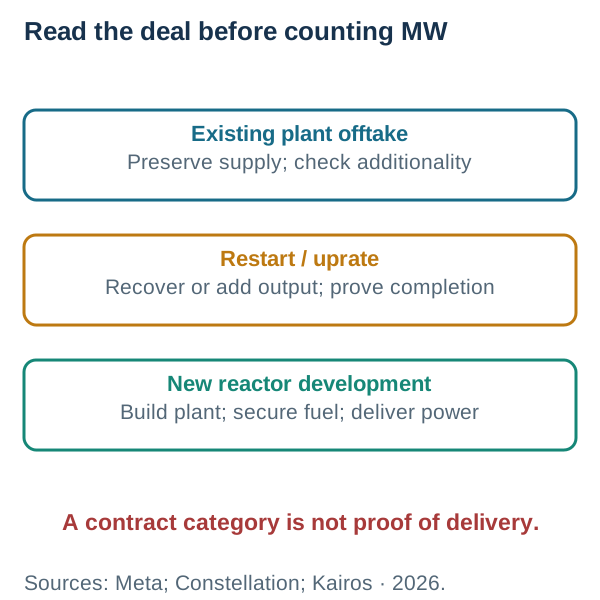
Microsoft’s agreement with Constellation concerns restarting the former TMI Unit 1, now Crane. Constellation’s August 2026 update targets 2027. The plant was not established as restarted by this research. Constellation update
Google’s Kairos arrangement supports future grid supply. Amazon, X-energy and AEP describe a feasibility-stage Indiana proposal with 12 units and 960 MW; it remains proposed development. Kairos · October 2026 joint announcement
Meta has moved beyond an RFP. Its January 2026 announcement includes existing Vistra plant offtake and future uprates, alongside Oklo and TerraPower development. Its Oklo plan potentially begins as early as 2030. Existing supply, incremental plant output and proposed new reactors are different categories. Meta announcement
I read these as evidence of serious customer intent and attempts to help finance future supply. I cannot infer from them that every announced megawatt is new, funded to completion, or available to an unrelated developer.
11 · Geography changes the answer
Singapore cannot import an American site plan
Singapore paused new data-centre capacity in 2019 and resumed selective allocations through calls for applications from 2022, according to the government’s October 2026 retrospective. The same speech distinguishes IT load from whole-facility electricity use and warns against adding overlapping capacity figures. MDDI speech
The Green Data Centre Roadmap targets at least 300 MW of additional near-term capacity, with further growth through green energy. This is a policy ambition, not evidence that the capacity is operating or that a particular project can obtain approval. IMDA roadmap factsheet
The founder implication is practical. Start with the local allocation, efficiency and acceptable-supply framework. American gas availability or a DOE reactor demonstration confers no Singapore siting permission. I would not sell the US readiness package locally without a fresh engineering and policy assessment.
Geothermal is another serious source of dependable energy. Fervo’s announced Google PPA covers 396 MW expected online in 2028; that is future contracted supply, not current output. Enhanced geothermal should not be conflated with demonstrated superhot-rock operation. Fervo announcement
I explored that physical frontier in Clean, Limitless Energy: Superhot Geothermal. Here the relevant point is portfolio choice: a developer can compare different qualified supply paths while the founder chooses one capability to own.
12 · The economics of readiness
The fee has to survive the engineering
My proposed package contains dated utility evidence, responsible-engineer-reviewed requirements, manufacturer-confirmed quotes and slot expiry, accepted alternatives, commissioning dependencies and a named owner for every blocking decision. It creates no right to certify equipment or guarantee energisation.
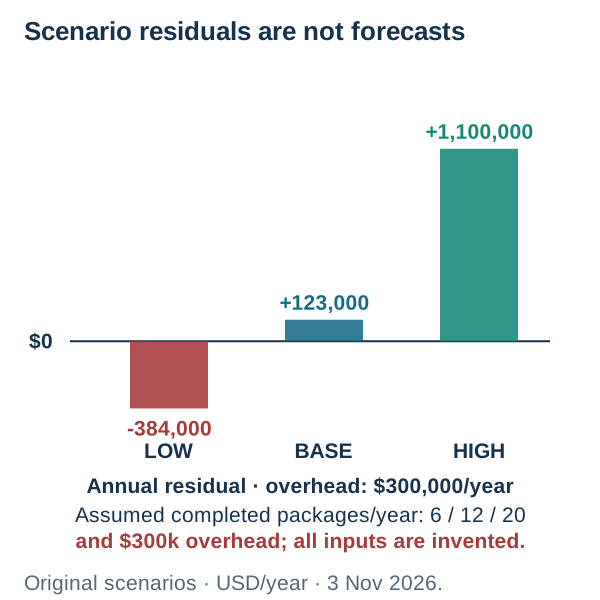
| Invented case | Fee/package | Contribution after acquisition | Packages/year | Annual residual |
|---|---|---|---|---|
| Low | $40,000 | −$14,000 | 6 | −$384,000 |
| Base | $75,000 | $35,250 | 12 | $123,000 |
| High | $100,000 | $70,000 | 20 | $1,100,000 |
All table values are original assumptions and calculated scenarios. Each case subtracts an invented $300,000 annual central overhead; this is separate from per-project delivery labour. Base break-even is 9 packages. Neither the annual volume nor the fee has been validated. Model arithmetic
The result is fragile in instructive ways. A 20% lower fee makes annual residual −$48,000. Increasing engineer hours by 50% makes it −$3,000. These are sensitivities to invented inputs, not forecasts. Sensitivity arithmetic
The first commercial question is therefore whether the customer will pay enough for a real, engineer-accepted improvement after comparison with its incumbent. A neat document alone does not justify the fee.
13 · What cheap power leaves out
Price the dependable service at the boundary
An onsite comparison needs a consistent denominator: net electricity delivered under the promised conditions. A capital-cost quote omits fuel and operations. A fuel-only calculation omits the plant. A nameplate rating omits auxiliaries and the extra equipment needed when a unit is unavailable.
Our deliberately incomplete gas illustration produces $82.57, $144.11 and $247.11 per MWh in low/base/high-cost cases. All fuel, capex, utilisation and financing inputs are invented. The model excludes redundancy, storage, firm pipeline reservation, gas lateral, land, interconnection, standby tariff and other site costs. These are not firm-power LCOEs and must not be compared with a complete utility tariff. Original gas assumptions and arithmetic
In the base illustration, $1/MMBtu more fuel adds $10/MWh, because the assumed heat rate is 10 MMBtu/MWh. This sensitivity is arithmetic, not a fuel-price forecast. Original model
Storage answers a different question. An illustrative 20 MW / 80 MWh battery provides four rated hours before losses and reserve. A full day at that load needs 480 MWh, before allowing for recharge and losses. These are energy/power identities, not a battery design. DOE storage framework · Original scenario
I have deliberately not estimated a nuclear electricity cost from a criticality announcement. The missing evidence—repeat construction, fuel, operating performance, financing, insurance and site delivery—is the very evidence that determines the answer.
14 · The bear case should change the plan
Scarcity can ease before the startup earns a position
The strongest objection is that the founder mistakes a temporary supply shortage for a durable coordination business. Manufacturers expand. Utilities improve their processes. Customers standardise designs. The capable EPC already knows how to get the project built.
There is real supply-response evidence. Hitachi announced over $1 billion in US grid manufacturing investment, including about $457 million for a large-power-transformer factory. Eaton announced over $30 million for switchgear expansion, targeting production in the first half of 2027. These are investment announcements and targets, not already available output. Hitachi · Eaton
Demand could disappoint too. The IEA’s 2035 scenarios span 700–1,700 TWh of global data-centre electricity. Forecast uncertainty is a reason to build a business that earns value on actual projects, rather than lever its balance sheet to every announced campus. IEA scenarios
For readiness services, bespoke engineering, long sales cycles and liability could consume the margin. For onsite owners, fuel and performance obligations could overwhelm the apparent spread. For reactor developers, a successful test could still precede a long, expensive path to repeatable commercial operation.
My response is to cap the first commitment at a paid comparison, preserve the option to remain an engineering service, and stop if the evidence workflow does not repeat. A smaller honest business is preferable to assuming software economics around physical work.
15 · A path that earns its expansion
Automate the repeated work after it is visible
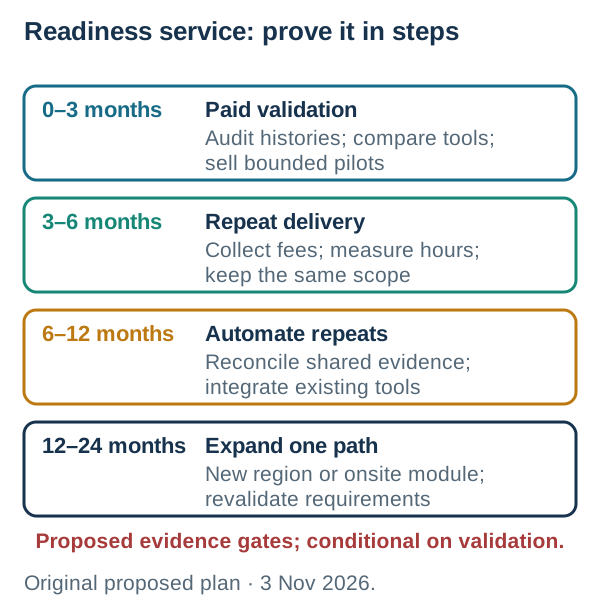
Months 0–3: founder and independent electrical engineer reconstruct actual project histories, compare incumbent workflows and sell bounded pilots. Continue only when customers pay and their engineer accepts an actionable improvement. Proposed validation gates
Months 3–6: repeat the same package with controlled scope. Measure collected fees, actual delivery hours, acquisition effort and rework. Find out whether the second customer buys the same job, rather than a completely new consultancy engagement. Original proposed sequence
Months 6–12: automate recurring evidence reconciliation: incompatible requirements, expiring quotes, missing acceptance documents and dependencies whose dates lack support. Integrate with existing engineering and utility systems. Keep responsible engineers in control of compatibility decisions. Original proposed sequence
Months 12–24: expand to one further utility region or a qualified onsite-partner evaluation module after repeat contribution is demonstrated. New tariffs, engineering requirements and authority boundaries need fresh validation. Generation ownership and reactor development would require a separate mandate. Original proposed sequence
For a nuclear team, I would use the same capital discipline around a different object: the next measurable plant advance. The gated evidence would concern useful output, operational reliability, fuel and repeat construction rather than readiness-service fees.
16 · The first decision gate
Leave with evidence of a business, or stop
The founder owns the commercial test; an independent qualified electrical engineer owns technical challenge. These are proposed thresholds, not market benchmarks. No interviews or pilots have occurred.
First 30 days: interview 12 decision makers across at least four developers and review six delayed-project histories, with permission. Continue only if three histories show material avoidable errors accepted by the customer’s engineer. Include cancellation cases and the customer’s best existing workflow. Original validation proposal
Days 31–60: offer three bounded pilots and require two paid engagements, engineer acceptance without unresolved critical compatibility errors, and evidence of an actionable critical-path improvement or a costly mistaken commitment avoided. An initial 30-day preventable-delay target is a screening proposal, never a promise; a revised forecast is not an actual saved day. Original validation proposal
Days 61–90: measure collected fee, delivery and acquisition hours, rework and legal/insurance burden; seek a follow-on order. An illustrative $25,000 contribution per package at 12 packages/year merely covers the invented $300,000 overhead before a buffer. Replace these assumptions with actual commitments before hiring. Original model
Stop a broad software build if access is unavailable, incumbents solve the job more cheaply, engineering cannot accept the deliverable, customers will not pay, or little work repeats. Never substitute unsafe equipment to satisfy a delay metric.
My decision is to test a company that makes the route to power more trustworthy. I would keep watching Valar and its peers with equal interest—and ask each new result exactly which part of the journey from nuclear heat to dependable customer electricity it has proved.
17 · The model and the evidence boundary
Read the assumptions before believing the margin
Evidence cutoff: 3 November 2026. Public government, laboratory, issuer and original research-provider pages support the factual claims. Company statements establish announced milestones or plans, not independently measured fleet performance. Paid Wood Mackenzie research, private supplier quotes, customer records and site engineering were not available. Last Energy’s announcement body and some NRC pages remained inaccessible; the narrative narrows claims accordingly.
Original service model, USD; every input invented. Low/base/high fees: 40,000 / 75,000 / 100,000. Engineer hours: 200 / 140 / 100, at 150/hour. Operations hours: 100 / 60 / 40, at 100/hour. Other direct cost: 4,000 / 3,000 / 2,000. Rework/risk reserve: 5% of fee. Acquisition cost: 8,000 / 6,000 / 4,000. Annual completed packages: 6 / 12 / 20. Central overhead: 300,000/year, excluding delivery labour already charged per project. These are this Fieldbook’s assumptions, not external findings.
Direct cost = engineer hours × rate + operations hours × rate + other + reserve. Contribution = fee − direct − acquisition. Annual residual = contribution × packages − overhead. Base: 75,000 − (21,000 + 6,000 + 3,000 + 3,750) − 6,000 = 35,250; 12 × 35,250 − 300,000 = 123,000. Break-even rounds up 300,000 / 35,250 to 9 packages. Low and high annual residuals are −384,000 and 1,100,000. Original calculations from the stated assumptions.
Sensitivities, original arithmetic: base fee × 0.8 leaves 21,000/package and −48,000/year. Base engineering hours × 1.5 leaves 24,750/package and −3,000/year. Doubling acquisition cost leaves 29,250/package and 51,000/year. Halving project volume leaves −88,500/year. Idle payroll, cash timing, tax, financing and unbounded liability can worsen outcomes. The model does not finance equipment deposits.
Original incomplete gas model: net 20 MW; capex $2,000 / $3,000 / $4,000 per kW; capacity factor 0.9 / 0.8 / 0.6; heat rate 8 / 10 / 12 MMBtu/MWh; delivered fuel $3 / $5 / $7 per MMBtu; variable O&M $10 / $15 / $25 per MWh; fixed O&M $120 / $160 / $200 per kW-year. Capital uses 10% over 15 years, giving a capital-recovery factor of 0.131474. Annual energy = MW × 8,760 × capacity factor. Partial cost = annualised capital and fixed O&M / annual energy + heat rate × fuel + variable O&M. Outputs: $82.57 / $144.11 / $247.11 per MWh. All are scenario calculations with the exclusions on card 13; none is a quote or full firm-power cost.
Open questions that can overturn the recommendation: Does the developer have a budget? Is the delay genuinely avoidable? Does the responsible engineer accept the alternative? Do usable manufacturer records exist? Does the work repeat after incumbent comparison? The proposed validation counts and calendar on card 16 are original experiment-design choices. They establish no observed customer behaviour.
Nuclear boundary: DOE’s reported criticality tally retains its unresolved original geographic-scope condition. Test criticality, useful electricity, commercial site permissions and repeat dependable delivery remain separate. No peer cost ranking, reactor purchase recommendation or claim of commercial output follows from the test record.
The ambition is abundant dependable energy. The first commitment should buy the evidence needed to build it.