THE BROKER BEHIND
THE PROMISE
Insurance should become useful at the moment a business needs it.
A founder’s Fieldbook · 3 November 2026 · Seah Ying Cong
Imagine running a regional manufacturer when a damaged shipment stops production. Someone already understands your business, finds the relevant cover, assembles the evidence and keeps the claim moving. At renewal, that experience improves the insurance you buy.

I would explore owning the brokerage that takes responsibility for this whole relationship. AI would help the professionals read, compare and follow through. Claims service would be the test of usefulness. Acquisitions would expand a working operating model.
My conditional choice: a Singapore specialty commercial broker, with a retained domain operator and permissioned claims-and-renewal workflow. Keep insurer recovery as a separately mandated experiment. A regional institution is the ambition; the right to buy the next broker has to be earned.
01 · Own the relationship through renewal
A commercial insurance broker helps a business describe its risks, find insurers willing to cover them and negotiate the contract. The insurer carries the insured risk. The broker carries advice, placement and service obligations. These are different businesses, even when both earn more as insured activity grows. Singapore’s registration framework makes professional competence and financial standing part of the entry requirement. MAS broker registration
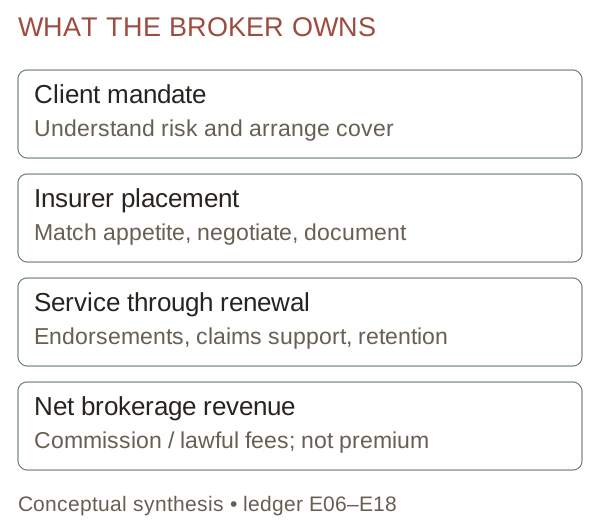
The attractive asset is a client who renews because the service remains useful. The fragile asset is a client who stays only while a particular producer stays. A producer is the person who wins and stewards the business; buying the company does not automatically buy that person’s future loyalty.
Premium passes toward the insurer. Brokerage revenue comes from commissions and permitted fees. Contingent commissions linked to volume or profitability add another incentive to examine. Hong Kong’s remuneration guidance calls for disclosure and additional measures around these arrangements; it does not establish a universal commission rate. IA remuneration practice note
I would underwrite collected, repeatable net revenue and the cost of serving it. A large premium book can conceal weak cash earnings.
02 · A region is not an acquisition inventory
The public denominators are encouraging enough to investigate, and too different to add together.
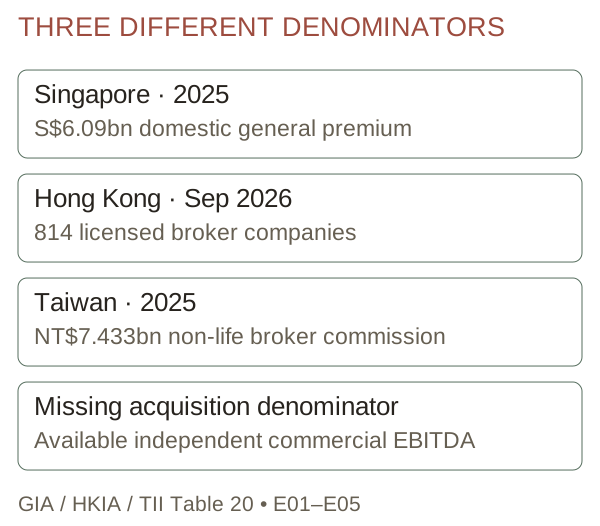
Singapore reported S$6.09bn domestic general written premium, and S$11.2bn including offshore business, for 2025. These include activity outside the proposed commercial brokerage wedge. GIA results
Hong Kong listed 814 licensed broker companies at September 2026. The general-eligible permission categories sum to 678, while only 85 were general-only. None of those counts tells us ultimate ownership, commercial revenue or willingness to sell. IA licence statistics
Taiwan’s 2025 broker table reports NT$7.432572bn non-life commissions on NT$66.105954bn written premium: an aggregate ratio of 11.24%, calculated from those columns. Its 431 brokers include persons and corporate forms, with life and mixed businesses. This is neither a commercial seller count nor a quote for a typical commission agreement. TII Table 20
The decisive missing object is an ownership map with non-overlapping, normalized earnings and consenting sellers. Multinational subsidiaries, life-oriented firms and unavailable owners can make apparent fragmentation disappear. I would not declare these markets sufficient—or insufficient—for the intended exit before building that map.
03 · Two claims businesses, two authorities
Claims advocacy helps the policyholder obtain what its insurance contract covers. Subrogation generally concerns an insurer pursuing a responsible third party after indemnifying its insured, subject to the applicable law and contract. Taiwan’s Insurance Act expressly distinguishes the broker’s role from the insurer’s subrogation right. Insurance Act, Articles 9 and 53

This distinction changes the acquisition thesis. Buying a broker can bring client relationships and claims expertise. It does not confer an insurer’s recovery mandate. A Singapore court case illustrates actual subrogation litigation in the insured’s name and the importance of settlement interactions; it is a case-specific lesson, rather than a universal procedural recipe. Singapore High Court, 2016
My starting claim service would assemble notifications, policy passages, chronology and evidence for qualified review. A recovery pilot would separately identify the rights holder, mandate, authority to settle, fee basis and counsel. Where the insurer’s interests and the policyholder’s interests diverge, separate authority and conflict controls become essential.
Better advocacy might improve retention. Better recovery might earn fees. Both are hypotheses here, with no uplift credited in the acquisition case.
04 · Choose the operator, keep the alternatives honest
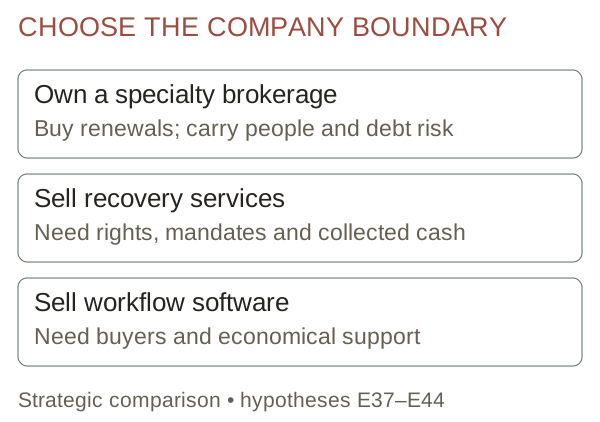
I prefer broker ownership because it combines an existing service relationship, renewal revenue and control over the workflow where learning happens. It also requires acquisition equity, qualified people and disciplined integration. I would abandon this choice if those advantages cannot be acquired at a viable price.
A standalone US recovery agency is a real category. Johns Hopkins Employer Health Programs describes using Rawlings for subrogation, and New Mountain’s investment in Rawlings establishes institutional interest in an established recovery business. Neither source gives a new entrant a contract or establishes Asian contingency-fee economics. EHP buyer evidence · Rawlings investment
US health-plan recovery also operates within a distinct legal system. Montanile limits particular ERISA recoveries against general assets after dissipation of traceable funds. That is a reminder to understand rights and timing, rather than transplant a US health-plan playbook into Asian cargo or property claims. US Supreme Court opinion
Software is the cheaper entry route if ownership fails. But FurtherAI already advertises broker workflows and Shift offers subrogation detection. I would need evidence of a missing local workflow, paying buyers and manageable implementation support. FurtherAI · Shift
05 · Let AI do the reading, then count the cash
The initial workflow is concrete: extract submission fields, prepare appetite comparisons against approved insurer rules, check policy wording against the agreed placement, and assemble renewal and claims exceptions. Each output should point back to its source and enter a professional review queue. Vendor menus establish that these tasks are already competitive territory; they do not prove reliable autonomous advice. FurtherAI workflow menu

Time saved becomes earnings only if it removes avoidable cost or creates capacity that customers actually pay for. My illustrative bridge starts with $2m eligible staff expense, saves 25% of that work and realizes 40% of the saving as cash value: $200k gross. Subtract $150k incremental tooling, security and review and only $50k remains. With no realization, the effect is negative $150k. These are original assumptions, not reported performance, and are not added again to the anchor cases. Original model bridge
Do not cut the experienced people who make the output trustworthy before measuring what the machine can do. Buy and benchmark incumbent tooling first. The defensible asset would be a better operating loop with permissioned evidence, measured service quality and renewals—not possession of a language model.
06 · Price the anchor
I would seek a profitable Singapore specialty commercial firm serving regional logistics or manufacturing customers. The seller needs a credible succession reason, durable insurer relationships and a team willing to remain. This is a search specification; no available target has been identified.
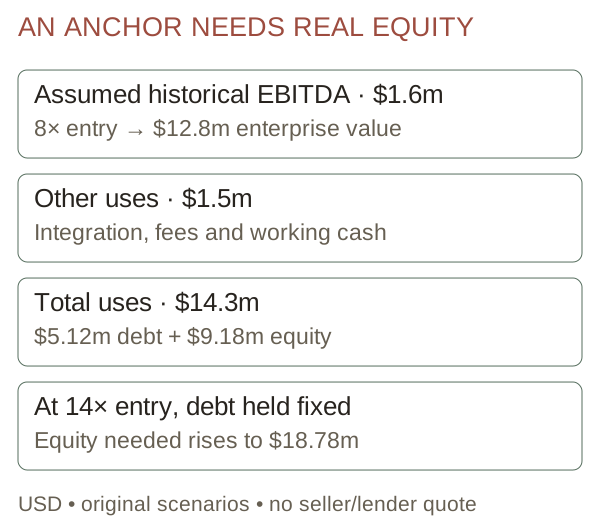
The example has $8m historical net revenue and $1.6m normalized EBITDA, a 20% margin. At an assumed 8× entry, enterprise value is $12.8m. Add $0.5m integration, $0.3m fees and $0.7m working cash: total uses are $14.3m. Assumed debt of $5.12m leaves $9.18m equity to find. Original sources-and-uses scenario
That entry price is deliberately a variable. Holding debt fixed, a 12× price requires $15.58m equity; 14× requires $18.78m. No evidence here establishes that a desirable seller accepts the cheaper assumption. Public adviser multiples concern different samples and price definitions; they cannot substitute for a local bid. Scenario comparison · MarshBerry public analysis
Before offering, bridge EV to actual equity consideration, net debt and working capital; add financing fees, regulatory capital and maximum earnouts. The acquisition must work on verified existing earnings. AI savings and speculative recoveries cannot make an otherwise unaffordable deal affordable.
07 · The cash test
EBITDA is earnings before interest, tax, depreciation and amortization. It is useful for comparison, but it is not the money left after a loan repayment or an earnout.
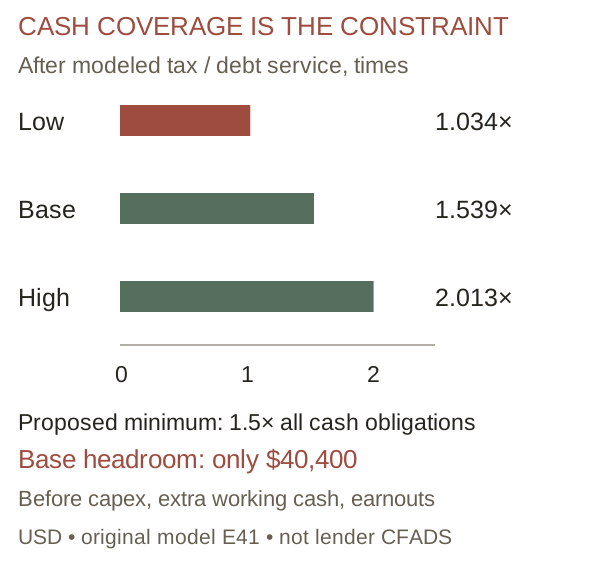
The original annual model uses $8m × retained revenue × pricing factor + new net revenue. Low/base/high retained fractions are 90% / 96% / 99%, pricing factors 0.95 / 1 / 1.05, new revenue $0.4m / $0.8m / $1.2m, and producer/service payroll 58% / 56% / 54% of revenue. Fixed costs are $1.8m. These are assumptions. Original scenario screen
| USD millions, original scenario | Low | Base | High |
|---|---|---|---|
| Net revenue | 7.240 | 8.480 | 9.516 |
| EBITDA | 1.241 | 1.931 | 2.577 |
| Cash after modeled tax and debt | 0.035 | 0.552 | 1.037 |
Debt assumptions are 10% interest and $0.512m annual principal on the opening balance; the cash-tax proxy is 25% of positive EBITDA less interest. All figures are simplified annual scenarios. Cash excludes additional capex, incremental working capital, earned seller payments and other omitted obligations. Original coverage model
The base case has only $40,400 above a 1.5× coverage screen before those extra uses. Low fails. A superficially attractive EBITDA ratio would hide this fragility. I would demand downside coverage under the actual lender definition after all senior cash obligations; this example does not pass that underwriting gate merely because the base column is positive. Original cash screen
The AI bridge on the prior card is a separate sensitivity, already reflected conceptually in operating cost choices. No incremental AI saving or recovery income is added to these results.
08 · Recovery must survive the collection lag
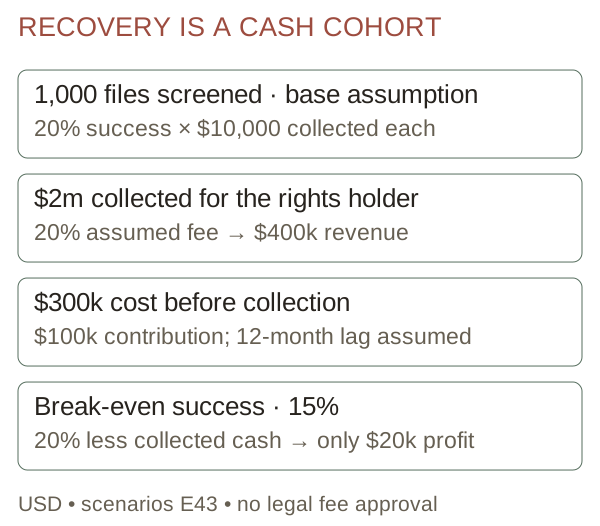
In the base scenario, screen 1,000 files; collect $10,000 on each of 20% successful files; earn a hypothetical 20% fee on collected cash. That produces $400k revenue, against $200 per screened file plus $100k fixed cost, leaving $100k contribution. Break-even success is 15%. Every screened file costs money. Original recovery cohort
Low/base/high contributions are negative $200k / positive $100k / positive $500k, with assumed collection lags of 18 / 12 / 6 months. Those cases also vary success, fees and costs; they are scenarios rather than an isolated causal experiment. Base needs $300k cost funding before receipts. A 20% drop in collected amounts leaves only $20k contribution; an extra $100 per screened file erases the original base contribution. Original recovery assumptions and sensitivity
The proposal is a bounded review of property or cargo files for an insurer, authorized TPA or self-insured rights holder. Fees must be lawful and tied to genuinely incremental collected cash, with baseline recoveries excluded and legal costs counted. No universal permitted percentage was established.
For comparison, the software scenario’s base has 15 customers paying $1,800 monthly, 8 support hours per customer monthly at $75, $150 monthly infrastructure per customer and $240k annual fixed cost. It loses $51k annually before acquisition cost and onboarding; break-even is 20 customers at those terms. This is an original alternative-case calculation, not validated willingness to pay. The capital-light route still needs a working business model. Model method and limits
09 · Work backwards from institutional scale
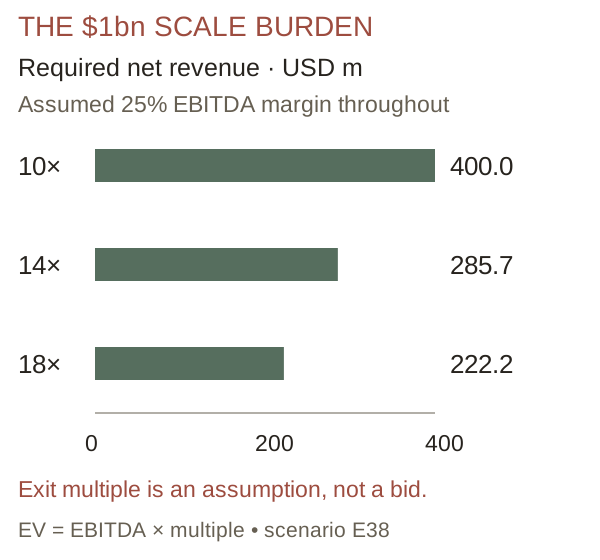
At $1bn enterprise value, assumed 10× / 14× / 18× EBITDA multiples require $100m / $71.4m / $55.6m EBITDA. At an assumed 25% margin, that means $400m / $285.7m / $222.2m net revenue. Broader combinations of 18–30% margins and those multiples imply roughly $185–556m revenue. This is arithmetic, not a forecast or acquisition TAM. Original scale model
The middle case needs about 45 historical anchor-equivalents before extra central overhead, using the assumed $1.6m EBITDA anchor. That should make a founder cautious about a story confined to small jurisdictions. It does not prove that exactly that many deals are necessary or that they exist. Original anchor · Scale translation
I would begin in Singapore, investigate Hong Kong and Taiwan, and let verified available earnings determine how far to widen across APAC. An MGA or program business adds delegated underwriting responsibility and depends on insurer capacity. Wholesale and reinsurance broking add specialist placement relationships. Neither is a magic valuation upgrade.
Ardonagh’s completed PSC acquisition establishes an APAC expansion precedent. bolttech’s financing establishes another distribution-platform path, with a different business and valuation basis. These are routes worth understanding, not proof that the proposed company can reach the same destination. Ardonagh 2024 report · bolttech financing
10 · The people are part of the asset

A consolidation spreadsheet can treat payroll as the largest source of savings. A client can treat the same person as the reason to renew. The first integration decision is therefore what to protect: professional judgment, producer incentives, carrier appointments and continuity of service.
Howden reported roughly 5,200 employee shareholders in 2024. That is a concrete ownership mechanism, not evidence that employee shares produce a particular retention rate. Howden ownership disclosure
Baldwin’s annual report shows another mechanism: contingent acquisition consideration. Recorded fair-value liabilities differ from the maximum that might ultimately be paid. A seller earnout can share risk while also consuming future cash and creating incentives that need supervision. Baldwin annual report
My proposal is seller rollover and carefully defined earnouts linked to durable collected revenue, service and compliance, with producer participation where appropriate. First reconcile client, policy, commission and premium records. Change the core system only when migration can preserve that reconciliation. Buying several firms into an unreconciled database would multiply uncertainty faster than scale.
11 · What the headline omits
Claims advocacy is already offered by Aon in Singapore. Howden describes claims-support offerings too, including a historical M&A service in which support for its placed policies was bundled into brokerage. A separately priced startup must establish why its buyer would pay again. Aon Singapore · Howden claims report
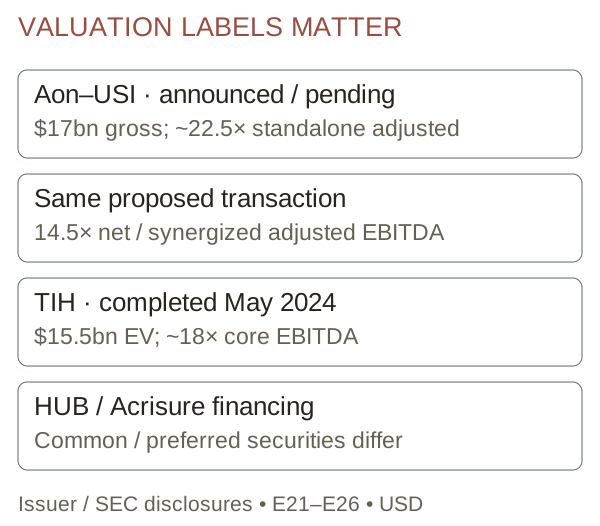
Aon’s announced USI purchase was $17bn inclusive of net debt. The issuer’s 14.5× number uses tax-adjusted price and synergized adjusted EBITDA. Dividing the gross price by $756m standalone adjusted EBITDA gives approximately 22.5×. These are different bases, not contradictory prices. The latest verified October disclosure still calls the transaction pending. Announcement · SEC prospectus · October results
TIH’s completed sale used $15.5bn EV and approximately 18× core EBITDA. HUB’s minority common-equity financing and Acrisure’s convertible senior preferred financing demonstrate capital access with different securities. None gives a startup a cheap acquisition facility or a guaranteed buyer. TIH terms · TIH completion · HUB · Acrisure
The strongest bear case is a small pool of expensive sellers, multinational competition, producer departures, country-level overhead and unproved AI savings. Even good operations can meet a bad exit market. The answer is to purchase durable cash earnings at a defensible price and retain the option to stop expanding.
12 · Spend the first tranche on access
The next step is a capped discovery-and-diligence programme, not an acquisition spree. All quantities on this and subsequent execution cards are proposed management rules, not industry benchmarks or completed work. Original stage gates
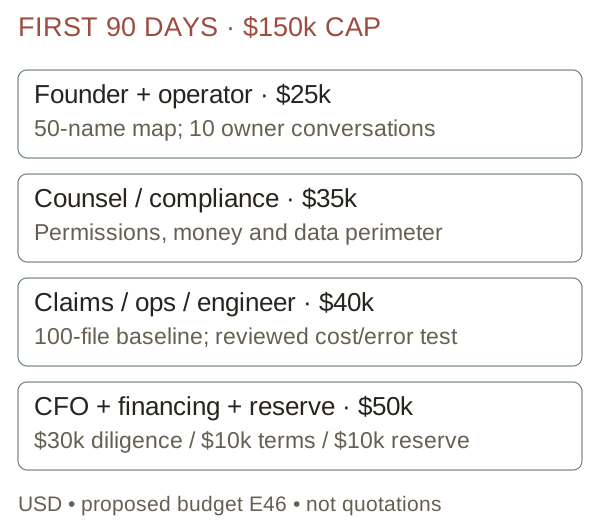
In the first 30 days, the founder and experienced broking partner build a 50-name register-derived ownership map and hold 10 consenting owner discussions, alongside 10 risk/finance-buyer interviews. Ask for commercial line mix, succession intent and permissioned cohort data. A licence list becomes useful only when these filters are applied. Proposed budget and scope · MAS directory
By day 60, operations, claims and engineering should have a permissioned 100-file baseline: human-review minutes, rework, source traceability, critical errors and all-in handling cost. Compare bought tooling with a minimal internal workflow. The screening gate is 20% lower handling cost with zero observed critical errors relative to competent review. This sample cannot establish that rare errors are eliminated. Continue controlled monitoring before consequential automation. Proposed operating gate
By day 90, require three diligence-ready sellers and three paid or explicitly budgeted design partners, plus a named domain operator and written legal perimeter. Ask partners for a defined service scope, data permission, decision date and price—not a general letter of enthusiasm. Fail those gates and stop acquisition fundraising. Total proposed spend is $150k. Original allocation
13 · Earn trust before asking for a book

The essential early partner is an experienced Singapore commercial broker with carrier relationships and operating judgment. Add a claims advocate, a fractional compliance and client-account controller, an acquisition CFO, local counsel and a workflow engineer. Recruit through incumbent alumni, insurance recruiters and professional advisers. These are proposed channels, with no warm introductions assumed.
The founder must learn how commissions are recognized, why renewals disappear, how endorsements alter cover, when a claim must be notified and how premium accounts reconcile. Publish an anonymized, permissioned workflow benchmark that includes failures and reviewer disagreement. Demonstrate a correct notification and a complete reconciliation. These establish credibility more directly than a polished AI demo.
For seller access, ask insurance accountants, succession advisers and professional-indemnity contacts for conversations with owner-managers. For demand, approach regional logistics and manufacturing CFOs with a specific renewal or claim-preparation problem. For recovery, approach an insurer’s claims/recovery head with a bounded mandate request. These are distinct buyers and asks.
Industry associations and future announced industry events can help build relationships. SIRC is a real access channel, but its listed 2026 registration period is already past at this research date; the plan needs follow-up meetings and verified future access. Organiser’s event page
14 · Design the permissions before the platform
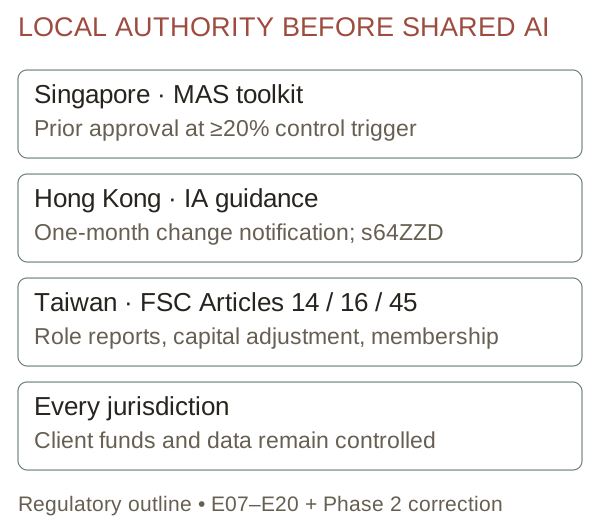
Singapore’s MAS toolkit requires prior approval for relevant appointments and direct or indirect control reaching 20% of capital or votes. Its premium-account rules also restrict withdrawals. Registration-processing expectations are not acquisition-approval timelines. MAS compliance toolkit v3.4
For Hong Kong, IA guidance describes one-month notification after becoming or ceasing to be a director/controller under s64ZZD, using Form N5. This is attributed to that guidance, not presented as a freshly obtained transaction clearance. Responsible-officer, licensing and other deal conditions still require advice. Client-account controls remain separate. IA controller guidance · IA money controls
Taiwan’s current Chinese rules specify applicable management recognition/reporting within 15 days in Article 14. Article 16 requires companies licensed before the March 2021 amendment, when cumulative equity/capital transfers reach 50%, to adjust capital within six months, subject to the stated inheritance exception. Current minimum paid-in capital is NT$20m for insurance or reinsurance broking, NT$30m for both. Article 45 requires practice through relevant association membership. Foreign-investment permissions and the transaction timetable remain unresolved. FSC current rules, amended September 2026
Do not centralize acquired client files until purpose, confidentiality, processor and transfer obligations are resolved. Singapore requires comparable protection for overseas transfers; Hong Kong’s data-protection principles constrain use and processor safeguards. Newer AI guidance also needs implementation review. Buying a group does not create unrestricted training rights. PDPC duties · PCPD principles
15 · Negotiate the founder outcome in the waterfall
The discovery service buys knowledge and access. It will not plausibly self-fund the example anchor’s equity cheque. The capital path is capped founder/angel diligence funding, then sponsor/search equity and negotiated seller rollover, then bank or private-credit debt against verified cash earnings. No financing availability is established here. Original anchor funding requirement
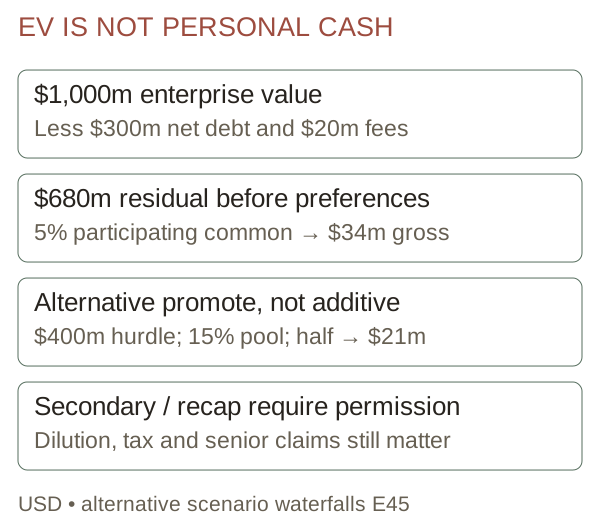
The personal goal needs its own arithmetic. At $1bn EV, less assumed $300m net debt and $20m fees, $680m remains before further senior claims. 3% / 5% / 10% genuinely participating common ownership would yield $20.4m / $34m / $68m gross only if preferences do not reduce that pool. These are scenarios, not promised net personal cash. Original waterfall
A different contract could first return $400m sponsor capital and hurdle, then allocate 15% of the remaining $280m to management. A founder receiving half that pool gets $21m gross. This is an alternative promote example, not an additional entitlement. Vesting, leaver terms, catch-up, dilution, rollover and secondary rights determine the actual result. Original alternative waterfall
Earlier liquidity is possible only on negotiated terms. A hypothetical $300m common-equity value, 12% founder stake and sale of 25% of that holding yields $9m gross, leaving 9% ownership. A dividend recap is different: $80m new debt less $10m costs/reserves could distribute $70m; 10% ownership gets $7m, while 10% interest adds $8m annual expense. Lender, solvency, regulatory and distribution constraints apply. Client money cannot fund it. Original liquidity scenarios and limits
Salary pays for work. Lawful dividends require actual distributable cash. Sponsor-approved secondaries require a willing counterparty. A credible route to $20–30m personal cash must specify which of these pays, when, and after what tax; enterprise value alone answers none of those questions. Original payout assumptions
16 · Replicate proof, then widen the map

During proposed months 4–12, the operator and CFO focus on a conditional anchor acquisition and its first complete observed renewal cohort. Require at least 95% retained revenue, normalized to exclude rate movement and new sales, clean client-money reconciliation and downside cash coverage of at least 1.5× after all obligations. The calendar cannot substitute for a full renewal cycle. Proposed operating gates
During months 12–24, choose one compatible bolt-on or one new jurisdiction, rather than simultaneous expansion in both directions. Reuse reconciled data definitions, evidence-linked review and local accountability. Buy only when incremental returns remain positive at a flat exit multiple and integration cash is funded. Proposed replication sequence
Build the regional ownership-and-earnings map alongside the operating proof. If Singapore, Hong Kong and Taiwan cannot supply enough available earnings on acceptable terms, investigate wider APAC. If the chosen specialty repeatedly needs delegated underwriting, evaluate an MGA/program with insurer capacity and its own performance cohort. If it needs wholesale or reinsurance access, first secure specialist talent and buyer demand. These are separate investment decisions.
My expectation is that institutional scale will demand a wider capability or geographic footprint. That remains an inference: this research has not summed a verified buyable earnings pool. Ardonagh’s PSC acquisition shows an expansion mechanism, while established regional brokers remain competitors for the same people and books. Ardonagh completion evidence
17 · What would change my mind
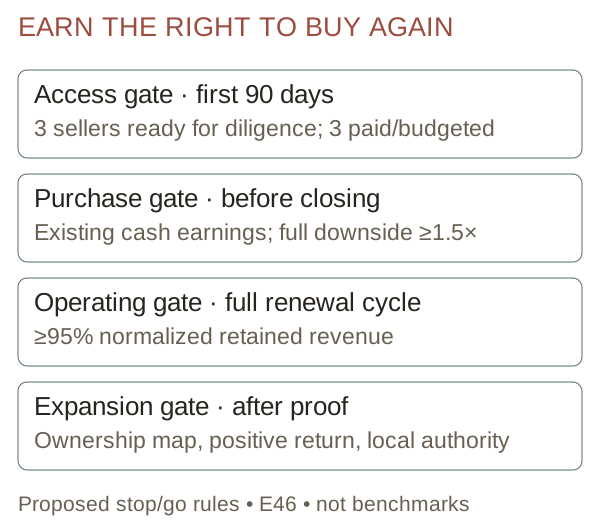
I would stop the acquisition fundraise if the first discovery tranche cannot produce willing sellers, budgeted service demand and an accountable operator. I would reject a purchase that needs unmeasured AI savings to service debt. I would pause bolt-ons after unexplained client-money differences, producer departures or weak normalized renewals. I would keep insurer recovery experimental until incremental collections exceed the complete cohort cost under a lawful mandate.
If seller prices make ownership unattractive but brokers will pay for a repeatable workflow, reconsider software. If insurers provide durable data rights, paid mandates and attractive collected-cash economics, reconsider standalone recovery. Those results could change the preferred company boundary. No route gets a valuation premium merely for adding AI to its name.
Model method. All operating prices, costs, fees, retention assumptions, financing terms, exit multiples and personal waterfalls in this report are original planning scenarios. They are not quotes. Brokerage cash equals EBITDA less modeled interest, tax and principal; additional earned seller payments, capex, working capital and other obligations must be deducted before underwriting or dividends. Recovery contribution equals screened files × success × collected cash × fee, less all screened-file and cohort costs. Software contribution deducts support, infrastructure and fixed costs; acquisition cost, onboarding, tax and financing remain additional. Personal waterfalls are mutually alternative unless a signed agreement says otherwise.
Evidence boundary. Public regulator materials, laws, statistics, company disclosures, court opinions and public adviser articles support the factual statements. Paywalled databases, seller earnings, lender terms, recovery contracts and customer tests were unavailable. Public multiple samples cannot establish a local clearing price. Newer AI guidance, Taiwan foreign-investment permissions and transaction-specific fee/legal-services rules remain implementation gates. Aon–USI is treated as announced/pending on the latest verified issuer disclosure. No outreach or transaction has been performed by this research.
My decision is to build toward a broker clients want to keep when a claim is difficult. Start with professional service and one sound book. Use AI where measured work improves. Let retained customers, reconciled cash and the terms of real acquisitions determine how large the institution should become.