THE BUYER’S AGENT
A founder’s Fieldbook · 3 November 2026 · Seah Ying Cong
Imagine telling your assistant what you need, and receiving a small set of things that actually fit your life. The dock works with your laptop. The apparent bargain includes delivery and tax. The recommendation can explain what it rejected, what it knows, and what remains uncertain.

I want a research layer whose founding rule is simple: surface the best products for the consumer. Nobody can buy a better rank, and no retailer owns the boundary of the search.
My decision: test that company in dock compatibility, through independent agent builders. Charge buyers for useful research before assuming that merchant revenue will fund it. The ambitious destination is the trusted research tool agents choose first; the first obligation is to earn that choice.
01 · How we choose
Curate a shortlist, then fit it precisely to the buyer
I would begin with a maintained, opinionated set of docks, not an exhaustive search engine. The initial eligible universe comes from lawful manufacturer and retailer facts, independent fixtures and buyer-nominated alternatives. Paying nothing must never disqualify a product. Every coverage gap is visible.
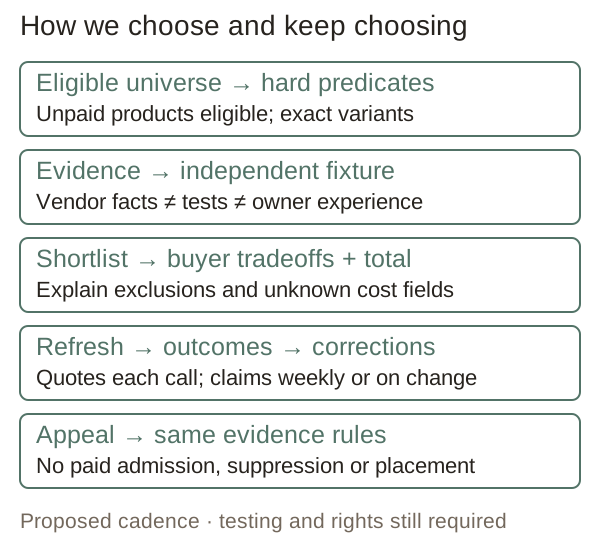
For each exact variant, check host, operating system, displays, cables and driver policy. Hard requirements are predicates, not preferences with large weights. Keep pass / fail / unknown separate. Then compare feasible candidates on the buyer’s softer priorities: portability, appearance, warranty, price and the strength of reliability evidence. An agent makes a curated set more useful by applying these rules precisely to each person.
A current total means product price plus mandatory shipping, tax and fees, less an eligible discount. Missing components stay estimated or unknown. Reject a candidate for an evidenced incompatibility, inadequate evidence or a buyer requirement—not for refusing a commission. Sometimes the result is a question, no match or no purchase.
My proposed maintenance cadence is live stock and quote checks per request, weekly compatibility-source review, immediate review on firmware/OS changes or a credible failure report, and periodic independent retesting when changed claims require it. Brands can appeal a fact under the same published evidence rules, without paying. This is an original policy to validate against actual cost and freshness needs.
ChatGPT already elicits requirements and rejection feedback. Our shortlist must prove better evidence and maintenance, not merely reproduce the conversation. OpenAI shopping research
02 · Begin with something that can be wrong
A dock cannot manufacture a capability the host does not have
My starting wedge is USB-C/Thunderbolt docks for US-delivered laptop-and-display configurations, reached through developer-oriented assistants. This is a founder hypothesis about testability and access, not a finding that docks are the largest market.

Apple specifies one native external display, up to 6K at 60Hz, for the M2 MacBook Air. That is a host constraint, not proof that every driver-mediated alternative is impossible. The assistant must ask whether installing such software is acceptable. CalDigit’s compatibility guidance similarly distinguishes hosts and display paths. Apple specifications · CalDigit guidance
I like this wedge because the wrong answer can be identified. Port shape, transport capability, host support and cable capability are separate facts. USB-IF’s capability and certification materials provide useful evidence classes; they do not certify general durability. USB-IF cable guidance
The unattractive part is equally clear: a person may need this help only occasionally. A useful dock answer does not establish a subscription business.
03 · Demand is moving; our demand is unproven
Follow the shopper without inventing a market size
Adobe observes purchases following AI referrals to retailers. Worldpay surveys willingness to use AI for shopping. These are reasons to investigate changing behavior. Neither tells me how many people will pay an independent compatibility researcher. Adobe retail analysis · Worldpay report article
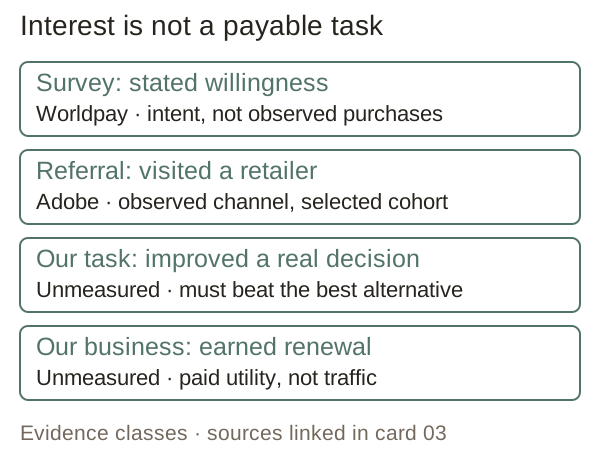
Adobe’s channel comparison is observational: people arriving from AI may differ from other visitors. A referral is not autonomous purchasing. Worldpay’s payment attitudes have a filtered denominator of people already open to AI, and the article’s publication metadata does not establish survey fieldwork dates. I would not multiply those figures into a startup revenue forecast.
The demand question is smaller and harder: can we observe an actual buying task, improve on the strongest available answer, and persuade the person to fund continued help? That is the bridge from an interesting distribution shift to a company.
04 · The research layer is already occupied
Every part of the stack has a serious incumbent
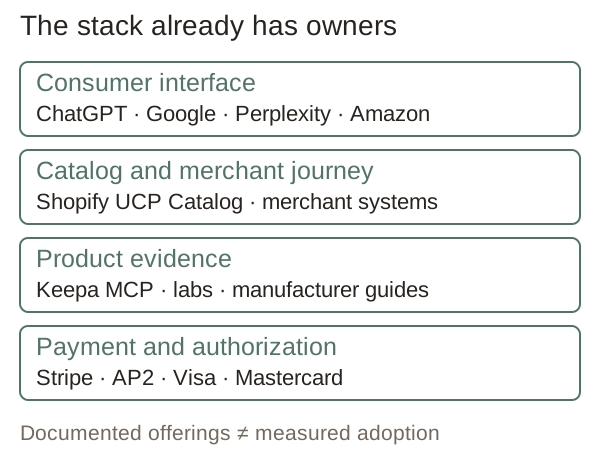
OpenAI offers research and checkout. Perplexity offers a shopping journey. Amazon’s Buy for Me reaches beyond its own store; its shopping assistant has also evolved. The breadth matters even when product pages do not establish reliable execution on our task. OpenAI checkout · Perplexity shopping · Amazon Buy for Me · Amazon shopping assistant
Shopify supplies agent-facing catalogs through UCP and MCP. Keepa already exposes product and price-history research through an official MCP service backed by its paid API. A founder cannot honestly sell “shopping data through a tool” as untouched territory. Shopify Catalog · Keepa MCP
Meta’s Muse and xAI’s Grok Bot broaden the set of agents that can act on the web; their existence does not prove shopping volume or access to every retailer. Meta announcement · xAI announcement
Shopify also documents an invite-led promoted-placement program, with attribution and settlement restrictions. That gives builders a native revenue alternative; it does not authorize our participation or make payment-influenced selection compatible with our promise. Shopify promoted placements
My proposed place is narrower: independently maintained configuration evidence that several clients prefer to rebuilding themselves.
05 · Independence must survive the revenue meeting
No pay-to-rank is an operating constraint

The attractive counter-position is to refuse the auction: buyer fit, verified outcomes and true landed cost determine rank. A merchant cannot pay for admission, preference, the removal of an unfavorable finding, or access to a private conversation. “Consumer-fiduciary” describes that proposed duty of loyalty; I am not asserting a legally established fiduciary status.
But the easy competitive story would be false. ChatGPT has ads, while OpenAI explicitly says advertising does not influence answers. Its shopping help separately says product results are independent of partnerships. Google’s Search AI experiences carry ads and also state that paid advertising does not influence organic AI responses. OpenAI ads policy · Shopping selection policy · Google Search policy
Google Search AI Mode is not the Gemini app. A dated Alphabet statement about the app’s free tier and subscriptions does not settle its current ad status. Perplexity’s original ad experiment promised answer independence; fresh primary evidence did not establish its current selling status here. Alphabet statement · Perplexity’s historical policy
My inference is an incentive conflict worth testing, not an inability theorem. A startup earns an advantage only if buyers can verify its stronger commitment and value it enough to choose it.
06 · People already pay for judgment
Borrow the discipline, not the economics
Consumer Reports provides an encouraging precedent: a nonprofit supported by members alongside donors, philanthropy and partnerships. Its commercial-partner policy allows fees while explicitly rejecting purchased placement, reviews or ratings. Independence is a governance practice, not simply the absence of business relationships. Funding · Commercial policy
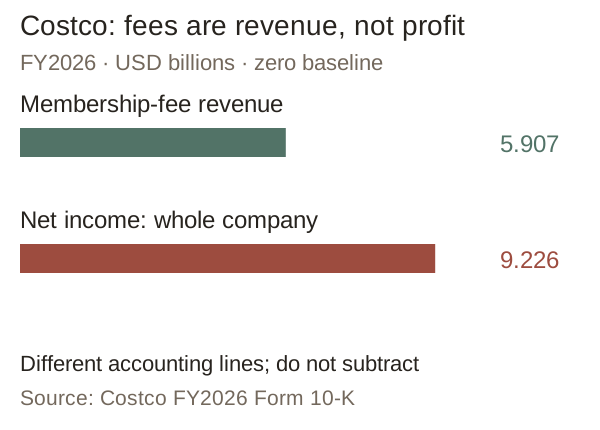
Costco’s FY2026 membership-fee revenue was $5.907 billion, alongside $9.226 billion in whole-company net income. The filing demonstrates substantial recurring fees within a retailer, not that every dollar of fee revenue becomes profit or that a research startup can reproduce its economics. Costco Form 10-K
Wirecutter’s owning-company help policy says editorial recommendations are independent of business deals and editors are kept unaware of retailer relationships. RTINGS describes purchased test units, a published method and separation of testing from revenue. These are close precedents—and potential competitors. Wirecutter policy · RTINGS independence
Costco also reports fewer than 4,000 active warehouse SKUs, compared with 9,000–11,000 online. That is bounded selection in a real retailer, not proof the same shortlist suits every person. Trader Joe’s own tasting-panel account describes internal product evaluation before selection. I take these as precedents for judgment over abundance, not transferable algorithms. Costco selection · Trader Joe’s selection process
The lesson I take is that people can fund judgment. The missing evidence is whether our particular judgment earns recurring payment.
07 · Put every revenue line through the same test
Can anyone pay to rank?
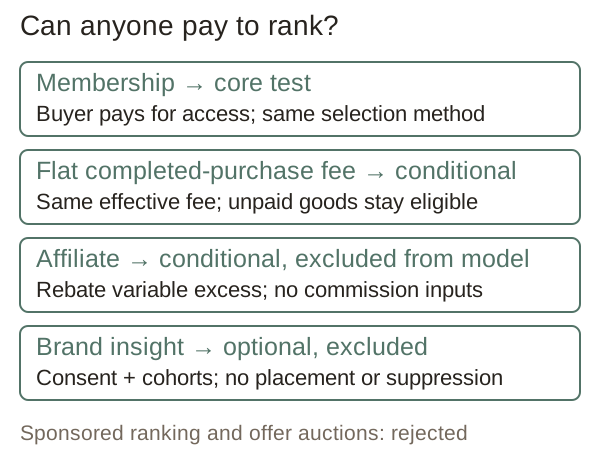
Membership passes most cleanly. The consumer pays for access to research, configuration upkeep or supported decisions. The selection method stays the same. Cancellation must be easy. The obvious failure is infrequent use: independence may be valuable while monthly membership is the wrong package.
A flat take on completed purchases can pass conditionally. The effective fee must be uniform, nonpaying products must remain eligible, and the shopper must see the charge. OpenAI’s checkout announcement is a narrow precedent for a seller fee with stated product-ranking independence; it does not prove uniform fees or observed neutrality. Instant Checkout policy
A seller may offer a lower net price to the buyer. Compare that quote under the same constraints and total-cost method; never auction visibility or let a bid purchase a place in the candidate set.
Affiliate revenue needs a stronger firewall. Rank before attaching monetized links; exclude commission fields from selection; rebate variable excess rather than favor the profitable link. Written program terms and actual settlement still matter. Impact, CJ and Rakuten document contract-specific qualification and attribution, not universal permission for agent traffic. Impact contract fields · CJ terms caveat · Rakuten policies
Post-ranking insights remain an option, not a subsidy assumption. Only separately consented, protected aggregate evidence at published terms; no raw chats, purchased suppression or ranking influence. Even then, a brand customer creates pressure. If the business needs paid steering to survive, this thesis has failed.
08 · The strongest bear has the distribution
García Martínez may be right about who captures demand
Antonio García Martínez’s central argument deserves to lead the bear case. In his public essay, open commerce protocols need not prevent the owner of the consumer AI experience from becoming the dominant aggregator. Human shopping also includes enjoyment, identity and persuasion; it is not all a computation over commodity specifications. His essay and post · X article

His other posts connect the mechanism: build at the MCP layer; sellers can bid through personalized programmatic offers; agents do not abolish the targeting, attribution and budgeting beneath advertising. These are practitioner opinions, recorded from author reads, not independently replicated market findings. MCP view · Programmatic offers · Seller bids · Advertising continuity
I agree that the interface owner can capture the economics. I choose a spec-driven, relatively fungible wedge precisely because it reduces the lifestyle objection. I reject paid ranking as the product I want to build, while accepting that an offer-funded competitor may distribute its service more cheaply.
Our counter-position wins only if a meaningful buyer segment wants auditable allegiance enough to route around the garden. Otherwise we are an enrichment supplier—or a small research business. An open endpoint does not change that bargaining position.
09 · Aggregate demand before executing purchases
Be called first for a reason
MCP is a standard way for an agent to call a tool. The registry makes servers discoverable; client marketplaces can curate their own selections. It is neither a neutral search-ranking system nor proof that invocations concentrate in a winner. Registry architecture
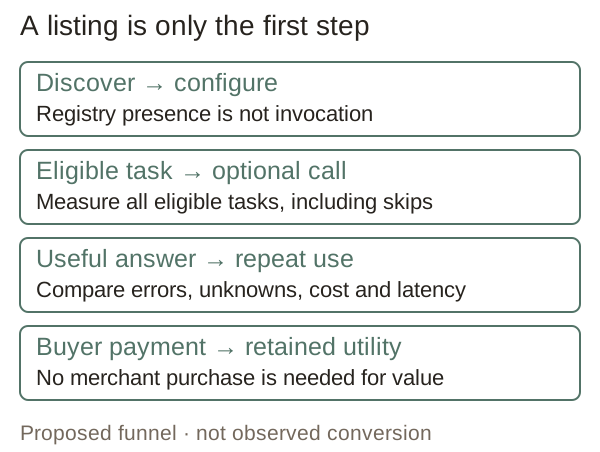
I would expose a small read-only API and MCP tools for constraints, evidence and cost. The caller receives exact variants, failures, unknowns, sources and timestamps. A concise reliable result can save a builder retrieval and verification work without taking over its consumer interface.
The hoped-for acquisition logic is that replacing our fixtures, licenses and correction history eventually costs more than buying the service. That is a hypothesis to test through renewal and replaceability, never an exit plan inferred from traffic.
The AEO comparison here is deliberately limited to the CJ/Impact evidence in this investigation. Measuring or influencing answer visibility is different from observing a real eligible task and its outcome. It is not proof that this company owns intent, nor a complete survey of AEO competitors. Impact AI direction · CJ documentation
10 · Capture why; do not pretend it is exclusive
An intent graph is useful only if it improves the next answer
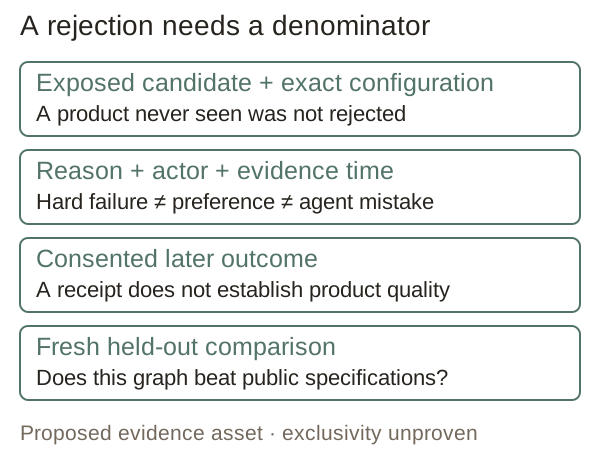
A structured request can arrive before any merchant sees the shopper. That timing is strategically interesting. Record the buyer’s confirmed hard constraints, uncertain preferences, candidate exposure, exclusion reasons and evidence state. A product never considered was not rejected. An agent’s mistaken exclusion is not consumer demand.
The potentially valuable asset is the relationship between configurations and later outcomes: what worked, what needed drivers, what failed after a change. Public specifications rarely answer every operational question. But early access confers no exclusivity. ChatGPT already collects rejection feedback; clients and users can retain the same history. Native feedback flow
I would test the asset prospectively: compare answers using public specifications alone against answers with permissioned outcome evidence on fresh tasks. Preserve source rights and allow deletion. If the outcome layer adds no measurable information, retire the moat claim.
The ambition is a compounding evidence system. The obligation is to demonstrate the compounding rather than count conversations and call them a network effect.
11 · A receipt begins the review
Reputation needs real experience and elapsed time

I would offer an opt-in post-purchase record: confirm the exact configuration, then ask through the user’s agent whether it worked and what changed. Follow-ups at days 30, 60 and 90 are proposed collection intervals, not established durability thresholds. Proposed outcome stage
Record exposure time, returns, respondents and nonrespondents. Separate owner testimony, lab tests and manufacturer statements. Repeated copies of a review are not independent votes. An agent can summarize a person’s confirmed experience; it must not manufacture one for a silent user.
The user gains a useful configuration and warranty history; the builder gains better future answers. A merchant may help resolve a problem but cannot purchase praise or erase an unfavorable finding. Neutral collection incentives would still need disclosure and legal review.
The FTC’s 2024 rule, effective October 21, addresses specified false reviews, suppression and sentiment-conditioned incentives. The Endorsement Guides address material connections and truthful endorsements; the Guides themselves are not the same legal instrument as the rule. Neither proves a fraud prevalence rate, and disclosure alone cannot make a biased ranking neutral. FTC rule Q&A · Endorsement Guides Q&A
12 · Own the decision before the payment
The transaction layer is a later responsibility
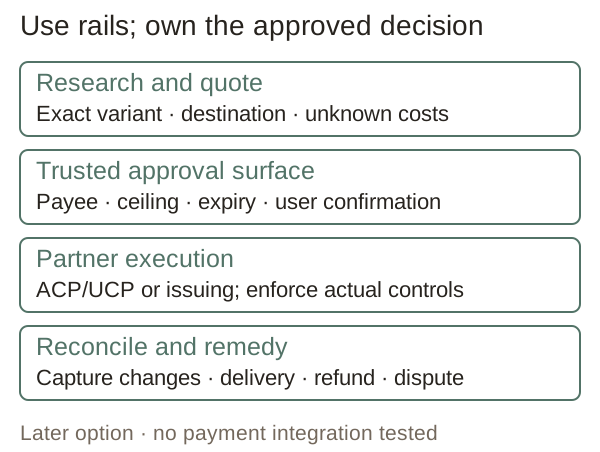
ACP and UCP provide merchant-journey interfaces. Google’s AP2 describes signed mandates. Visa and Mastercard describe agent trust and payment programs. Stripe/Tempo’s MPP and x402 address programmatic payments, including resources used by agents. These mechanisms do not establish recommendation truth or remove delivery and dispute obligations. ACP · UCP · AP2 · Visa · Mastercard announcement · MPP · x402
A later service could bind a trusted passkey or biometric approval to the exact product, payee, amount ceiling and expiry, then use a partner’s rails. Virtual cards and network tokens can limit credential exposure. A disposable number is not automatically a single-use, exact-product authorization: Stripe’s documented spending controls have aggregation and later-charge caveats. Issuing controls
Prompt injection can corrupt a basket or payee; concurrent agents can exceed a budget; a merchant can fail to fulfill or abuse refunds. Authorization, reconciliation and loss allocation require separate proof. Agent identity is a related but different layer, covered in Trust When Agents Arrive.
I would use payment networks as suppliers. The strategic asset is the buyer’s approved decision and evidence record, if users choose to entrust it to us.
13 · The membership test
Independence has a full cost
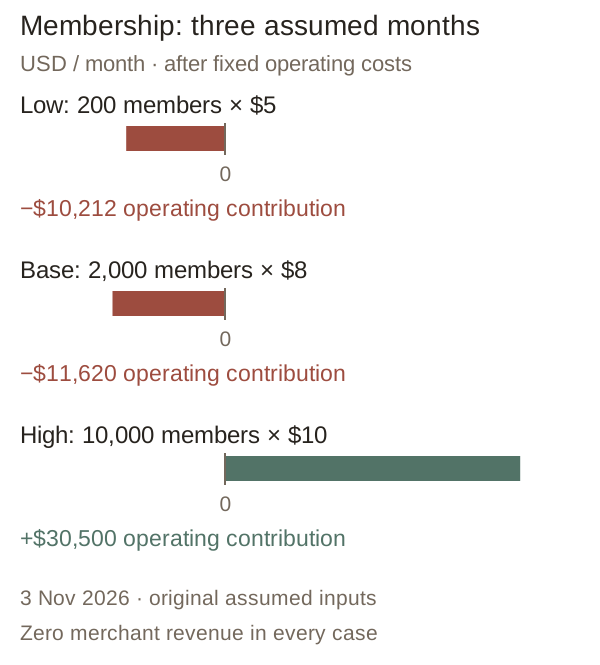
My assumed base is 2,000 members paying $8 per month. Allow four tasks per member at $0.21 each, $0.75 support, $0.30 distribution, 4% payment cost, and replacement acquisition of 8% monthly churn at $20 per member. That leaves $4.19 contribution per member before $20,000 fixed monthly costs: an operating loss of $11,620. Original model
At unchanged unit and fixed costs, break-even is 4,774 members. The low case has negative member contribution, so volume makes it worse. The high case assumes better retention, acquisition and delivery economics together; its surplus precedes tax, financing, guarantee reserves and distributions. Model arithmetic and sensitivities
What the headline omits: research costs money without a purchase. Freshness, lawful data, human testing, failed calls, abstentions and support all count. Subscription churn can overwhelm cheap inference. Initial acquisition cash and growth acquisition are additional to steady-state replacement costs.
This model is a tool for discovering what must become true. It is not evidence that recurring dock research is worth the assumed membership price.
14 · The Master Plan
Each stage proves something and earns the next
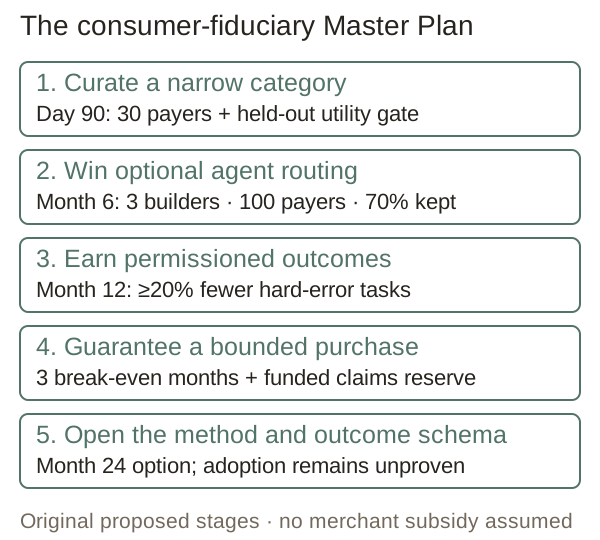
Curate one category better than anyone; use trust to win the agents; use their purchases to earn verified outcomes; use outcomes to guarantee purchases; use guarantees to become how agents buy. That is the proposed Master Plan. It is a sequence of earned responsibilities, not an assertion that the intermediate assets already exist.
Tesla’s original Master Plan is the structural precedent: a staged product and funding sequence. Its manufacturing economics do not transfer to this company. Tesla’s original post
Curation → routing. Prove lawful evidence and useful selection, then paid membership. Founder capital funds the experiment; receipts offset it. Do not assume commissions.
Routing → outcomes. Earn optional calls, mature retention and positive contribution before another category. Reuse the method and adapters; repeat the benchmark and rights review. Membership funds only what collected contribution supports.
Outcomes → guarantees. Show that permissioned follow-ups improve later answers. Insight sales remain excluded from the model. A scoped guarantee needs separate pricing, partners and reserves, even if the data improves.
Guarantees → an open standard. Publish the method and outcome schema under equal integration terms. Make selection portable across agents and merchants. Adoption remains uncertain; incumbents already promise organic independence.
The proposed 12–24 month programme and its numeric gates appear in the following stage cards and appendix. Keepa and RTINGS establish packaging and independent-testing precedents, not this growth sequence or its profitability. Original gate assumptions · Keepa · RTINGS
15 · Stage one: curate at a bench
Spend against evidence, not category breadth

In the first 30 days, the founder observes 20 recent purchase or support histories, documents 30 lawful eligible tasks, and seeks two unrelated builders willing to instrument optional trials. The hardware reviewer freezes exact host, OS, display and cable fixtures. Counsel checks permitted use of each required field. The cumulative spend ceiling is $12,000, inside the larger experiment cap. Original experiment gates
During days 31–90, the engineer builds the bounded tool; an independent reviewer grades 100 held-out tasks against native research, manufacturer guidance and the best accessible alternative. Require 90% correctness among answered tasks, 80% coverage, and 30% fewer hard-error tasks. If the baseline has fewer than 10 errors, expand the sample instead of celebrating a fragile relative improvement. Pre-registered screening rules
Then expose at least 100 qualified users to a clear paid offer. Seek 30 actual members, with 20 still paying after 60 days, delaying the retention verdict until the cohort matures. These are founder-set screening thresholds, not industry norms or observed results. Membership gate
First receipts offset the experiment; they do not enlarge its cap. If the best existing answer is already sufficient, or subscriptions add no recurring value, a polished tool is not a reason to expand.
16 · Stage two: win optional routing
Independent builders distribute; people decide whether to pay
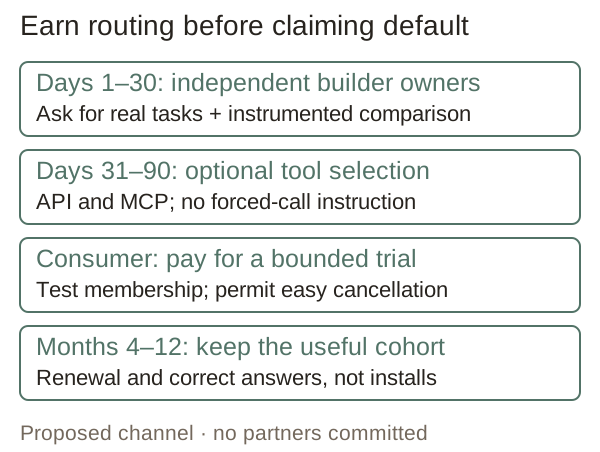
The first partner is a product or engineering owner at an independent personal assistant or hardware-selection agent. Reach these people through relevant developer communities, public tool-maintainer channels and founder introductions. Ask for their real task denominator and a bounded comparison, rather than a logo or guaranteed call instruction.
The consumer buyer is a developer or remote worker solving a real configuration problem. Ask for a plainly priced, cancelable membership after showing useful work. Configuration upkeep and later supported decisions must earn renewal; the product cannot manufacture another dock purchase every month.
My proposed month-6 distribution gate is three unrelated integrations, with two builders routing at least 50% of eligible tasks over four weeks, each with at least 50 eligible tasks. Exclude founder calls and forced routing. Target 100 paying members, 70% mature 90-day retention, and positive measured contribution after churn replacement acquisition. Original stage gates
Reliable schemas, concise answers, explicit unknowns and useful corrections may earn preference. A registry listing makes the experiment possible; it does not make the service the agents’ default. The API should remain usable without MCP. Only collected positive contribution can finance the next learning tranche; otherwise narrow scope or seek a separately justified funding commitment. Registry design
17 · Stage three: earn the outcome asset
Trust becomes a moat only through better future answers
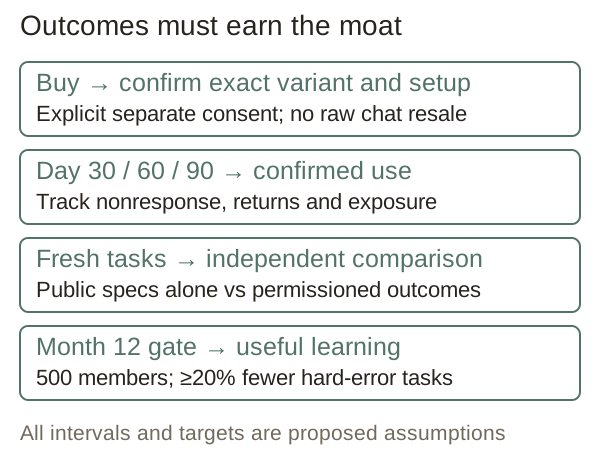
At the proposed month-12 gate, seek 500 paying members, mature retention evidence and 20% fewer hard-error tasks on at least 100 fresh tasks when outcome records are added to public specifications, with unchanged or better coverage and adequate baseline errors. Otherwise retire the data-moat claim. Original stage rules
Members’ collected contribution may pay for the next evidence tranche. It is not guaranteed to cover it; the base model loses money. Optional aggregate insight sales require separate consent and privacy protections and contribute nothing to the forecast. The most dangerous shortcut is calling every retained conversation an exclusive asset.
A founder with marketplace operating experience should recruit the knowledge they lack: an engineer who separates deterministic rules from uncertain retrieval, a USB/Thunderbolt practitioner with reproducible fixtures, and privacy/licensing counsel. Test labs, hardware support communities and developer networks are recruiting routes, not committed relationships.
Publish supported scope, methods, source dates, exclusions and corrections. Keep candidate-generation and ranking logs. An independent reviewer should replay decisions after removing or perturbing merchant economics: the same buyer evidence must yield the same rank. Include nonpaying products and show coverage gaps. A perfect ranker over a commission-selected catalog still breaks the promise.
RTINGS and Consumer Reports provide operating precedents for published methods and commercial separation. They do not certify our implementation. RTINGS policy · Consumer Reports policy
18 · Finance a useful company first
Dividends require residual cash

The 90-day ceiling is $45,000: $15,000 founder stipend, $12,000 engineering, $6,000 devices, $5,000 counsel, $2,000 data and compute, $3,000 grading and research operations, $2,000 reserve. Release spending by gate. Borrow hardware where permitted; narrow scope if rights or fixtures cost more. Original budget
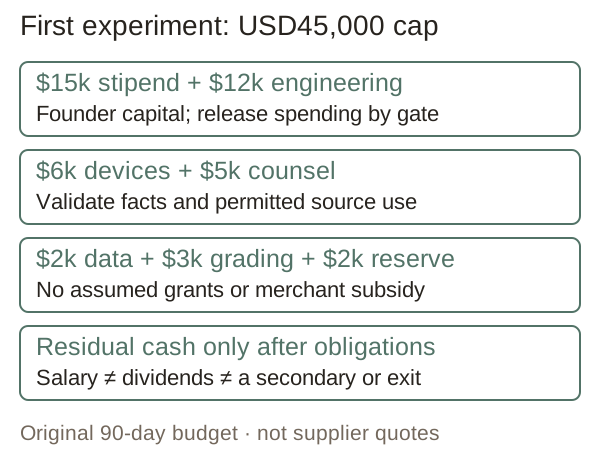
Use capped founder capital first, then collected member revenue if it arrives. Angels can finance a demonstrated retention or evidence bottleneck. Venture makes sense only when several independent clients, repeatable economics and adjacent-category learning support a much larger company. Strategic money that requires exclusivity or ranking influence can undermine the proposition. No grant or debt subsidy is assumed.
The model’s base initial acquisition cash is $40,000, additional to operating economics. Its two-month no-receipts stress is $55,240, already above the experiment cap; the early validation budget does not finance the modeled steady-state company. Original cash model
A stipend is compensation. Dividends come after company costs, tax, reserves and reinvestment. A secondary requires a buyer and agreed terms; an acquisition requires strategic demand and transferable rights. A decacorn path would require repeated expansion beyond docks. I would build a company capable of paying its way, then decide whether the evidence warrants that larger ambition.
19 · Guarantees, then an open standard
Earn the liability before selling the promise
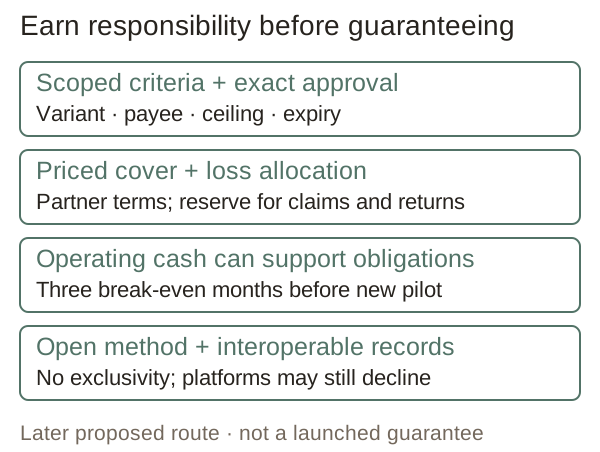
The proposed month-24 option begins only after three consecutive months of full operating break-even, partner-priced cover, a stress-tested reserve and tested exact-approval/loss allocation. A guarantee might cover failure of a stated compatibility criterion; it must not quietly imply universal durability or fulfillment insurance. No guarantee revenue or claims costs are modeled. Original conditional gates
Use collected surplus or separately raised capital for the reserve; membership alone does not make claims liability disappear. Only then consider an open fiduciary method and outcome protocol, with equal terms and no exclusivity. That may earn integration; it cannot force platforms to adopt it.
Before pilot ingestion, counsel must document permission for collection, display, retention and derived cross-client learning. Shopify’s catalog guidelines restrict caching; RTINGS restricts systematic commercial reuse. Link or license evidence, or generate it through our own fixtures. Shopify guidelines · RTINGS terms
Amazon’s litigation against Perplexity is a warning against treating user direction as blanket access permission. The appellate opinion vacated a preliminary injunction on a limited access-law record and preserved private-contract questions. It did not grant unrestricted scraping or data resale; this research does not establish the complete later docket. Appellate opinion
The buyer gets fit and an honest no-purchase option; the builder gets dependable evidence; a merchant gets better-qualified demand; publishers get permissioned licensing; payment networks retain execution volume. Some ad intermediaries lose steering revenue, and some merchants lose sales when evidence goes against them. These conflicts cannot all be harmonized.
Publish integration terms without exclusivity. Minimize retained user context, separate outcome consent, support deletion and export, and assess reidentification before any aggregate report. Anonymisation guidance is a starting point, not worldwide legal clearance. PDPC resource
The open-market promise means searching beyond paying suppliers within disclosed lawful coverage. It cannot mean claiming omniscience or bypassing a source’s restrictions.
20 · Working backwards
A launch promise to test, not a launch announcement

Illustrative future press release · Singapore · 15 February 2027. This date is a planning assumption, conditional on the first-stage gates; no service is available or announced by this Fieldbook.
A shopping shortlist that works for you. The proposed Buyer’s Agent helps people choose a compatible dock through assistants that integrate its research API or MCP tool. Its picks follow published buyer-fit and evidence rules. Merchants cannot buy entry, rank or suppression of an unfavorable finding.
The customer problem is a desk full of apparently compatible products and an assistant that cannot show why a recommendation will work. The proposed solution is a maintained shortlist, exact configuration checks, visible landed-cost uncertainty and evidence behind each exclusion. Research can conclude that no purchase is needed.
Illustrative customer quote, fictional: “I wanted to know which dock would work with the screens I already owned—and what the researcher could not yet verify.”
Illustrative founder quote, fictional: “We want the buyer to fund better judgment. If we cannot earn that payment without selling preference, we should change the business.”
Proposed getting started: shoppers bring a real configuration through a participating assistant; builders request a bounded read-only API/MCP pilot and eligible-task comparison. No claim of universal agent compatibility, automatic purchasing or a launch guarantee is made.
Working backwards uses a customer-facing promise to expose missing decisions before building. This is the method precedent, not evidence of demand. The dossier’s PR/FAQ expands the external and internal questions; the next card makes the hardest ones visible. AWS method
21 · Questions that can kill the plan
The FAQ is an execution contract
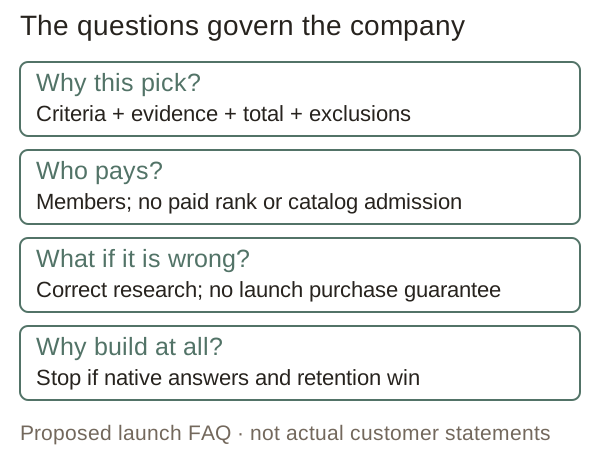
| Customer asks | Proposed answer |
|---|---|
| How are picks chosen? | Lawful eligible universe, hard predicates, independent evidence, buyer tradeoffs and total cost; the method card specifies maintenance and appeals. |
| Can a brand pay to rank? | No. Lack of commission cannot exclude a product; factual appeals follow equal rules. |
| How do you make money? | Test consumer membership first. Flat fees, rebated affiliate economics and aggregate insights remain conditional and absent from the model. |
| What if the pick is wrong? | Correct the research and disclose the error. Merchant returns are separate; no launch purchase guarantee is promised. |
| What happens to my data? | Minimum configuration context; separate outcome consent, deletion/export and rights review; no raw-chat resale. |
| Which agents work? | Only those that actually integrate and pass the pilot. API/MCP exposure is not universal availability. |
| How can a brand enter? | Submit exact product evidence under the public method; never buy admission or favorable treatment. |
Why won’t the platforms do it? They already do substantial research and promise organic independence. We must win on maintained evidence and verifiable allegiance, while accepting their control of routing. Native adequacy kills the broad thesis. OpenAI shopping policy
Why does curation scale? Only if the same method, variant graph and independent fixtures reduce later work across clients. Each adjacent category must pass fresh rights and usefulness tests. Human upkeep that remains bespoke is a service business; it does not become a platform by adding a catalog.
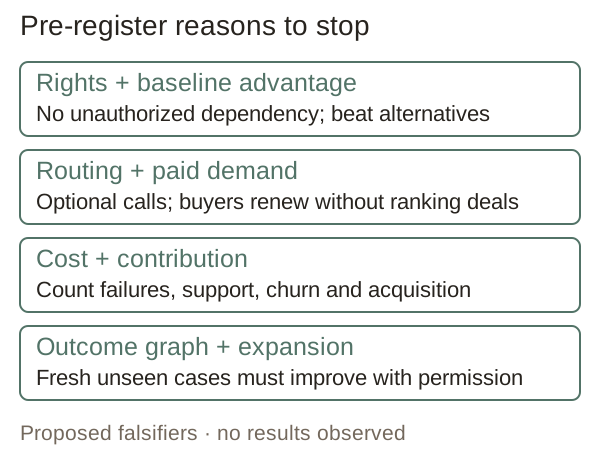
What finances the next gate? Actual contribution, capped founder funds or a separately agreed financing tranche. The assumed base loses $11,620 a month; 4,774 members is a static break-even calculation, not a forecast. Distribution may stay fragmented, membership may churn, sources may restrict reuse and the outcome asset may add nothing. The appendix makes those reasons to stop explicit. Original model and gates
22 · Evidence and stop rules
Make the ambition falsifiable
Model appendix. All values below are original assumptions, in USD per month. Task usage allocates failures, abstentions and trial costs to members. Formula: members × [price − payment − task costs − support − distribution − churn × acquisition cost] − fixed cost. Fixed costs include lean ongoing payroll and administration; task QA is incremental.
| Assumed input / output | Low | Base | High |
|---|---|---|---|
| Paying members | 200 | 2,000 | 10,000 |
| Monthly price | $5 | $8 | $10 |
| Tasks per member | 3 | 4 | 5 |
| Inference / task | $0.12 | $0.06 | $0.04 |
| Data / task | $0.08 | $0.04 | $0.03 |
| Testing QA / task | $0.20 | $0.10 | $0.06 |
| Infrastructure / task | $0.02 | $0.01 | $0.01 |
| Support / member | $1.20 | $0.75 | $0.50 |
| Distribution / member | $0.40 | $0.30 | $0.25 |
| Payment cost / revenue | 4% | 4% | 4% |
| Monthly churn | 12% | 8% | 4% |
| Acquisition / new member | $25 | $20 | $15 |
| Fixed cost | $10,000 | $20,000 | $45,000 |
| Contribution / member | −$1.06 | $4.19 | $7.55 |
| Operating contribution | −$10,212 | −$11,620 | $30,500 |
| Break-even members | None | 4,774 | 5,961 |
| Initial acquisition cash | $5,000 | $40,000 | $150,000 |
Sensitivity. At the base assumptions, halving members leaves −$15,810 operating contribution; reducing price to $5 leaves −$17,380; doubling usage leaves −$13,300; doubling inference leaves −$12,100; doubling testing QA leaves −$12,420; doubling churn or acquisition cost leaves −$14,820. Merchant revenue remains zero throughout. Tax, financing, guarantee liabilities and growth acquisition are excluded. These are arithmetic comparisons, not empirical estimates.
Proposed gates. The founder owns spending and payment, the reviewer owns blinded labels, builders own routing denominators, the engineer owns costs, and counsel owns source-use review.
| Stage / owner | Evidence required to continue |
|---|---|
| Days 1–14 / founder | $5,000 ceiling inside $45,000; 20 histories, 30 lawful tasks, 2 optional builder trials and source-rights path |
| Day 30 / founder + reviewer | $12,000 cumulative ceiling; supported fixtures, method and candidate-coverage record |
| Days 31–90 / reviewer + founder | 100 held-out tasks; ≥90% correct among answered, ≥80% coverage, ≥30% fewer hard-error tasks; expand if baseline <10 errors |
| Paid trial / founder | ≥100 qualified offers; 30 actual payers; ≥20 retained at 60 days; mature cohort required |
| Quote test / engineer | 30 consented comparisons; ≥90% within max($2,1%) of same-variant/destination/service checkout; otherwise fail exact-total promise and label estimates |
| Month 6 / builders + founder | 3 unrelated integrations; 2 voluntarily route ≥50% of eligible tasks for 4 weeks, ≥50 tasks/app; 100 payers; ≥70% mature 90-day paid retention; positive contribution |
| Month 12 / data lead + reviewer | 500 payers; two mature retention cohorts; ≥20% fewer hard errors with outcome evidence on ≥100 fresh tasks, unchanged or better coverage and adequate baseline errors |
| Month 24 option / founder + counsel | 3 consecutive months full operating break-even before separately financed guarantee/transaction pilot; priced reserves and tested approval/loss allocation |
Source ledger and disagreements. Official product and protocol pages establish documented offerings, not tested superiority. OpenAI already promises organic independence; that limits the counter-positioning claim. Costco’s fees are revenue, not profit. Survey interest, AI referral and autonomous orders are different measures. AP2’s current Google page prints September 16, 2025, conflicting with a September 17 reading; no thesis depends on that day. Amazon’s Buy for Me launch date comes from original publication metadata; Worldpay’s publication metadata is not fieldwork. Mastercard and the X article retain author-read boundaries from the source record; the later independent reviewer did not re-read those bodies. Dedicated AEO coverage is limited to CJ/Impact. OpenAI policy · Costco filing · AP2 original
Public/paywalled boundary. No private operating data, paid research contents, member-only review measurements, affiliate contracts or customer commitments are inferred. Fresh primary confirmation of Gemini-app and Perplexity advertising status remains unresolved. No outreach, purchase, live tool integration or hardware benchmark was conducted.
My next action is to observe real decisions with a hardware reviewer, price the lawful evidence path, and test whether independent builders and consumers choose the result. Stop if native answers suffice, sources cannot be used, members will not stay, or the evidence graph adds no value. The future worth pursuing is a buyer’s agent that deserves its allegiance—and a company whose economics let it keep that promise.