THE TIME BETWEEN
MOLECULE AND MEDICINE
A promising treatment should spend less time waiting for its chance to be tested.
A Fieldbook by Seah Ying Cong · 3 November 2026
I want a patient to reach a well-designed clinical study sooner because the protocol makes sense, the site is ready, and the people responsible have the same evidence in front of them. There is something profoundly useful to build in the distance between a promising molecule and an answer in humans.

My starting bet: test a focused trial-startup service for small biotechs before building broad software. Sell a sponsor-accepted feasibility and readiness package. Earn the right to promise an earlier clinical milestone by measuring whether the work actually moves it.
01 · More beginnings need better passages
A candidate is the beginning of the question
In Pipeline in a Person, I explored the possibility of a small founder-led company coordinating the work needed to create a therapeutic asset. This Fieldbook asks what happens when such a programme reaches people.
A clinical trial turns a biological proposal into a testable question: does this intervention produce a useful outcome, with acceptable risks, in the intended patients? The protocol specifies who can participate, what happens to them, what gets measured, and how the comparison will support an answer.
AI could increase the supply of promising programmes. That is a motivation for this company, not an established estimate of future trial demand. Financing, manufacturing and biological failure can stop a programme before a patient ever enrolls. Anthropic’s reported work with BMS already places AI inside study-plan assessment, but supplies no controlled result for shorter trials. Primary case studies
I am interested in the founder who makes a valid experiment easier to start and complete. The opportunity is the work between those verbs: preparing, checking, obtaining access, coordinating, and earning acceptance.
02 · The clock that matters
A faster task must move a dependent milestone
Imagine that a protocol packet becomes ready while site contracting and drug supply are still unfinished. The team has saved effort. The first patient may arrive on exactly the same day.
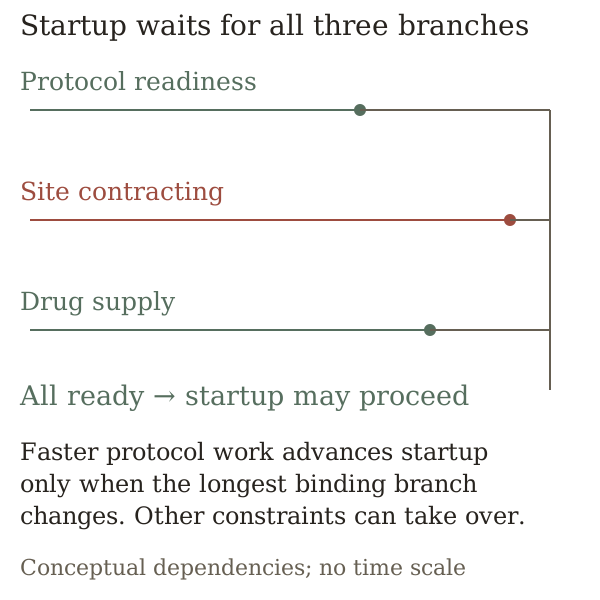
The critical path is the sequence of dependent work that determines the earliest possible finish. My inference is that an AI service creates trial-time value only when its improvement changes that path. It can also create labor or quality value, but the buyer should price those benefits separately.
I would distinguish receipt of complete inputs, accepted preparation, site activation, first patient first visit, enrollment completion, and database lock. Database lock is the point at which the cleaned study data are finalized for analysis. These are different events, with different owners.
That distinction changes the product. A document generator reports time to output. A trial-startup company must explain what accepted output unlocks, what still blocks progress, and who can resolve it.
03 · A protocol meets a real clinic
Every extra requirement has to fit someone’s life
An eligibility rule can make the scientific comparison cleaner while excluding people the site actually sees. A visit can improve measurement while making participation difficult for someone with work or caring responsibilities. A test can be scientifically sensible and operationally unavailable at a proposed site.
This is why I would put a clinician, a statistician and a site operator beside the software. The clinician challenges safety and relevance. The statistician challenges whether the design can answer the question. The operator challenges whether the work can actually be delivered.
There is substantial amendment burden, but also a strong warning against assuming it is all preventable. A sampled observational Tufts benchmark covering 950 protocols from 16 organizations found 76% were amended; 77% of amendments were judged unavoidable. The cohort included pandemic disruption. Changes in science and regulatory requests can be legitimate reasons to change a study.
Historical cost estimates establish that amendments can be expensive. They do not establish a modern service price or the amount a startup could save. I would price from observed work and customer value rather than a percentage of an old trial-cost headline. Tufts cost abstract · Pivotal-trial cost study
04 · Several clocks, one patient journey
Long elapsed time is evidence to investigate
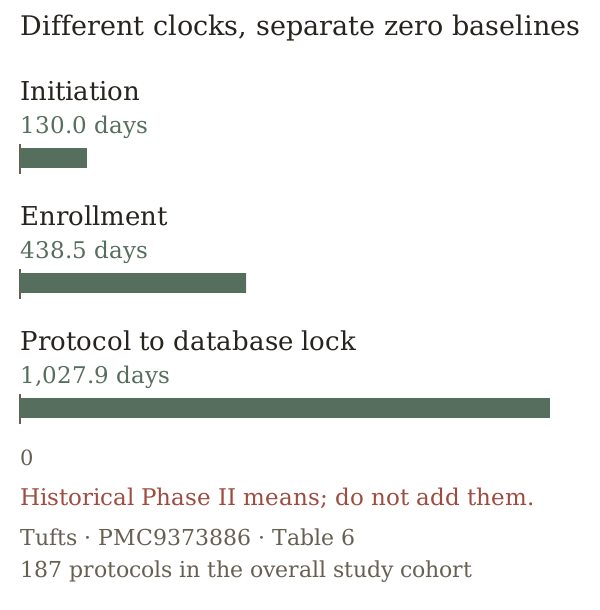
In this pre-pandemic cohort, Phase II mean initiation was 130.0 days, enrollment 438.5 days, and final protocol to database lock 1,027.9 days. The full study covered 187 protocols across 20 participating organizations. It is neither a current small-biotech benchmark nor an atopic-dermatitis forecast. Do not sum these intervals.
Long duration creates room for inquiry, not an automatic savings pool. Some time is waiting for a signature; some is observing an outcome that cannot yet be known. The same amendment benchmark reports a 260-day mean from identifying the need to the last oversight approval. That interval is not necessarily additional critical-path delay.
I would ask the buyer to reconstruct actual dates and dependencies from recent projects. Without that reconstruction, “faster trials” is too vague to be a product specification.
05 · What the new AI evidence earns
A narrow result can still be valuable
Anthropic reports an 89% reduction in human review time at Enveda. That is an exciting company-reported task result. It concerns quality review of executed manufacturing batch records, rather than total clinical-trial duration.
Enveda’s technical evaluation used four records containing 1,061 pages from one clinical campaign. The report says all human-identified actionable issues were matched across runs; that does not mean every run found every issue. It also explicitly describes the system as advisory and not validated as a GMP computerized system. Human quality staff retain disposition decisions. Technical report, evaluation and compliance sections
BMS’s reported application is study-plan assessment. Its public case describes early use and planned expansion, without a controlled trial-duration or success-rate improvement. Anthropic case study
The product lesson I draw is specific: retrieve evidence, compare versions, flag contradictions, and make expert review easier to audit. Then measure the accepted workflow. The published case does not establish the size of the downstream opportunity.
06 · A match is an invitation to investigate
Records do not walk into a clinic
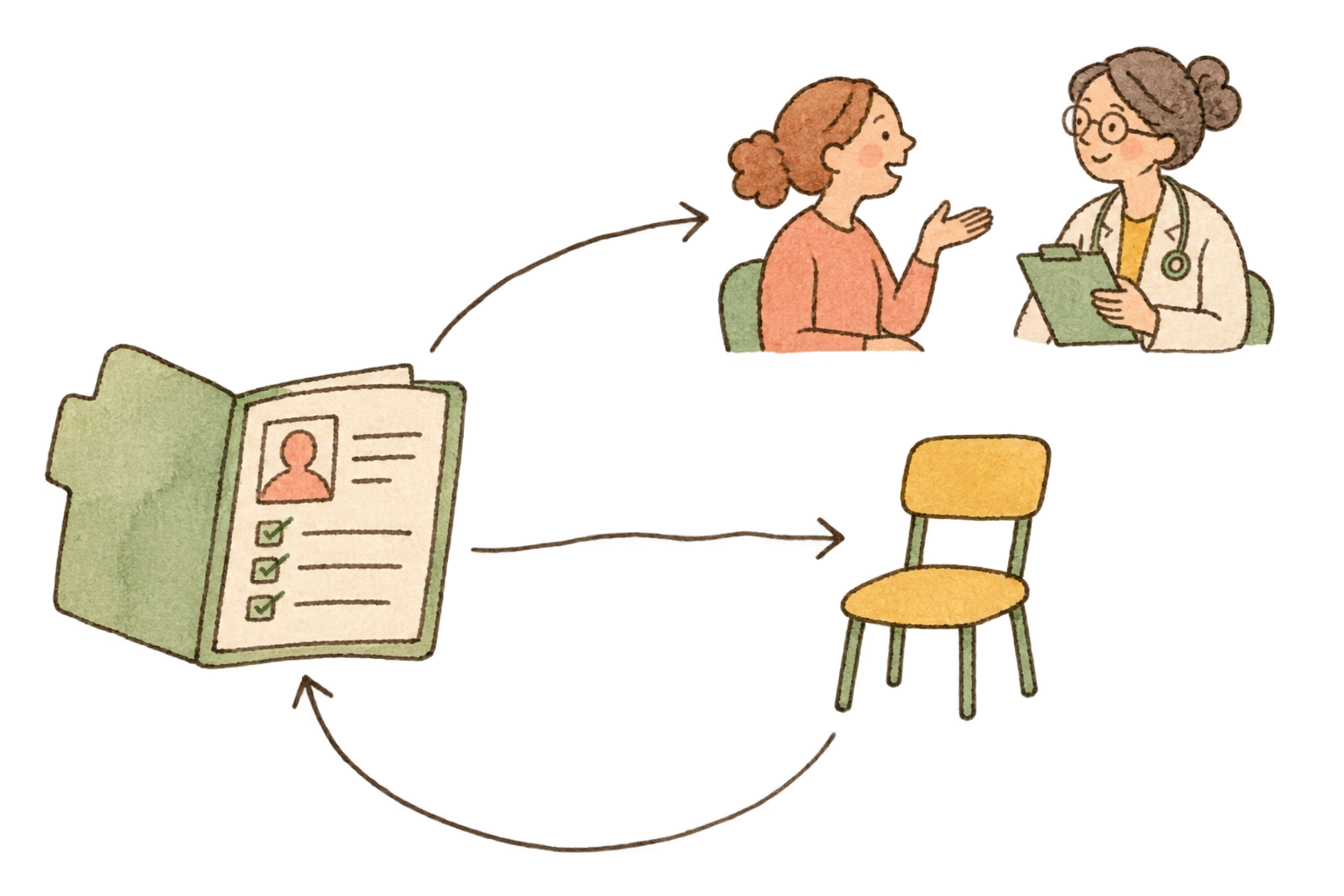
A recruitment system has to move through accessible records, clinical eligibility, permission to contact, willingness to participate, consent, randomization and retention. A model that improves chart prioritization addresses part of that chain.
The denominator matters. A historical cardiovascular registry study found 11% of 8,900 closed trials were terminated; poor accrual accounted for 41% of terminated trials. That is evidence of consequential recruitment failure in a bounded cohort, not a universal failure rate. The source itself has a start-year inconsistency, recorded in the evidence notes.
For the proposed wedge, public registry data help identify programmes and competing studies. They do not establish hospital patient access, eligible willing people, or live site capacity. ClinicalTrials.gov API
I would expand into matching only with a participating site, lawful access, clinical adjudication and a way to measure what happens after the match.
07 · Change where the visit happens
Flexibility has an operating cost
Some trial activities can happen through telehealth, home visits or local healthcare professionals. FDA’s September 2024 final guidance on decentralized elements describes these options while retaining the same regulatory requirements.
That can reduce a participant’s burden. It also introduces questions about product delivery, local assessments, safety escalation, missing data and consistency of measurement. A home visit that is more convenient but less comparable may change the evidence produced. FDA design and oversight guidance
I would choose decentralized elements procedure by procedure. Ask whether the activity can be conducted reliably outside the central site, who is accountable, how the result reaches the study record, and what happens when it is late or abnormal.
FDA’s September 2025 final E6(R3) guidance supports flexible, risk-based approaches and technology. It preserves responsibilities; transferring work to a provider does not remove ultimate sponsor responsibility. E6(R3), section 3.6.6
My inference is that convenience can be a product advantage only when the evidence and oversight still work. “Decentralized” describes a design choice; it is not a measured speed benefit by itself.
08 · A control is a comparison
Predicting a patient is different from observing one
A trial needs a credible account of what would have happened without the intervention. Random assignment helps make groups comparable. External controls instead use outcomes observed outside the treated study. Digital twins predict prognosis. Those approaches need different arguments for validity.
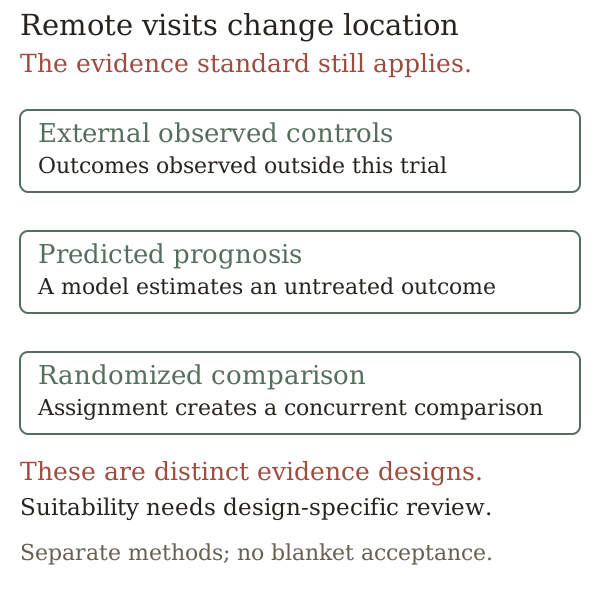
The FDA external-control guidance remained a February 2023 draft, not for implementation, when checked. Its scientific warning matters: unmeasured confounding and other bias cannot simply be eliminated. If comparison patients differ in unrecorded ways, a model may confidently explain the wrong difference. Draft, design considerations
FDA’s real-world-evidence guidance also emphasizes prespecification, access and verification obligations. A data license suitable for analytics may not grant the access needed to support a regulatory submission. RWE final guidance
I would treat external-control work as a specialist, programme-specific business. It is an ambitious opportunity, with a different validation burden from startup preparation.
09 · Singapore as a place to learn
A defined process is useful; patient access still has to be earned
Singapore provides a concrete setting in which to understand responsibilities and process. HSA lists a standard CTA turnaround of 30 working days. Clarification stop clocks are excluded. A clinical trial authorisation application can proceed in parallel with ethics review; that does not mean the site is ready when either finishes. HSA application requirements
I would not borrow the shorter notification route as a new-drug shortcut: CTN applies to a different eligible category. Nor would I extrapolate Singapore’s process across Southeast Asia. HSA route definitions
HSA also preserves overall sponsor responsibility when work is transferred and describes the local-sponsor requirements. Supplying a tool does not automatically make its vendor the trial sponsor; the contracted role needs to be explicit. Sponsor guidance
For discovery, I would propose outpatient atopic dermatitis, conditional on a qualified clinical lead and willing sponsor and sites. That is a focus hypothesis, not an evidence-selected best market. The missing evidence is practical: investigator access, competing studies, staffing, permissions and the population a site can actually reach.
10 · Sell something that can be accepted
The first product is a readiness package
My proposed buyer is the small biotech’s clinical-operations budget owner preparing an outpatient Phase II study. The sale is a bounded package with a qualified sponsor acceptance rubric.
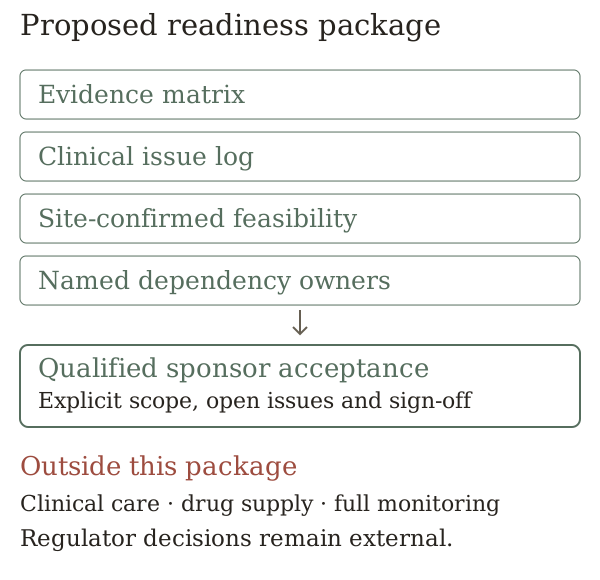
The package contains a source-linked eligibility and procedures matrix, an expert issue log, a feasibility matrix grounded in site-confirmed facts, version-consistency checks, and a dependency plan with named owners. It preserves unresolved questions as well as resolved ones.
Clinical care, drug supply, site grants, full monitoring and regulatory decisions stay outside this first fee. A clinical lead and statistician review scientific content; the sponsor’s qualified reviewers accept the result. The company commits to preparation and agreed corrections.
I would add an accelerated-startup commitment only after delivery evidence supports it. The distinction is commercially useful: it tells a buyer exactly what they can hold the company accountable for today, while leaving room to own more execution later.
11 · Service first is a learning strategy
Software needs repeated work and a route to adoption
A service gives the founder direct contact with the problem: incomplete inputs, expert disagreements, site reality, acceptance and collections. It can reveal which work repeats and what a buyer considers valuable.
It can also become bespoke consulting. Every sponsor may need a different workflow. Qualified reviewers can become the capacity constraint. The founder can finish projects without accumulating a reusable product.
Software changes the risk. It may scale the repeated task, but it requires data rights, integration, validation, support and enterprise purchasing before those costs are understood. A CRO can also bundle a similar feature into an existing relationship. Medidata already describes an integrated trial-lifecycle platform; established CROs already sell execution. Medidata platform · Medpace filing
I would start with service unless the founding team already has unusually strong buyer access and a repeated software job. The switch condition is evidence that unrelated customers can use the same module with bounded configuration and a common validation package. Paid adoption matters more than the amount of code extracted from consulting.
12 · The buyer must win too
Positive supplier contribution is insufficient
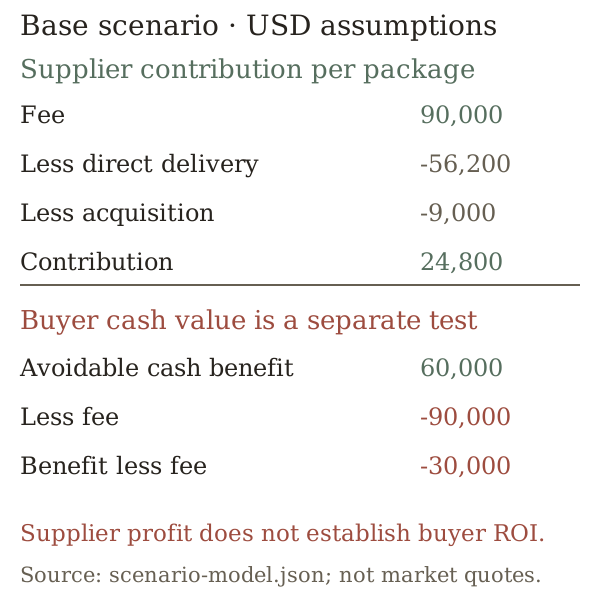
My invented base fee is $90,000 per accepted package. Delivery and reserve consume $56,200; acquisition another $9,000; contribution is $24,800. Those figures are a test of arithmetic, not a finding about willingness to pay.
Now take the buyer’s side. Suppose the workflow saves 30 days, half of which advance the critical path, with $4,000 of documented avoidable cash per day. Benefit is $60,000, leaving negative $30,000 after the fee, before customer integration costs.
At that assumed daily cash value, the fee needs 22.5 attributable days of advancement just to cover itself. An earlier scientific answer may have strategic value too, but I would ask the buyer to establish it, rather than invent a drug valuation to rescue the model.
This is the unresolved commercial question. A company can deliver efficiently and still sell something the customer should decline.
13 · Expert time decides the company
Reuse, utilization and winning work dominate
The service cases deliberately span failure and success. All amounts are invented USD inputs and arithmetic.
| Per accepted package | Low | Base | High |
|---|---|---|---|
| Fee | $65,000 | $90,000 | $110,000 |
| Delivery hours | 520 | 360 | 260 |
| Contribution after acquisition | −$30,000 | $24,800 | $64,400 |
| Buyer cash benefit less fee | −$65,000 | −$30,000 | $70,000 |
Source for every cell: author’s scenarios and equations. These are not confidence intervals or forecasts.
At the base assumptions, 3,600 annual delivery hours support 10 packages; 8 paid packages cover $180,000 of fixed overhead. Qualified roles are not interchangeable, so aggregate hours can overstate practical capacity. This is a steady-operation view; ramp and financing remain outside it.
If work expands to 480 hours per package, modeled capacity falls to 7 and annual result becomes negative $107,200. Cheap tokens cannot rescue expensive expert rework.
The software comparison is equally conditional: assumed $120,000 annual contract value leaves $37,000 of first-contract-year contribution; 11 new contracts cover assumed $400,000 fixed costs. No enterprise price, renewal rate or procurement duration has been established.
14 · The customer already has alternatives
Compete with the whole existing workflow
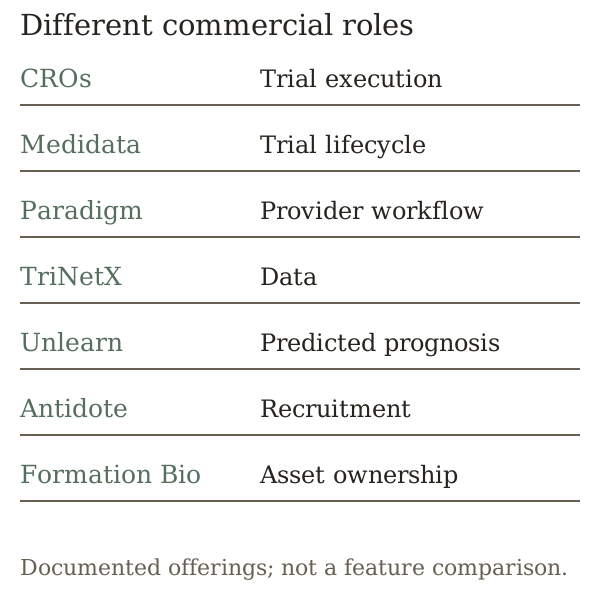
IQVIA, ICON and Medpace bring clinical execution and existing purchasing relationships. Medpace already targets small and midsized biopharma. Small sponsors are an occupied segment.
Medidata describes lifecycle software. Paradigm Health describes provider-integrated design, feasibility and enrollment. TriNetX offers data-network analytics. Unlearn positions digital twins and prognosis for trial decisions. Antidote offers patient search and recruitment. These pages establish offered scope, not independent proof of acceleration.
Formation Bio takes a different route: developing acquired or licensed therapeutic assets. Asset ownership captures a different upside and imports a different financing and biological risk.
My defensibility hypothesis is an indication-specific operating system of accepted evidence, trusted site relationships and repeatable delivery. Generic drafting alone is an exposed position. A buyer must have a reason to choose the company after comparing incumbent configuration, partnership and doing nothing.
15 · What the headline omits
The hard assets are trust, access and responsibility
The strongest bear case is that data access and clinical judgment dominate, while drafting is readily bundled. The founder inherits integration, expert review, QA, sales and liability exposure. A cash-constrained biotech may prefer a single accountable CRO, even if a specialist has a better demonstration. That is a business-risk inference from the documented competitive surfaces, not measured win/loss evidence. CRO model · Integrated provider model
Another headline concerns animal testing. FDA’s April 2025 NAMs roadmap announcement addresses context-specific modernization of preclinical safety. It does not eliminate the question of efficacy in humans. Nothing in this dossier establishes that the roadmap has already shortened clinical studies.
The commercial omissions are just as consequential: a deposit does not fund all overhead; a cancellation reserve is not comprehensive insurance; a registry record is not a reachable patient; a faster draft is not an accepted submission. Sponsor responsibility persists under GCP.
I would want the actual expert hours, procurement terms, insurer constraints, lawful access rights and buyer-approved cash effects before investing in scale. Those are the expensive questions concealed by a cheap-looking model call.
16 · Earn the next stage
A conditional plan over a clinical workflow
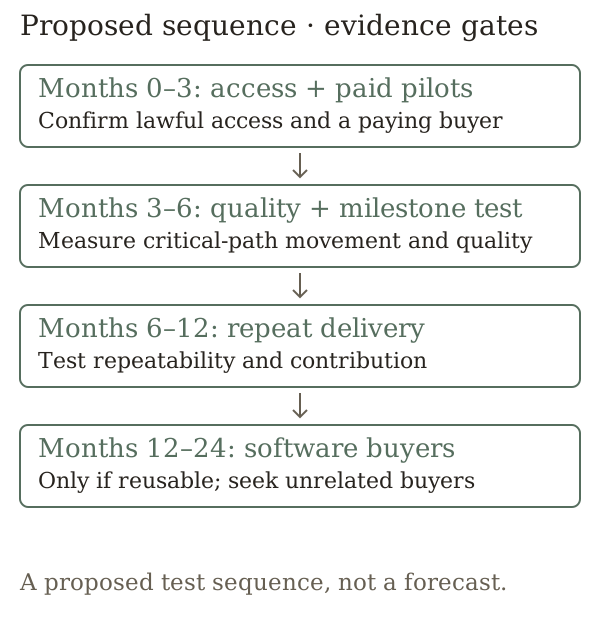
My proposed opening test: the founder and a qualified clinical-operations lead spend 6 weeks reconstructing recent timelines with consenting small sponsors. Obtain dated records and current CRO scopes. Interview budget owners and site operators. Locate work the new company can actually control.
If access and paid interest exist: use the next 3–6 months for paid packages with pre-agreed acceptance criteria and baselines. Track all delivery attempts and customer costs. Keep the scientific design under qualified review.
During the proposed 6–12 month stage: repeat within the indication and sponsor type, examine cancellations and collection delays, and test why an incumbent cannot match the result. During the proposed 12–24 month stage: test the repeated module with unrelated paying organizations. Author’s proposed stage gates
Patient matching and external controls are later branches, each with separate access, quality and validation requirements. They should earn their own investment case rather than enlarge the first sales pitch.
17 · Measure the accepted path
Include the projects that went badly
Before delivery, I would agree what complete input means and how the sponsor will accept the output. Record the usual-workflow baseline and all external dependencies before knowing the result.
The project log should separate input waiting, active work, expert review queues, corrections, contracting, authority review and supply. It should record who changed what and why. Report cancelled and failed assignments alongside successful ones. An intention to deliver is a better denominator than a curated set of finished packages.
Quality assessment needs independent qualified reviewers. A plausible output can contain a consequential omission. Count substantive corrections and adjudicated critical safety or eligibility misses, not merely pages generated or comments accepted.
Compare accepted package lead time and downstream final-protocol-to-first-patient timing. A contemporaneous comparable usual workflow is preferable where practical; patient mix, protocol changes and site differences can still confound a tiny operational pilot. Keep causal claims narrower than the evidence.
This is my proposed measurement design. The published AI and duration studies do not validate it, and a small pilot cannot certify safety or estimate a general effect on clinical success. The purpose is to decide whether there is enough evidence to fund a stronger test.
18 · The company can fail this test
Stop rules are part of the ambition
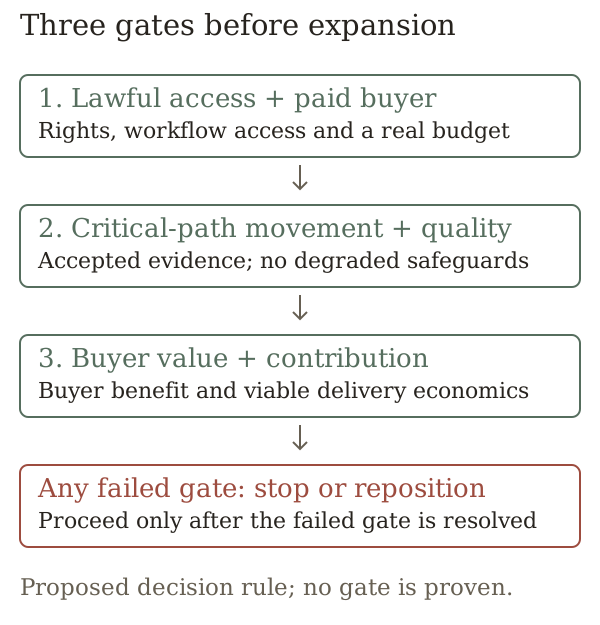
Proposed access gate: within the opening 6 weeks, inspect recent projects from 3 consenting sponsors, interview 10 budget owners and 5 site operators, and proceed only if 2 sponsors identify a recurring controllable bottleneck, share lawful evidence and agree in principle to a paid bounded pilot. These counts are my test design.
Proposed delivery gate: sell 3 packages over 3–6 months. Seek zero adjudicated critical omissions, at least 20% shorter package lead time without more substantive corrections, and at least 14 calendar days of attributable startup advancement in 2 pilots. Seek at least 25% contribution after delivery, rework and acquisition, and paid renewal or referral from 2 sponsors. These thresholds are assumptions, not results.
A critical omission pauses live use for repair and revalidation. Faster preparation without an earlier milestone falsifies the time-compression claim. Customer value below the price falsifies the commercial offer at that price.
Proposed expansion gate: repeat delivery during months 6–12; during months 12–24, require 2 unrelated paying organizations using the same software module without a core-code fork. If access requires building a hospital network first, or customization absorbs the value, stay narrow, reposition or stop. This entire card is an original proposed experiment; none of its counts predicts success.
19 · The model notes
Assumptions make the uncertainty inspectable
Original author scenarios, 3 November 2026. All commercial inputs below are invented USD assumptions. They are not quotes, observed productivity or forecasts. This card is the public arithmetic source for the scenario links. The reproducible internal files are scenario-model.json, scenario-arithmetic.md and build-model.py in the topic dossier.
For low/base/high respectively: fees $65,000 / $90,000 / $110,000; hours 520 / 360 / 260; loaded rates $125 / $120 / $110; other direct cost $12,000 / $9,000 / $7,000; rework/cancellation reserve $6,000 / $4,000 / $3,000; acquisition $12,000 / $9,000 / $7,000.
Contribution = fee − hours × loaded rate − other direct costs − reserve − acquisition. This gives −$30,000 / $24,800 / $64,400. Base: $90,000 − 360 × $120 − $9,000 − $4,000 − $9,000 = $24,800.
Annual delivery capacity is assumed 3,600 hours; fixed overhead excluding the charged delivery labor is $180,000. Capacity is rounded down; break-even paid projects round up. Base: floor(3,600/360) = 10 packages; ceil(180,000/24,800) = 8 to break even; at capacity, 10 × $24,800 − $180,000 = $68,000. First-year ramp, tax and financing are excluded. Clinical care, supply, site grants and full monitoring are outside both fee and cost. Review and coordination time remain inside delivery hours.
Buyer cash benefit = workflow days saved × critical-path fraction × documented avoidable cash/day. Assumed low/base/high: 10 / 30 / 40 days, fractions 0 / 0.5 / 0.75, daily cash $2,000 / $4,000 / $6,000. Benefit: $0 / $60,000 / $180,000; less fee: −$65,000 / −$30,000 / $70,000. Subtract buyer integration costs as well when known. Base fee coverage: $90,000 ÷ $4,000 = 22.5 attributable days. No speculative drug NPV is included.
Base sensitivity, all other inputs held fixed: fee $75,000 gives −$82,000 annual result; fee $105,000 gives $218,000. At 480 hours, contribution $10,400, capacity 7, annual result −$107,200. At 260 hours, contribution $36,800, capacity 13, result $298,400. Acquisition $18,000 gives annual −$22,000. Only 6 paid base projects gives −$31,200.
Software first-contract-year assumptions, low/base/high: contract $75,000 / $120,000 / $180,000; onboarding $35,000 / $25,000 / $15,000; support/hosting $20,000 / $18,000 / $15,000; acquisition $30,000 / $25,000 / $20,000; customer validation $25,000 / $15,000 / $10,000. Contribution: −$35,000 / $37,000 / $120,000. Assumed fixed costs $400,000 need 11 new base contracts. This is contract-year arithmetic, not a calendar-year sales forecast. Renewal is unproven.
20 · The evidence boundary
What would change my mind
Primary evidence: FDA decentralized elements, E6(R3), RWE, external-control draft, NAMs announcement, and HSA application requirements. These define possibilities, statuses and responsibilities. They do not establish this company’s acceleration effect.
Study evidence: Tufts duration full paper is a historical sampled observational cohort. Tufts amendment abstract supplies bounded burden estimates. The cardiovascular enrollment paper says 2006–2015 in its text but 2005–2015 in Table 2; I preserve the inconsistency rather than choose a start year. Its terminated-study denominator remains essential. These sources do not establish current customer-specific avoidable delay.
Company evidence: Anthropic’s cases and Enveda’s technical report are company-reported. Competitor pages establish positioning. CRO filings establish an existing services business; revenue is not software TAM, and backlog is not guaranteed cash. ICON’s accounting obligations and revised-method backlog are different measures. ICON results and methodology
Public boundary: no paid Tufts benchmark dataset or subscription report was accessed; unseen tables were not reconstructed. Public abstracts support the cited amendment/cost claims. No patient records, interviews, signed orders or trial interventions underpin this thesis. TrialGPT’s numerical pilot result is excluded pending fresh full-text confirmation. Public registry data support lead generation rather than an estimate of patients or available capacity.
The next evidence I would buy with my time: actual sponsor timelines, site-confirmed feasibility, independent review corrections, all expert hours, paid acceptance and customer-approved avoidable spend. If better preparation changes a valuable milestone without degrading quality, there is a company worth building. That is the experiment I want to run.